

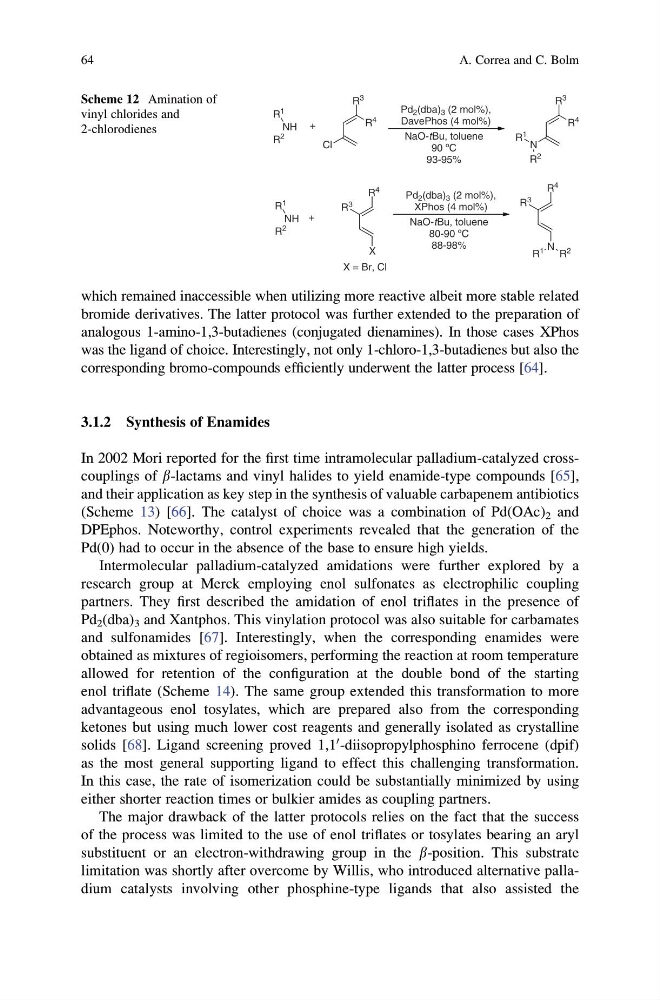
which remained inaccessible when utilizing more reactive albeit more stable related
bromide derivatives. The latter protocol was further extended to the preparation of
analogous 1-amino-1,3-butadienes (conjugated dienamines). In those cases XPhos
was the ligand of choice. Interestingly, not only 1-chloro-1,3-butadienes but also the
corresponding bromo-compounds efficiently underwent the latter process [64].
3.1.2 Synthesis of Enamides
In 2002 Mori reported for the first time intramolecular palladium-catalyzed crosscouplings of b-lactams and vinyl halides to yield enamide-type compounds [65],
and their application as key step in the synthesis of valuable carbapenem antibiotics
(Scheme 13) [66]. The catalyst of choice was a combination of Pd(OAc) 2 and
DPEphos. Noteworthy, control experiments revealed that the generation of the
Pd(0) had to occur in the absence of the base to ensure high yields.
Intermolecular palladium-catalyzed amidations were further explored by a
research group at Merck employing enol sulfonates as electrophilic coupling
partners. They first described the amidation of enol triflates in the presence of
Pd 2 (dba) 3 and Xantphos. This vinylation protocol was also suitable for carbamates
and sulfonamides [67]. Interestingly, when the corresponding enamides were
obtained as mixtures of regioisomers, performing the reaction at room temperature
allowed for retention of the configuration at the double bond of the starting
enol triflate (Scheme 14). The same group extended this transformation to more
advantageous enol tosylates, which are prepared also from the corresponding
ketones but using much lower cost reagents and generally isolated as crystalline
solids [68]. Ligand screening proved 1,1
0 -diisopropylphosphino ferrocene (dpif)
as the most general supporting ligand to effect this challenging transformation.
In this case, the rate of isomerization could be substantially minimized by using
either shorter reaction times or bulkier amides as coupling partners.
The major drawback of the latter protocols relies on the fact that the success
of the process was limited to the use of enol triflates or tosylates bearing an aryl
substituent or an electron-withdrawing group in the b-position. This substrate
limitation was shortly after overcome by Willis, who introduced alternative palladium catalysts involving other phosphine-type ligands that also assisted the
R
2
NH
R
1
+
R
4
R
3
Cl
R
2
NH
R
1
+
R
4
X
R
3
Pd 2 (dba) 3 (2 mol%),
DavePhos (4 mol%)
NaO-tBu, toluene
90 ºC
93-95%
X = Br, Cl
R
4
R
3
N
R
1
R
2
Pd 2 (dba) 3 (2 mol%),
XPhos (4 mol%)
NaO-tBu, toluene
80-90 ºC
88-98%
R
4
N
R
3
R
2
R
1
Scheme 12 Amination of
vinyl chlorides and
2-chlorodienes
64
A. Correa and C. Bolm
bromide derivatives. The latter protocol was further extended to the preparation of
analogous 1-amino-1,3-butadienes (conjugated dienamines). In those cases XPhos
was the ligand of choice. Interestingly, not only 1-chloro-1,3-butadienes but also the
corresponding bromo-compounds efficiently underwent the latter process [64].
3.1.2 Synthesis of Enamides
In 2002 Mori reported for the first time intramolecular palladium-catalyzed crosscouplings of b-lactams and vinyl halides to yield enamide-type compounds [65],
and their application as key step in the synthesis of valuable carbapenem antibiotics
(Scheme 13) [66]. The catalyst of choice was a combination of Pd(OAc) 2 and
DPEphos. Noteworthy, control experiments revealed that the generation of the
Pd(0) had to occur in the absence of the base to ensure high yields.
Intermolecular palladium-catalyzed amidations were further explored by a
research group at Merck employing enol sulfonates as electrophilic coupling
partners. They first described the amidation of enol triflates in the presence of
Pd 2 (dba) 3 and Xantphos. This vinylation protocol was also suitable for carbamates
and sulfonamides [67]. Interestingly, when the corresponding enamides were
obtained as mixtures of regioisomers, performing the reaction at room temperature
allowed for retention of the configuration at the double bond of the starting
enol triflate (Scheme 14). The same group extended this transformation to more
advantageous enol tosylates, which are prepared also from the corresponding
ketones but using much lower cost reagents and generally isolated as crystalline
solids [68]. Ligand screening proved 1,1
0 -diisopropylphosphino ferrocene (dpif)
as the most general supporting ligand to effect this challenging transformation.
In this case, the rate of isomerization could be substantially minimized by using
either shorter reaction times or bulkier amides as coupling partners.
The major drawback of the latter protocols relies on the fact that the success
of the process was limited to the use of enol triflates or tosylates bearing an aryl
substituent or an electron-withdrawing group in the b-position. This substrate
limitation was shortly after overcome by Willis, who introduced alternative palladium catalysts involving other phosphine-type ligands that also assisted the
R
2
NH
R
1
+
R
4
R
3
Cl
R
2
NH
R
1
+
R
4
X
R
3
Pd 2 (dba) 3 (2 mol%),
DavePhos (4 mol%)
NaO-tBu, toluene
90 ºC
93-95%
X = Br, Cl
R
4
R
3
N
R
1
R
2
Pd 2 (dba) 3 (2 mol%),
XPhos (4 mol%)
NaO-tBu, toluene
80-90 ºC
88-98%
R
4
N
R
3
R
2
R
1
Scheme 12 Amination of
vinyl chlorides and
2-chlorodienes
64
A. Correa and C. Bolm