

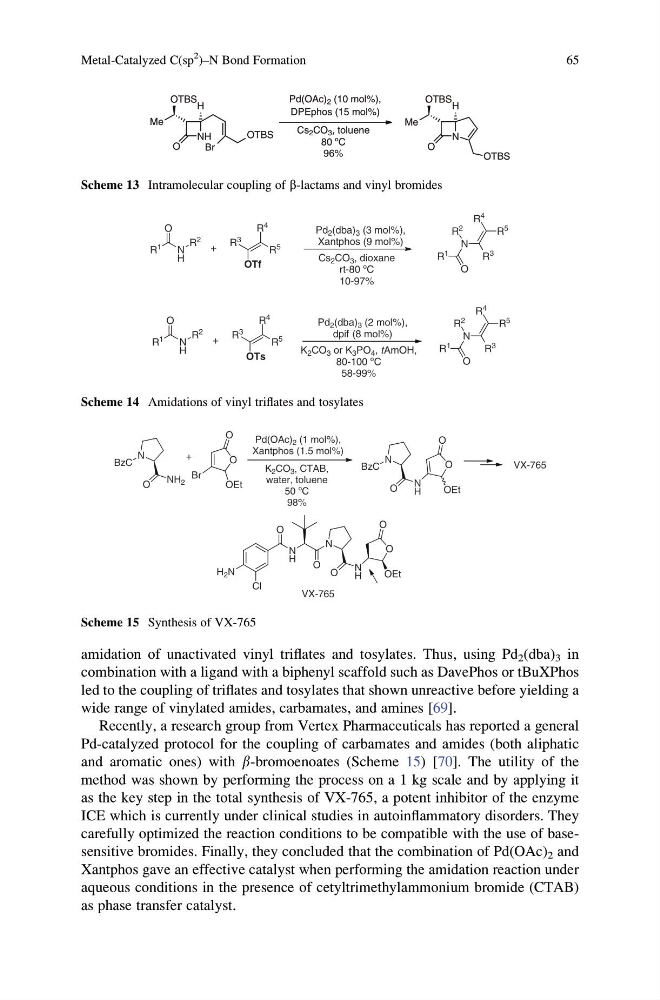
amidation of unactivated vinyl triflates and tosylates. Thus, using Pd 2 (dba) 3 in
combination with a ligand with a biphenyl scaffold such as DavePhos or tBuXPhos
led to the coupling of triflates and tosylates that shown unreactive before yielding a
wide range of vinylated amides, carbamates, and amines [69].
Recently, a research group from Vertex Pharmaceuticals has reported a general
Pd-catalyzed protocol for the coupling of carbamates and amides (both aliphatic
and aromatic ones) with b-bromoenoates (Scheme 15) [70]. The utility of the
method was shown by performing the process on a 1 kg scale and by applying it
as the key step in the total synthesis of VX-765, a potent inhibitor of the enzyme
ICE which is currently under clinical studies in autoinflammatory disorders. They
carefully optimized the reaction conditions to be compatible with the use of basesensitive bromides. Finally, they concluded that the combination of Pd(OAc) 2 and
Xantphos gave an effective catalyst when performing the amidation reaction under
aqueous conditions in the presence of cetyltrimethylammonium bromide (CTAB)
as phase transfer catalyst.
Pd(OAc) 2 (10 mol%),
DPEphos (15 mol%)
Cs 2 CO 3 , toluene
80 ºC
96%
NH
Me
OTBS H
O
Br
OTBS
N
Me
OTBS H
O
OTBS
Scheme 13 Intramolecular coupling of b-lactams and vinyl bromides
R
3
OTf
R
5
R
4
+
Pd 2 (dba) 3 (3 mol%),
Xantphos (9 mol%)
Cs 2 CO 3 , dioxane
rt-80 ºC
10-97%
N
R
2
R
5
R
4
R
3
R
1
N
H
O
R
2
O
R
1
R
3
OTs
R
5
R
4
+
Pd 2 (dba) 3 (2 mol%),
dpif (8 mol%)
K 2 CO 3 or K 3 PO 4 , tAmOH,
80-100 ºC
58-99%
N
R
2
R
5
R
4
R
3
R
1
N
H
O
R
2
O
R
1
Scheme 14 Amidations of vinyl triflates and tosylates
Pd(OAc) 2 (1 mol%),
Xantphos (1.5 mol%)
K 2 CO 3 , CTAB,
water, toluene
50 ºC
98%
H 2 N
Cl
N
H
O
O
N
N
H
O
O
OEt
O
VX-765
N
O
BzC
NH 2
O
O
OEt
Br
+
N
O
BzC
N
H
O
O
OEt
VX-765
Scheme 15 Synthesis of VX-765
Metal-Catalyzed C(sp
2
)–N Bond Formation
65
combination with a ligand with a biphenyl scaffold such as DavePhos or tBuXPhos
led to the coupling of triflates and tosylates that shown unreactive before yielding a
wide range of vinylated amides, carbamates, and amines [69].
Recently, a research group from Vertex Pharmaceuticals has reported a general
Pd-catalyzed protocol for the coupling of carbamates and amides (both aliphatic
and aromatic ones) with b-bromoenoates (Scheme 15) [70]. The utility of the
method was shown by performing the process on a 1 kg scale and by applying it
as the key step in the total synthesis of VX-765, a potent inhibitor of the enzyme
ICE which is currently under clinical studies in autoinflammatory disorders. They
carefully optimized the reaction conditions to be compatible with the use of basesensitive bromides. Finally, they concluded that the combination of Pd(OAc) 2 and
Xantphos gave an effective catalyst when performing the amidation reaction under
aqueous conditions in the presence of cetyltrimethylammonium bromide (CTAB)
as phase transfer catalyst.
Pd(OAc) 2 (10 mol%),
DPEphos (15 mol%)
Cs 2 CO 3 , toluene
80 ºC
96%
NH
Me
OTBS H
O
Br
OTBS
N
Me
OTBS H
O
OTBS
Scheme 13 Intramolecular coupling of b-lactams and vinyl bromides
R
3
OTf
R
5
R
4
+
Pd 2 (dba) 3 (3 mol%),
Xantphos (9 mol%)
Cs 2 CO 3 , dioxane
rt-80 ºC
10-97%
N
R
2
R
5
R
4
R
3
R
1
N
H
O
R
2
O
R
1
R
3
OTs
R
5
R
4
+
Pd 2 (dba) 3 (2 mol%),
dpif (8 mol%)
K 2 CO 3 or K 3 PO 4 , tAmOH,
80-100 ºC
58-99%
N
R
2
R
5
R
4
R
3
R
1
N
H
O
R
2
O
R
1
Scheme 14 Amidations of vinyl triflates and tosylates
Pd(OAc) 2 (1 mol%),
Xantphos (1.5 mol%)
K 2 CO 3 , CTAB,
water, toluene
50 ºC
98%
H 2 N
Cl
N
H
O
O
N
N
H
O
O
OEt
O
VX-765
N
O
BzC
NH 2
O
O
OEt
Br
+
N
O
BzC
N
H
O
O
OEt
VX-765
Scheme 15 Synthesis of VX-765
Metal-Catalyzed C(sp
2
)–N Bond Formation
65