

dried anhydrous K 3 PO 4 and, unlike in the former protocol, the use of preformed
pyrrolyllithium under such conditions gave predominantly undesired elimination product.
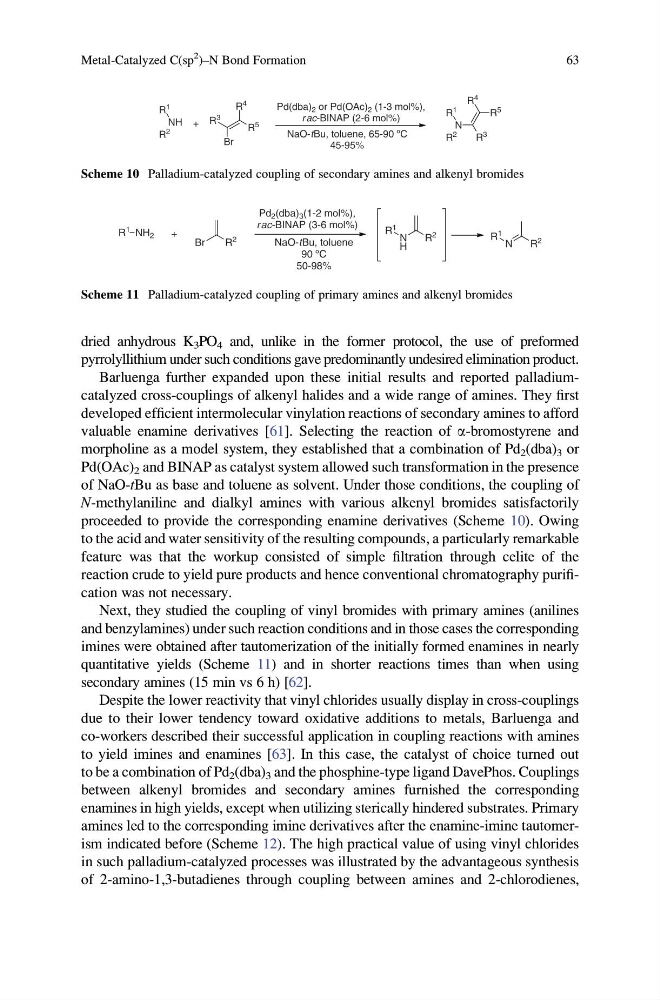
Barluenga further expanded upon these initial results and reported palladiumcatalyzed cross-couplings of alkenyl halides and a wide range of amines. They first
developed efficient intermolecular vinylation reactions of secondary amines to afford
valuable enamine derivatives [61]. Selecting the reaction of a-bromostyrene and
morpholine as a model system, they established that a combination of Pd 2 (dba) 3 or
Pd(OAc) 2 and BINAP as catalyst system allowed such transformation in the presence
of NaO-tBu as base and toluene as solvent. Under those conditions, the coupling of
N-methylaniline and dialkyl amines with various alkenyl bromides satisfactorily
proceeded to provide the corresponding enamine derivatives (Scheme 10). Owing
to the acid and water sensitivity of the resulting compounds, a particularly remarkable
feature was that the workup consisted of simple filtration through celite of the
reaction crude to yield pure products and hence conventional chromatography purification was not necessary.
Next, they studied the coupling of vinyl bromides with primary amines (anilines
and benzylamines) under such reaction conditions and in those cases the corresponding
imines were obtained after tautomerization of the initially formed enamines in nearly
quantitative yields (Scheme 11) and in shorter reactions times than when using
secondary amines (15 min vs 6 h) [62].
Despite the lower reactivity that vinyl chlorides usually display in cross-couplings
due to their lower tendency toward oxidative additions to metals, Barluenga and
co-workers described their successful application in coupling reactions with amines
to yield imines and enamines [63]. In this case, the catalyst of choice turned out
to be a combination of Pd 2 (dba) 3 and the phosphine-type ligand DavePhos. Couplings
between alkenyl bromides and secondary amines furnished the corresponding
enamines in high yields, except when utilizing sterically hindered substrates. Primary
amines led to the corresponding imine derivatives after the enamine-imine tautomerism indicated before (Scheme 12). The high practical value of using vinyl chlorides
in such palladium-catalyzed processes was illustrated by the advantageous synthesis
of 2-amino-1,3-butadienes through coupling between amines and 2-chlorodienes,
R
2
NH
R
1
R
3
Br
R
5
R
4
+
Pd(dba) 2 or Pd(OAc) 2 (1-3 mol%),
rac-BINAP (2-6 mol%)
NaO-tBu, toluene, 65-90 ºC
45-95%
R
2
N
R
1
R
5
R
4
R
3
Scheme 10 Palladium-catalyzed coupling of secondary amines and alkenyl bromides
NH 2
+
Pd 2 (dba) 3 (1-2 mol%),
rac-BINAP (3-6 mol%)
NaO-tBu, toluene
90 ºC
50-98%
R
1
R
2
R
2
N
H
R
1
R
2
N
R
1
Br
Scheme 11 Palladium-catalyzed coupling of primary amines and alkenyl bromides
Metal-Catalyzed C(sp
2
)–N Bond Formation
63
pyrrolyllithium under such conditions gave predominantly undesired elimination product.
Barluenga further expanded upon these initial results and reported palladiumcatalyzed cross-couplings of alkenyl halides and a wide range of amines. They first
developed efficient intermolecular vinylation reactions of secondary amines to afford
valuable enamine derivatives [61]. Selecting the reaction of a-bromostyrene and
morpholine as a model system, they established that a combination of Pd 2 (dba) 3 or
Pd(OAc) 2 and BINAP as catalyst system allowed such transformation in the presence
of NaO-tBu as base and toluene as solvent. Under those conditions, the coupling of
N-methylaniline and dialkyl amines with various alkenyl bromides satisfactorily
proceeded to provide the corresponding enamine derivatives (Scheme 10). Owing
to the acid and water sensitivity of the resulting compounds, a particularly remarkable
feature was that the workup consisted of simple filtration through celite of the
reaction crude to yield pure products and hence conventional chromatography purification was not necessary.
Next, they studied the coupling of vinyl bromides with primary amines (anilines
and benzylamines) under such reaction conditions and in those cases the corresponding
imines were obtained after tautomerization of the initially formed enamines in nearly
quantitative yields (Scheme 11) and in shorter reactions times than when using
secondary amines (15 min vs 6 h) [62].
Despite the lower reactivity that vinyl chlorides usually display in cross-couplings
due to their lower tendency toward oxidative additions to metals, Barluenga and
co-workers described their successful application in coupling reactions with amines
to yield imines and enamines [63]. In this case, the catalyst of choice turned out
to be a combination of Pd 2 (dba) 3 and the phosphine-type ligand DavePhos. Couplings
between alkenyl bromides and secondary amines furnished the corresponding
enamines in high yields, except when utilizing sterically hindered substrates. Primary
amines led to the corresponding imine derivatives after the enamine-imine tautomerism indicated before (Scheme 12). The high practical value of using vinyl chlorides
in such palladium-catalyzed processes was illustrated by the advantageous synthesis
of 2-amino-1,3-butadienes through coupling between amines and 2-chlorodienes,
R
2
NH
R
1
R
3
Br
R
5
R
4
+
Pd(dba) 2 or Pd(OAc) 2 (1-3 mol%),
rac-BINAP (2-6 mol%)
NaO-tBu, toluene, 65-90 ºC
45-95%
R
2
N
R
1
R
5
R
4
R
3
Scheme 10 Palladium-catalyzed coupling of secondary amines and alkenyl bromides
NH 2
+
Pd 2 (dba) 3 (1-2 mol%),
rac-BINAP (3-6 mol%)
NaO-tBu, toluene
90 ºC
50-98%
R
1
R
2
R
2
N
H
R
1
R
2
N
R
1
Br
Scheme 11 Palladium-catalyzed coupling of primary amines and alkenyl bromides
Metal-Catalyzed C(sp
2
)–N Bond Formation
63