

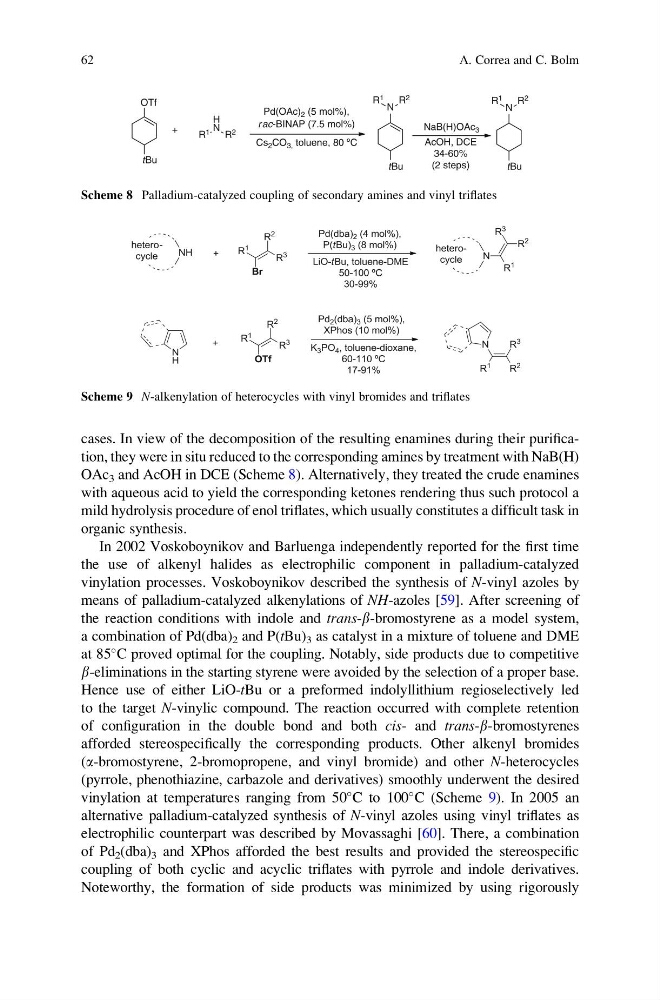
cases. In view of the decomposition of the resulting enamines during their purification, they were in situ reduced to the corresponding amines by treatment with NaB(H)
OAc 3 and AcOH in DCE (Scheme 8). Alternatively, they treated the crude enamines
with aqueous acid to yield the corresponding ketones rendering thus such protocol a
mild hydrolysis procedure of enol triflates, which usually constitutes a difficult task in
organic synthesis.
In 2002 Voskoboynikov and Barluenga independently reported for the first time
the use of alkenyl halides as electrophilic component in palladium-catalyzed
vinylation processes. Voskoboynikov described the synthesis of N-vinyl azoles by
means of palladium-catalyzed alkenylations of NH-azoles [59]. After screening of
the reaction conditions with indole and trans-b-bromostyrene as a model system,
a combination of Pd(dba) 2 and P(tBu) 3 as catalyst in a mixture of toluene and DME
at 85
C proved optimal for the coupling. Notably, side products due to competitive
b-eliminations in the starting styrene were avoided by the selection of a proper base.
Hence use of either LiO-tBu or a preformed indolyllithium regioselectively led
to the target N-vinylic compound. The reaction occurred with complete retention
of configuration in the double bond and both cis- and trans-b-bromostyrenes
afforded stereospecifically the corresponding products. Other alkenyl bromides
(a-bromostyrene, 2-bromopropene, and vinyl bromide) and other N-heterocycles
(pyrrole, phenothiazine, carbazole and derivatives) smoothly underwent the desired
vinylation at temperatures ranging from 50
C to 100
C (Scheme 9). In 2005 an
alternative palladium-catalyzed synthesis of N-vinyl azoles using vinyl triflates as
electrophilic counterpart was described by Movassaghi [60]. There, a combination
of Pd 2 (dba) 3 and XPhos afforded the best results and provided the stereospecific
coupling of both cyclic and acyclic triflates with pyrrole and indole derivatives.
Noteworthy, the formation of side products was minimized by using rigorously
+
Pd(OAc) 2 (5 mol%),
rac-BINAP (7.5 mol%)
Cs 2 CO 3, toluene, 80 ºC
OTf
tBu
R 1
R 2
H
N
N
tBu
R 1
R 2
N
tBu
R 1
R 2
NaB(H)OAc 3
AcOH, DCE
34-60%
(2 steps)
Scheme 8 Palladium-catalyzed coupling of secondary amines and vinyl triflates
Scheme 9 N-alkenylation of heterocycles with vinyl bromides and triflates
62
A. Correa and C. Bolm
OAc 3 and AcOH in DCE (Scheme 8). Alternatively, they treated the crude enamines
with aqueous acid to yield the corresponding ketones rendering thus such protocol a
mild hydrolysis procedure of enol triflates, which usually constitutes a difficult task in
organic synthesis.
In 2002 Voskoboynikov and Barluenga independently reported for the first time
the use of alkenyl halides as electrophilic component in palladium-catalyzed
vinylation processes. Voskoboynikov described the synthesis of N-vinyl azoles by
means of palladium-catalyzed alkenylations of NH-azoles [59]. After screening of
the reaction conditions with indole and trans-b-bromostyrene as a model system,
a combination of Pd(dba) 2 and P(tBu) 3 as catalyst in a mixture of toluene and DME
at 85
C proved optimal for the coupling. Notably, side products due to competitive
b-eliminations in the starting styrene were avoided by the selection of a proper base.
Hence use of either LiO-tBu or a preformed indolyllithium regioselectively led
to the target N-vinylic compound. The reaction occurred with complete retention
of configuration in the double bond and both cis- and trans-b-bromostyrenes
afforded stereospecifically the corresponding products. Other alkenyl bromides
(a-bromostyrene, 2-bromopropene, and vinyl bromide) and other N-heterocycles
(pyrrole, phenothiazine, carbazole and derivatives) smoothly underwent the desired
vinylation at temperatures ranging from 50
C to 100
C (Scheme 9). In 2005 an
alternative palladium-catalyzed synthesis of N-vinyl azoles using vinyl triflates as
electrophilic counterpart was described by Movassaghi [60]. There, a combination
of Pd 2 (dba) 3 and XPhos afforded the best results and provided the stereospecific
coupling of both cyclic and acyclic triflates with pyrrole and indole derivatives.
Noteworthy, the formation of side products was minimized by using rigorously
+
Pd(OAc) 2 (5 mol%),
rac-BINAP (7.5 mol%)
Cs 2 CO 3, toluene, 80 ºC
OTf
tBu
R 1
R 2
H
N
N
tBu
R 1
R 2
N
tBu
R 1
R 2
NaB(H)OAc 3
AcOH, DCE
34-60%
(2 steps)
Scheme 8 Palladium-catalyzed coupling of secondary amines and vinyl triflates
Scheme 9 N-alkenylation of heterocycles with vinyl bromides and triflates
62
A. Correa and C. Bolm