

even when sterically hindered anilines were employed. Moreover, electron poor
2,6-dihaloanilines provided regioselectively the desired tropone derivatives and
side products due to competitive coupling reactions were not observed.
Similar reaction conditions were further utilized by Willis and Brace to conduct
the synthesis of enamines from cyclic vinyl triflates and secondary amines [58].
Although the use of Cs 2 CO 3 as base at 80
C delivered satisfactorily the target
enamines, the effectiveness of using a strong base such as KO-tBu at room temperature was also demonstrated and moderate to good conversions were achieved in those
Pd
L n
X
R
1
Pd
L n
NR
2
R
3
R
1
R
1
-X
NHR
2 R
3 + B
BH + X
N
R
3
R
1
R
2
reductive
elimination
L n Pd(0)
oxidative
addition
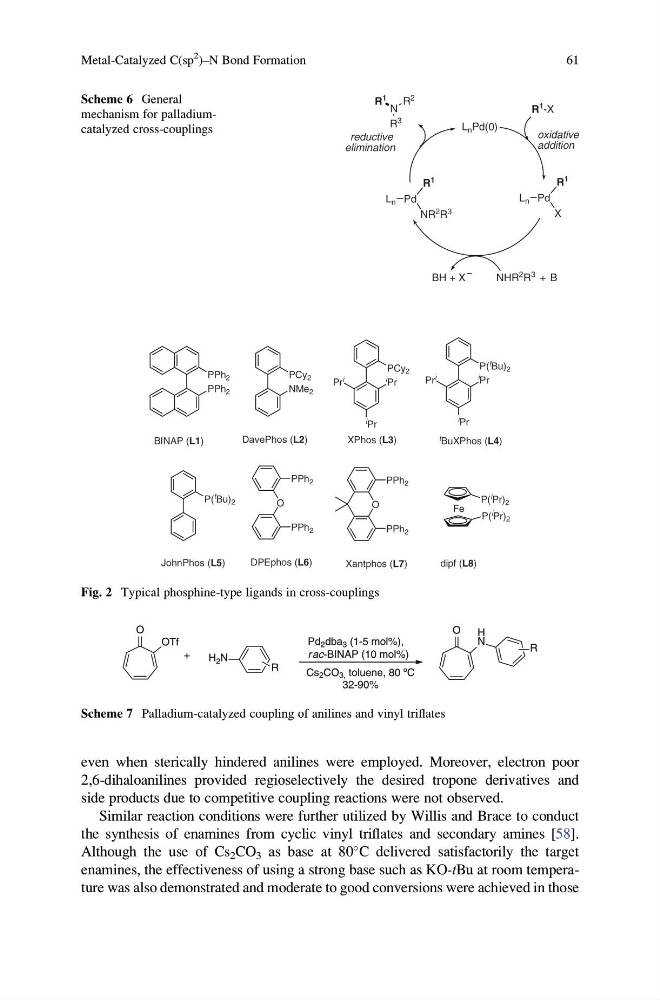
Scheme 6 General
mechanism for palladiumcatalyzed cross-couplings
PPh 2
PPh 2
BINAP (L1)
PCy 2
NMe 2
DavePhos (L2)
PCy 2
i Pr
XPhos (L3)
Pr
i
i
Pr
O
PPh 2
PPh 2
Xantphos (L7)
O
PPh 2
PPh 2
DPEphos (L6)
P(
i Pr) 2
P(
i Pr) 2
Fe
dipf (L8)
P(
t Bu) 2
JohnPhos (L5)
P(
t
Bu) 2
i
Pr
t
BuXPhos (L4)
Pr
i
i Pr
Fig. 2 Typical phosphine-type ligands in cross-couplings
O
OTf
H 2 N
R
+
Pd 2 dba 3 (1-5 mol%),
rac-BINAP (10 mol%)
Cs 2 CO 3, toluene, 80 ºC
32-90%
O
H
N
R
Scheme 7 Palladium-catalyzed coupling of anilines and vinyl triflates
Metal-Catalyzed C(sp
2
)–N Bond Formation
61
2,6-dihaloanilines provided regioselectively the desired tropone derivatives and
side products due to competitive coupling reactions were not observed.
Similar reaction conditions were further utilized by Willis and Brace to conduct
the synthesis of enamines from cyclic vinyl triflates and secondary amines [58].
Although the use of Cs 2 CO 3 as base at 80
C delivered satisfactorily the target
enamines, the effectiveness of using a strong base such as KO-tBu at room temperature was also demonstrated and moderate to good conversions were achieved in those
Pd
L n
X
R
1
Pd
L n
NR
2
R
3
R
1
R
1
-X
NHR
2 R
3 + B
BH + X
N
R
3
R
1
R
2
reductive
elimination
L n Pd(0)
oxidative
addition
Scheme 6 General
mechanism for palladiumcatalyzed cross-couplings
PPh 2
PPh 2
BINAP (L1)
PCy 2
NMe 2
DavePhos (L2)
PCy 2
i Pr
XPhos (L3)
Pr
i
i
Pr
O
PPh 2
PPh 2
Xantphos (L7)
O
PPh 2
PPh 2
DPEphos (L6)
P(
i Pr) 2
P(
i Pr) 2
Fe
dipf (L8)
P(
t Bu) 2
JohnPhos (L5)
P(
t
Bu) 2
i
Pr
t
BuXPhos (L4)
Pr
i
i Pr
Fig. 2 Typical phosphine-type ligands in cross-couplings
O
OTf
H 2 N
R
+
Pd 2 dba 3 (1-5 mol%),
rac-BINAP (10 mol%)
Cs 2 CO 3, toluene, 80 ºC
32-90%
O
H
N
R
Scheme 7 Palladium-catalyzed coupling of anilines and vinyl triflates
Metal-Catalyzed C(sp
2
)–N Bond Formation
61