

Ph
O
TfO
NH 2
+
Pd 2 (dba) 3 (5 mol %)
BINAP (10 mol %)
Ph
O
NH
K 3 PO 4 , toluene
90 ºC
47%
ð75Þ
A series of C2 symmetric N,N
0 -bis(aryl)diamines, which have been broadly
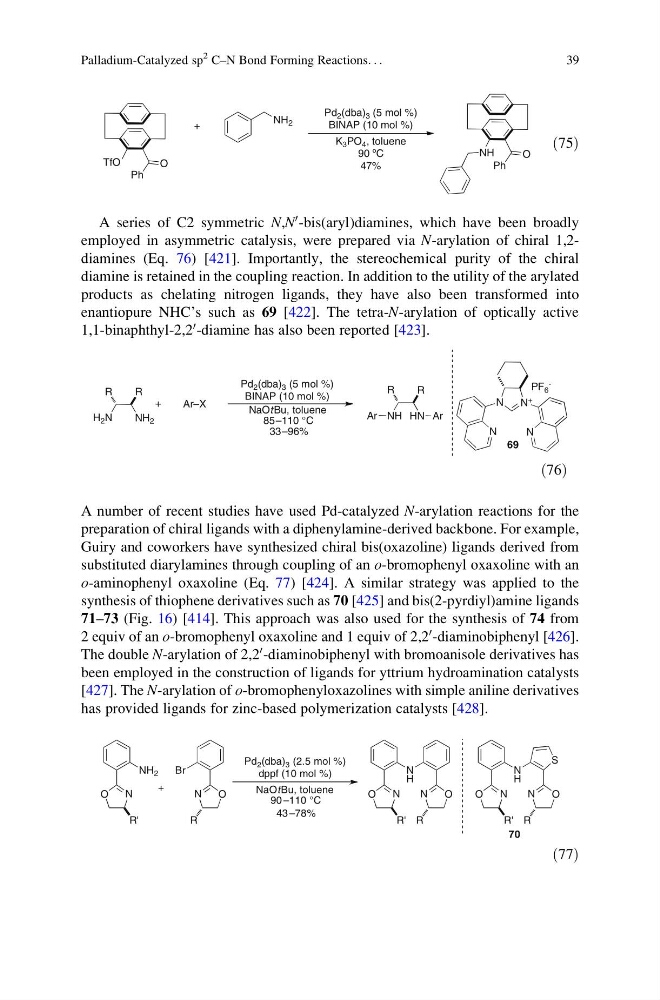
employed in asymmetric catalysis, were prepared via N-arylation of chiral 1,2diamines (Eq. 76) [421]. Importantly, the stereochemical purity of the chiral
diamine is retained in the coupling reaction. In addition to the utility of the arylated
products as chelating nitrogen ligands, they have also been transformed into
enantiopure NHC’s such as 69 [422]. The tetra-N-arylation of optically active
1,1-binaphthyl-2,2
0 -diamine has also been reported [423].
NH HN
Ar
Ar
R
R
N
N +
N
N
PF 6
-
H 2 N
NH 2
R
R
Pd 2 (dba) 3 (5 mol %)
BINAP (10 mol %)
33–96%
69
NaOtBu, toluene
85–110 °C
+
Ar–X
ð76Þ
A number of recent studies have used Pd-catalyzed N-arylation reactions for the
preparation of chiral ligands with a diphenylamine-derived backbone. For example,
Guiry and coworkers have synthesized chiral bis(oxazoline) ligands derived from
substituted diarylamines through coupling of an o-bromophenyl oxaxoline with an
o-aminophenyl oxaxoline (Eq. 77) [424]. A similar strategy was applied to the
synthesis of thiophene derivatives such as 70 [425] and bis(2-pyrdiyl)amine ligands
71–73 (Fig. 16) [414]. This approach was also used for the synthesis of 74 from
2 equiv of an o-bromophenyl oxaxoline and 1 equiv of 2,2
0 -diaminobiphenyl [426].
The double N-arylation of 2,2
0 -diaminobiphenyl with bromoanisole derivatives has
been employed in the construction of ligands for yttrium hydroamination catalysts
[427]. The N-arylation of o-bromophenyloxazolines with simple aniline derivatives
has provided ligands for zinc-based polymerization catalysts [428].
N
H
O
N
N
O
R' R
N
H
O
N
N
O
R' R
S
NH 2
O
N
N
O
R'
R
Pd 2 (dba) 3 (2.5 mol %)
dppf (10 mol %)
Br
+
43 –78%
70
NaOtBu, toluene
90 –110 °C
ð77Þ
Palladium-Catalyzed sp
2 C–N Bond Forming Reactions. . .
39
O
TfO
NH 2
+
Pd 2 (dba) 3 (5 mol %)
BINAP (10 mol %)
Ph
O
NH
K 3 PO 4 , toluene
90 ºC
47%
ð75Þ
A series of C2 symmetric N,N
0 -bis(aryl)diamines, which have been broadly
employed in asymmetric catalysis, were prepared via N-arylation of chiral 1,2diamines (Eq. 76) [421]. Importantly, the stereochemical purity of the chiral
diamine is retained in the coupling reaction. In addition to the utility of the arylated
products as chelating nitrogen ligands, they have also been transformed into
enantiopure NHC’s such as 69 [422]. The tetra-N-arylation of optically active
1,1-binaphthyl-2,2
0 -diamine has also been reported [423].
NH HN
Ar
Ar
R
R
N
N +
N
N
PF 6
-
H 2 N
NH 2
R
R
Pd 2 (dba) 3 (5 mol %)
BINAP (10 mol %)
33–96%
69
NaOtBu, toluene
85–110 °C
+
Ar–X
ð76Þ
A number of recent studies have used Pd-catalyzed N-arylation reactions for the
preparation of chiral ligands with a diphenylamine-derived backbone. For example,
Guiry and coworkers have synthesized chiral bis(oxazoline) ligands derived from
substituted diarylamines through coupling of an o-bromophenyl oxaxoline with an
o-aminophenyl oxaxoline (Eq. 77) [424]. A similar strategy was applied to the
synthesis of thiophene derivatives such as 70 [425] and bis(2-pyrdiyl)amine ligands
71–73 (Fig. 16) [414]. This approach was also used for the synthesis of 74 from
2 equiv of an o-bromophenyl oxaxoline and 1 equiv of 2,2
0 -diaminobiphenyl [426].
The double N-arylation of 2,2
0 -diaminobiphenyl with bromoanisole derivatives has
been employed in the construction of ligands for yttrium hydroamination catalysts
[427]. The N-arylation of o-bromophenyloxazolines with simple aniline derivatives
has provided ligands for zinc-based polymerization catalysts [428].
N
H
O
N
N
O
R' R
N
H
O
N
N
O
R' R
S
NH 2
O
N
N
O
R'
R
Pd 2 (dba) 3 (2.5 mol %)
dppf (10 mol %)
Br
+
43 –78%
70
NaOtBu, toluene
90 –110 °C
ð77Þ
Palladium-Catalyzed sp
2 C–N Bond Forming Reactions. . .
39