

4.5 Process Scale Applications of Pd-Catalyzed N-Arylation
Reactions
The Pd-catalyzed N-arylation of amines has proven to be amenable to large scale
synthesis in a number of industrial applications [429–431]. For example, a collaboration between Lanxess, Rhodia, and Buchwald resulted in several applications of
Pd-catalyzed amination reactions to the large-scale synthesis of both pharmaceutically
relevant molecules and precursors for materials applications. A detailed description of
this work was published in a recent review [432].
In the production of ZM549865, which is a 5-HT 1B receptor antagonist,
Robinson and coworkers at AstraZeneca effected the Pd-catalyzed coupling of
N-methyl piperazine with a functionalized bromo-chromenone derivative
(Scheme 10) [433]. Hydrolysis of the product with aqueous KOH followed by
acidification afforded carboxylic acid 75, which served as a key intermediate in the
synthesis of the desired target. During initial manufacturing, three batches of 75
were produced from 116 kg of the bromo-chromenone.
A related synthesis of another 5-HT 1B receptor antagonist, AR-A2, was also carried
out by scientists at AstraZeneca (Scheme 11) [434, 435]. The coupling of N-methyl
piperazine with a bromotetrahydronaphthalene derivative was successfully executed
on a 1 kg scale using only 0.47 mol% of the palladium catalyst (Scheme 11). Scientists
at Abbot Pharmaceuticals conducted an eight-step preparation of 2.1 g of the glucuronide metabolite of ABT-74, a D 4 Dopamine receptor antagonist [436]. The key
N-arylation reaction was effected on a 19 g scale (Scheme 12).
Torcetrapib, a compound designed by Pfizer to increase HDL cholesterol was
synthesized in the final process using a key palladium catalyzed N-arylation reaction
[437]. As shown below (Scheme 13), the coupling of (R)-3-aminopentanenitrile with
4-chlorobenzotrifluoride proceeded in 75–79% yield on a 3 kg scale. This route
allowed for the use of enantiopure starting material, which avoided a late-stage
resolution step. In addition, this approach also avoided the use of
N
Bn
N
N
t-Bu
t-Bu
OH HO
N
N
N
O
t-Bu
HO
N
Bn
N
N
N
H
H
N
N
O
N
O
R'
R
71
72
73
74
Bu
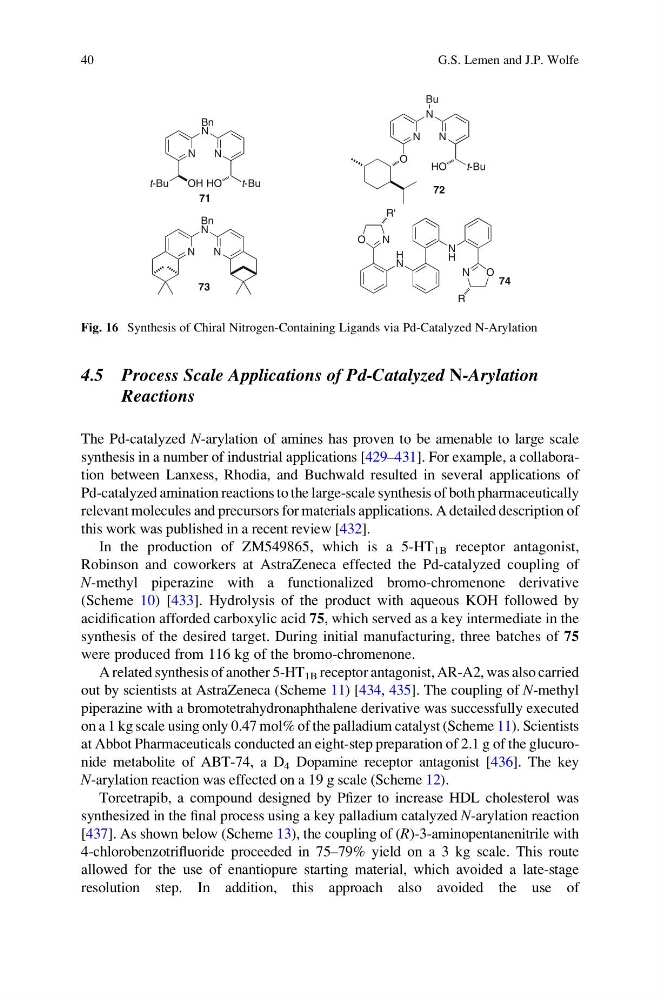
Fig. 16 Synthesis of Chiral Nitrogen-Containing Ligands via Pd-Catalyzed N-Arylation
40
G.S. Lemen and J.P. Wolfe
Reactions
The Pd-catalyzed N-arylation of amines has proven to be amenable to large scale
synthesis in a number of industrial applications [429–431]. For example, a collaboration between Lanxess, Rhodia, and Buchwald resulted in several applications of
Pd-catalyzed amination reactions to the large-scale synthesis of both pharmaceutically
relevant molecules and precursors for materials applications. A detailed description of
this work was published in a recent review [432].
In the production of ZM549865, which is a 5-HT 1B receptor antagonist,
Robinson and coworkers at AstraZeneca effected the Pd-catalyzed coupling of
N-methyl piperazine with a functionalized bromo-chromenone derivative
(Scheme 10) [433]. Hydrolysis of the product with aqueous KOH followed by
acidification afforded carboxylic acid 75, which served as a key intermediate in the
synthesis of the desired target. During initial manufacturing, three batches of 75
were produced from 116 kg of the bromo-chromenone.
A related synthesis of another 5-HT 1B receptor antagonist, AR-A2, was also carried
out by scientists at AstraZeneca (Scheme 11) [434, 435]. The coupling of N-methyl
piperazine with a bromotetrahydronaphthalene derivative was successfully executed
on a 1 kg scale using only 0.47 mol% of the palladium catalyst (Scheme 11). Scientists
at Abbot Pharmaceuticals conducted an eight-step preparation of 2.1 g of the glucuronide metabolite of ABT-74, a D 4 Dopamine receptor antagonist [436]. The key
N-arylation reaction was effected on a 19 g scale (Scheme 12).
Torcetrapib, a compound designed by Pfizer to increase HDL cholesterol was
synthesized in the final process using a key palladium catalyzed N-arylation reaction
[437]. As shown below (Scheme 13), the coupling of (R)-3-aminopentanenitrile with
4-chlorobenzotrifluoride proceeded in 75–79% yield on a 3 kg scale. This route
allowed for the use of enantiopure starting material, which avoided a late-stage
resolution step. In addition, this approach also avoided the use of
N
Bn
N
N
t-Bu
t-Bu
OH HO
N
N
N
O
t-Bu
HO
N
Bn
N
N
N
H
H
N
N
O
N
O
R'
R
71
72
73
74
Bu
Fig. 16 Synthesis of Chiral Nitrogen-Containing Ligands via Pd-Catalyzed N-Arylation
40
G.S. Lemen and J.P. Wolfe