

4.4 Use of N-Arylation Reactions for the Synthesis
of Ligands for Metal Complexes and Catalysts
A number of transition metal catalysts with interesting reactivity are supported by
nitrogen containing ligands. Palladium-catalyzed N-arylation reactions have proven
to be very useful for the synthesis of ligands for metal complexes [11]. For example,
an early application in this area was reported by Schrock, who effected the triple
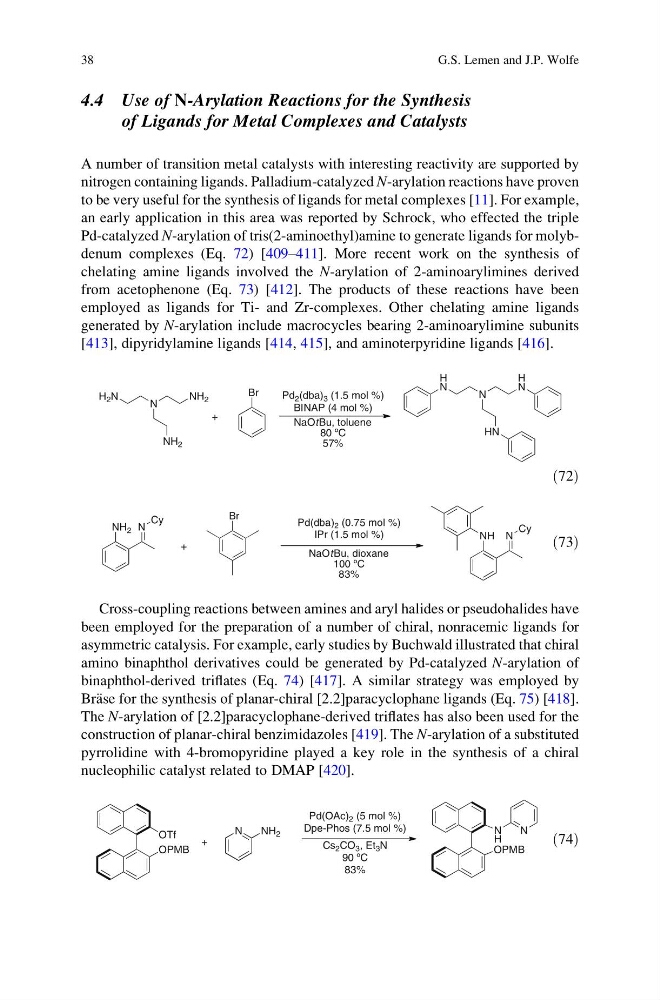
Pd-catalyzed N-arylation of tris(2-aminoethyl)amine to generate ligands for molybdenum complexes (Eq. 72) [409–411]. More recent work on the synthesis of
chelating amine ligands involved the N-arylation of 2-aminoarylimines derived
from acetophenone (Eq. 73) [412]. The products of these reactions have been
employed as ligands for Ti- and Zr-complexes. Other chelating amine ligands
generated by N-arylation include macrocycles bearing 2-aminoarylimine subunits
[413], dipyridylamine ligands [414, 415], and aminoterpyridine ligands [416].
N
NH 2
NH 2
H 2 N
+
Br
Pd 2 (dba) 3 (1.5 mol %)
BINAP (4 mol %)
N
H
N
HN
H
N
NaOtBu, toluene
80 ºC
57%
ð72Þ
NH 2 N
Cy
+
Br
Pd(dba) 2 (0.75 mol %)
IPr (1.5 mol %)
NH N
Cy
NaOtBu, dioxane
100 ºC
83%
ð73Þ
Cross-coupling reactions between amines and aryl halides or pseudohalides have
been employed for the preparation of a number of chiral, nonracemic ligands for
asymmetric catalysis. For example, early studies by Buchwald illustrated that chiral
amino binaphthol derivatives could be generated by Pd-catalyzed N-arylation of
binaphthol-derived triflates (Eq. 74) [417]. A similar strategy was employed by
Bra ¨se for the synthesis of planar-chiral [2.2]paracyclophane ligands (Eq. 75) [418].
The N-arylation of [2.2]paracyclophane-derived triflates has also been used for the
construction of planar-chiral benzimidazoles [419]. The N-arylation of a substituted
pyrrolidine with 4-bromopyridine played a key role in the synthesis of a chiral
nucleophilic catalyst related to DMAP [420].
OTf
OPMB
+
N
NH 2
Pd(OAc) 2 (5 mol %)
Dpe-Phos (7.5 mol %)
N
H
OPMB
N
Cs 2 CO 3 , Et 3 N
90 ºC
83%
ð74Þ
38
G.S. Lemen and J.P. Wolfe
of Ligands for Metal Complexes and Catalysts
A number of transition metal catalysts with interesting reactivity are supported by
nitrogen containing ligands. Palladium-catalyzed N-arylation reactions have proven
to be very useful for the synthesis of ligands for metal complexes [11]. For example,
an early application in this area was reported by Schrock, who effected the triple
Pd-catalyzed N-arylation of tris(2-aminoethyl)amine to generate ligands for molybdenum complexes (Eq. 72) [409–411]. More recent work on the synthesis of
chelating amine ligands involved the N-arylation of 2-aminoarylimines derived
from acetophenone (Eq. 73) [412]. The products of these reactions have been
employed as ligands for Ti- and Zr-complexes. Other chelating amine ligands
generated by N-arylation include macrocycles bearing 2-aminoarylimine subunits
[413], dipyridylamine ligands [414, 415], and aminoterpyridine ligands [416].
N
NH 2
NH 2
H 2 N
+
Br
Pd 2 (dba) 3 (1.5 mol %)
BINAP (4 mol %)
N
H
N
HN
H
N
NaOtBu, toluene
80 ºC
57%
ð72Þ
NH 2 N
Cy
+
Br
Pd(dba) 2 (0.75 mol %)
IPr (1.5 mol %)
NH N
Cy
NaOtBu, dioxane
100 ºC
83%
ð73Þ
Cross-coupling reactions between amines and aryl halides or pseudohalides have
been employed for the preparation of a number of chiral, nonracemic ligands for
asymmetric catalysis. For example, early studies by Buchwald illustrated that chiral
amino binaphthol derivatives could be generated by Pd-catalyzed N-arylation of
binaphthol-derived triflates (Eq. 74) [417]. A similar strategy was employed by
Bra ¨se for the synthesis of planar-chiral [2.2]paracyclophane ligands (Eq. 75) [418].
The N-arylation of [2.2]paracyclophane-derived triflates has also been used for the
construction of planar-chiral benzimidazoles [419]. The N-arylation of a substituted
pyrrolidine with 4-bromopyridine played a key role in the synthesis of a chiral
nucleophilic catalyst related to DMAP [420].
OTf
OPMB
+
N
NH 2
Pd(OAc) 2 (5 mol %)
Dpe-Phos (7.5 mol %)
N
H
OPMB
N
Cs 2 CO 3 , Et 3 N
90 ºC
83%
ð74Þ
38
G.S. Lemen and J.P. Wolfe