

N
N
N
N
N
N
Me
Me
Me
Me
3
56
N
N
Br
Br
Me
Me
+
NH
N
H
Me
Me
22%
Pd 2 (dba) 3 (10 mol %)
dppp (20 mol %)
55
NaOtBu, Toluene
110 °C
ð68Þ
N
N
N
N
Me
Me
Me
Me
58
OMe
OMe
MeO
OMe
t-Bu
t-Bu
t-Bu
t-Bu
N
N
N
Me
Me
Me
57
OMe
OMe
MeO
OMe
t-Bu
t-Bu
t-Bu
t-Bu
Br N(H)Me
Pd(dba) 2 (20 mol %)
P(t-Bu) 3 (16 mol %)
NaOt Bu, Toluene
110 °C
30%
ð69Þ
4.3.3 Synthesis of Molecules with Useful Magnetic or Photophysical Properties
A number of molecules that contain aryl C–N bonds have both interesting and useful
magnetic, optical, or photophysical properties [384–396]. For example, the synthesis
of high-spin organic molecules has attracted considerable attention due to potential
applications of these compounds for the construction of organic magnets. Palladiumcatalyzed aryl C–N bond formation has provided a powerful means to access these
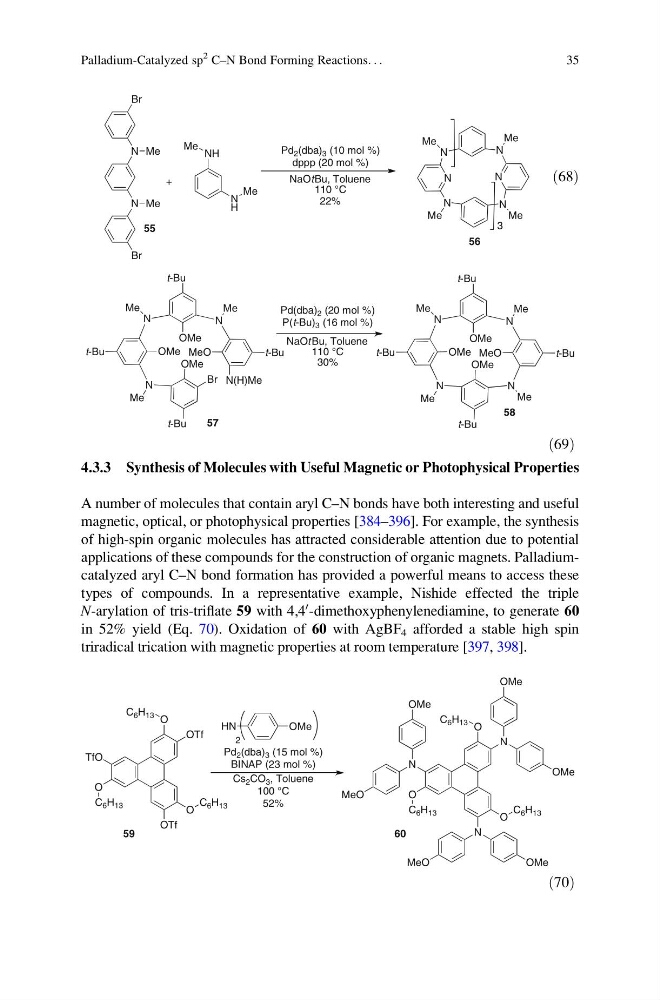
types of compounds. In a representative example, Nishide effected the triple
N-arylation of tris-triflate 59 with 4,4
0 -dimethoxyphenylenediamine, to generate 60
in 52% yield (Eq. 70). Oxidation of 60 with AgBF 4 afforded a stable high spin
triradical trication with magnetic properties at room temperature [397, 398].
O
N
O
N
O
N
OMe
MeO
MeO
OMe
OMe
OMe
C 6 H 13
C 6 H 13
C 6 H 13
60
O
O
O
TfO
C 6 H 13
C 6 H 13
C 6 H 13
OTf
OTf
Pd 2 (dba) 3 (15 mol %)
BINAP (23 mol %)
59
Cs 2 CO 3 , Toluene
100 °C
52%
OMe
HN
2
ð70Þ
Palladium-Catalyzed sp
2 C–N Bond Forming Reactions. . .
35
N
N
N
N
N
Me
Me
Me
Me
3
56
N
N
Br
Br
Me
Me
+
NH
N
H
Me
Me
22%
Pd 2 (dba) 3 (10 mol %)
dppp (20 mol %)
55
NaOtBu, Toluene
110 °C
ð68Þ
N
N
N
N
Me
Me
Me
Me
58
OMe
OMe
MeO
OMe
t-Bu
t-Bu
t-Bu
t-Bu
N
N
N
Me
Me
Me
57
OMe
OMe
MeO
OMe
t-Bu
t-Bu
t-Bu
t-Bu
Br N(H)Me
Pd(dba) 2 (20 mol %)
P(t-Bu) 3 (16 mol %)
NaOt Bu, Toluene
110 °C
30%
ð69Þ
4.3.3 Synthesis of Molecules with Useful Magnetic or Photophysical Properties
A number of molecules that contain aryl C–N bonds have both interesting and useful
magnetic, optical, or photophysical properties [384–396]. For example, the synthesis
of high-spin organic molecules has attracted considerable attention due to potential
applications of these compounds for the construction of organic magnets. Palladiumcatalyzed aryl C–N bond formation has provided a powerful means to access these
types of compounds. In a representative example, Nishide effected the triple
N-arylation of tris-triflate 59 with 4,4
0 -dimethoxyphenylenediamine, to generate 60
in 52% yield (Eq. 70). Oxidation of 60 with AgBF 4 afforded a stable high spin
triradical trication with magnetic properties at room temperature [397, 398].
O
N
O
N
O
N
OMe
MeO
MeO
OMe
OMe
OMe
C 6 H 13
C 6 H 13
C 6 H 13
60
O
O
O
TfO
C 6 H 13
C 6 H 13
C 6 H 13
OTf
OTf
Pd 2 (dba) 3 (15 mol %)
BINAP (23 mol %)
59
Cs 2 CO 3 , Toluene
100 °C
52%
OMe
HN
2
ð70Þ
Palladium-Catalyzed sp
2 C–N Bond Forming Reactions. . .
35