

The synthesis of N-arylamino stilbene derivatives that have interesting electronic
and photophysical properties has also been accomplished using Pd-catalyzed
N-arylation reactions [399–403]. For example, the coupling of E-4-bromostilbene
with p-substituted anilines afforded compounds with the general structure 61
(Eq. 71) [399]. These molecules exhibit intramolecular charge transfer characteristics
in their excited states, which may be useful in nonlinear optics, chemical sensors, and
fluorescence probe applications. A similar strategy was employed for the synthesis of
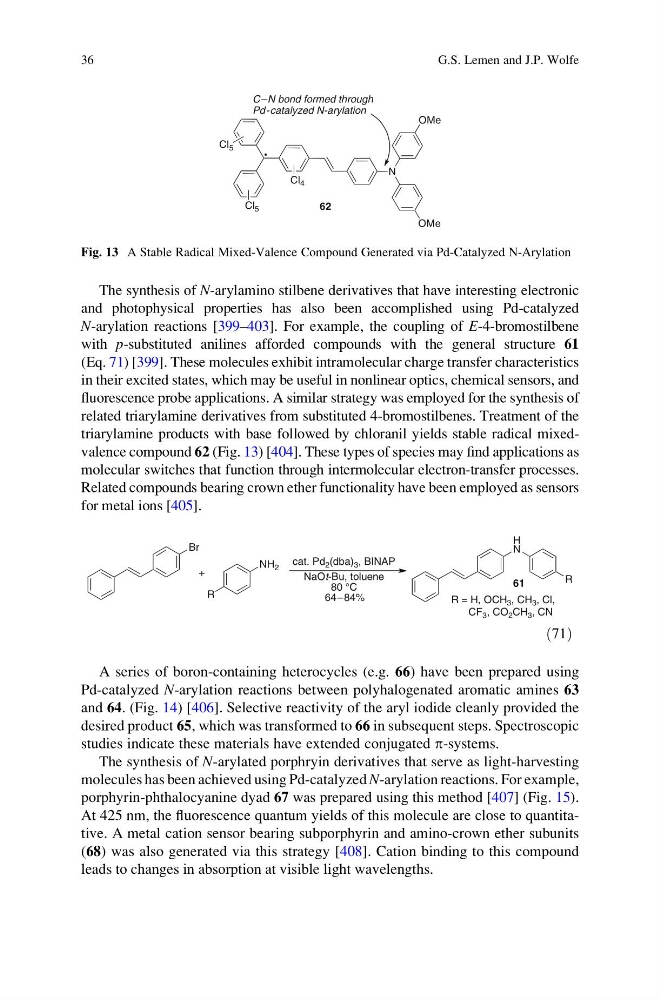
related triarylamine derivatives from substituted 4-bromostilbenes. Treatment of the
triarylamine products with base followed by chloranil yields stable radical mixedvalence compound 62 (Fig. 13) [404]. These types of species may find applications as
molecular switches that function through intermolecular electron-transfer processes.
Related compounds bearing crown ether functionality have been employed as sensors
for metal ions [405].
Br
+
NH 2
R
cat. Pd 2 (dba) 3 , BINAP
H
N
R
R = H, OCH 3 , CH 3 , Cl,
CF 3 , CO 2 CH 3 , CN
61
NaOt-Bu, toluene
80 °C
64–84%
ð71Þ
A series of boron-containing heterocycles (e.g. 66) have been prepared using
Pd-catalyzed N-arylation reactions between polyhalogenated aromatic amines 63
and 64. (Fig. 14) [406]. Selective reactivity of the aryl iodide cleanly provided the
desired product 65, which was transformed to 66 in subsequent steps. Spectroscopic
studies indicate these materials have extended conjugated p-systems.
The synthesis of N-arylated porphryin derivatives that serve as light-harvesting
molecules has been achieved using Pd-catalyzed N-arylation reactions. For example,
porphyrin-phthalocyanine dyad 67 was prepared using this method [407] (Fig. 15).
At 425 nm, the fluorescence quantum yields of this molecule are close to quantitative. A metal cation sensor bearing subporphyrin and amino-crown ether subunits
(68) was also generated via this strategy [408]. Cation binding to this compound
leads to changes in absorption at visible light wavelengths.
Cl 5
Cl 5
Cl 4
N
OMe
OMe
62
C– N bond formed through
Pd-catalyzed N-arylation
Fig. 13 A Stable Radical Mixed-Valence Compound Generated via Pd-Catalyzed N-Arylation
36
G.S. Lemen and J.P. Wolfe
and photophysical properties has also been accomplished using Pd-catalyzed
N-arylation reactions [399–403]. For example, the coupling of E-4-bromostilbene
with p-substituted anilines afforded compounds with the general structure 61
(Eq. 71) [399]. These molecules exhibit intramolecular charge transfer characteristics
in their excited states, which may be useful in nonlinear optics, chemical sensors, and
fluorescence probe applications. A similar strategy was employed for the synthesis of
related triarylamine derivatives from substituted 4-bromostilbenes. Treatment of the
triarylamine products with base followed by chloranil yields stable radical mixedvalence compound 62 (Fig. 13) [404]. These types of species may find applications as
molecular switches that function through intermolecular electron-transfer processes.
Related compounds bearing crown ether functionality have been employed as sensors
for metal ions [405].
Br
+
NH 2
R
cat. Pd 2 (dba) 3 , BINAP
H
N
R
R = H, OCH 3 , CH 3 , Cl,
CF 3 , CO 2 CH 3 , CN
61
NaOt-Bu, toluene
80 °C
64–84%
ð71Þ
A series of boron-containing heterocycles (e.g. 66) have been prepared using
Pd-catalyzed N-arylation reactions between polyhalogenated aromatic amines 63
and 64. (Fig. 14) [406]. Selective reactivity of the aryl iodide cleanly provided the
desired product 65, which was transformed to 66 in subsequent steps. Spectroscopic
studies indicate these materials have extended conjugated p-systems.
The synthesis of N-arylated porphryin derivatives that serve as light-harvesting
molecules has been achieved using Pd-catalyzed N-arylation reactions. For example,
porphyrin-phthalocyanine dyad 67 was prepared using this method [407] (Fig. 15).
At 425 nm, the fluorescence quantum yields of this molecule are close to quantitative. A metal cation sensor bearing subporphyrin and amino-crown ether subunits
(68) was also generated via this strategy [408]. Cation binding to this compound
leads to changes in absorption at visible light wavelengths.
Cl 5
Cl 5
Cl 4
N
OMe
OMe
62
C– N bond formed through
Pd-catalyzed N-arylation
Fig. 13 A Stable Radical Mixed-Valence Compound Generated via Pd-Catalyzed N-Arylation
36
G.S. Lemen and J.P. Wolfe