

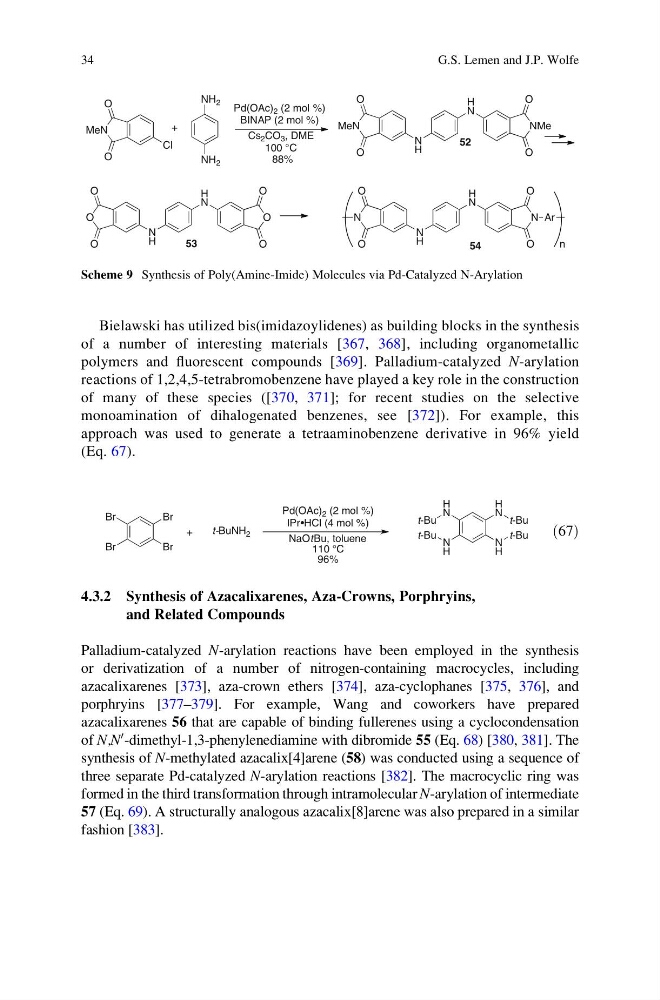
Bielawski has utilized bis(imidazoylidenes) as building blocks in the synthesis
of a number of interesting materials [367, 368], including organometallic
polymers and fluorescent compounds [369]. Palladium-catalyzed N-arylation
reactions of 1,2,4,5-tetrabromobenzene have played a key role in the construction
of many of these species ([370, 371]; for recent studies on the selective
monoamination of dihalogenated benzenes, see [372]). For example, this
approach was used to generate a tetraaminobenzene derivative in 96% yield
(Eq. 67).
Br
Br
Br
Br
+
t-BuNH 2
H
N
N
H
N
H
H
N
t-Bu
t-Bu
t-Bu
t-Bu
Pd(OAc) 2 (2 mol %)
IPr•HCl (4 mol %)
NaOtBu, toluene
110 °C
96%
ð67Þ
4.3.2 Synthesis of Azacalixarenes, Aza-Crowns, Porphryins,
and Related Compounds
Palladium-catalyzed N-arylation reactions have been employed in the synthesis
or derivatization of a number of nitrogen-containing macrocycles, including
azacalixarenes [373], aza-crown ethers [374], aza-cyclophanes [375, 376], and
porphryins [377–379]. For example, Wang and coworkers have prepared
azacalixarenes 56 that are capable of binding fullerenes using a cyclocondensation
of N,N
0 -dimethyl-1,3-phenylenediamine with dibromide 55 (Eq. 68) [380, 381]. The
synthesis of N-methylated azacalix[4]arene (58) was conducted using a sequence of
three separate Pd-catalyzed N-arylation reactions [382]. The macrocyclic ring was
formed in the third transformation through intramolecular N-arylation of intermediate
57 (Eq. 69). A structurally analogous azacalix[8]arene was also prepared in a similar
fashion [383].
N
O
O
N
H
H
N
N
O
Ar
O
n
O
O
O
N
H
H
N
O
O
O
MeN
O
O
N
H
H
N
NMe
O
O
MeN
O
O
Cl
+
NH 2
NH 2 Pd(OAc) 2 (2 mol %)
BINAP (2 mol %)
88%
52
53
54
Cs 2 CO 3 , DME
100 °C
Scheme 9 Synthesis of Poly(Amine-Imide) Molecules via Pd-Catalyzed N-Arylation
34
G.S. Lemen and J.P. Wolfe
of a number of interesting materials [367, 368], including organometallic
polymers and fluorescent compounds [369]. Palladium-catalyzed N-arylation
reactions of 1,2,4,5-tetrabromobenzene have played a key role in the construction
of many of these species ([370, 371]; for recent studies on the selective
monoamination of dihalogenated benzenes, see [372]). For example, this
approach was used to generate a tetraaminobenzene derivative in 96% yield
(Eq. 67).
Br
Br
Br
Br
+
t-BuNH 2
H
N
N
H
N
H
H
N
t-Bu
t-Bu
t-Bu
t-Bu
Pd(OAc) 2 (2 mol %)
IPr•HCl (4 mol %)
NaOtBu, toluene
110 °C
96%
ð67Þ
4.3.2 Synthesis of Azacalixarenes, Aza-Crowns, Porphryins,
and Related Compounds
Palladium-catalyzed N-arylation reactions have been employed in the synthesis
or derivatization of a number of nitrogen-containing macrocycles, including
azacalixarenes [373], aza-crown ethers [374], aza-cyclophanes [375, 376], and
porphryins [377–379]. For example, Wang and coworkers have prepared
azacalixarenes 56 that are capable of binding fullerenes using a cyclocondensation
of N,N
0 -dimethyl-1,3-phenylenediamine with dibromide 55 (Eq. 68) [380, 381]. The
synthesis of N-methylated azacalix[4]arene (58) was conducted using a sequence of
three separate Pd-catalyzed N-arylation reactions [382]. The macrocyclic ring was
formed in the third transformation through intramolecular N-arylation of intermediate
57 (Eq. 69). A structurally analogous azacalix[8]arene was also prepared in a similar
fashion [383].
N
O
O
N
H
H
N
N
O
Ar
O
n
O
O
O
N
H
H
N
O
O
O
MeN
O
O
N
H
H
N
NMe
O
O
MeN
O
O
Cl
+
NH 2
NH 2 Pd(OAc) 2 (2 mol %)
BINAP (2 mol %)
88%
52
53
54
Cs 2 CO 3 , DME
100 °C
Scheme 9 Synthesis of Poly(Amine-Imide) Molecules via Pd-Catalyzed N-Arylation
34
G.S. Lemen and J.P. Wolfe