

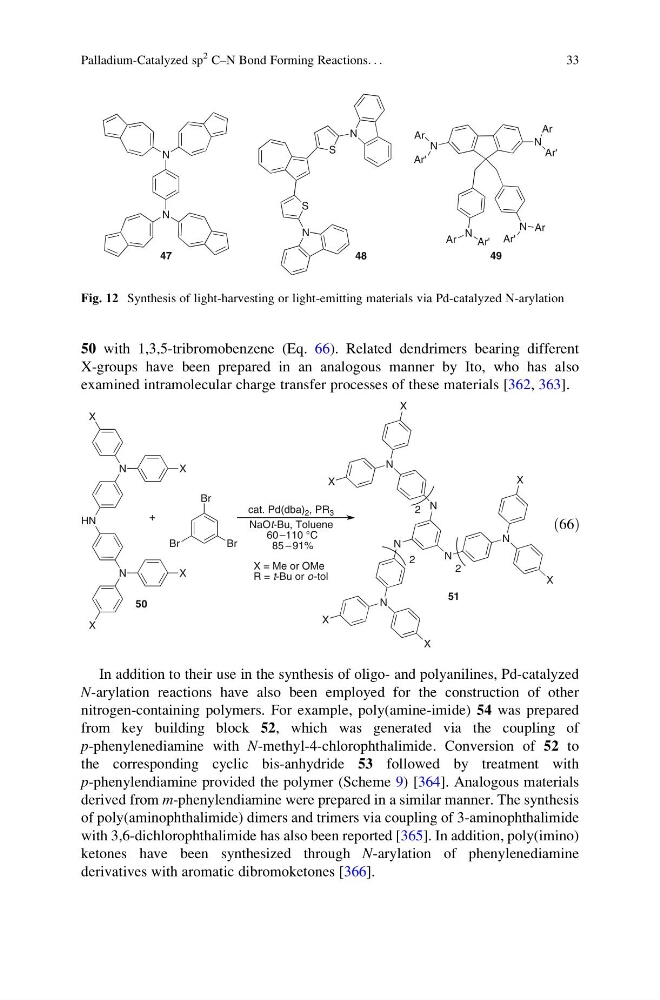
50 with 1,3,5-tribromobenzene (Eq. 66). Related dendrimers bearing different
X-groups have been prepared in an analogous manner by Ito, who has also
examined intramolecular charge transfer processes of these materials [362, 363].
HN
N
N
X
X
X
X
Br
Br
Br
+
cat. Pd(dba) 2 , PR 3
N
N
X
X
N
N
N
X
X
2
2
N
X
2
X
X = Me or OMe
R = t-Bu or o-tol
NaOt-Bu, Toluene
60 –110 °C
85 – 91%
50
51
ð66Þ
In addition to their use in the synthesis of oligo- and polyanilines, Pd-catalyzed
N-arylation reactions have also been employed for the construction of other
nitrogen-containing polymers. For example, poly(amine-imide) 54 was prepared
from key building block 52, which was generated via the coupling of
p-phenylenediamine with N-methyl-4-chlorophthalimide. Conversion of 52 to
the corresponding cyclic bis-anhydride 53 followed by treatment with
p-phenylendiamine provided the polymer (Scheme 9) [364]. Analogous materials
derived from m-phenylendiamine were prepared in a similar manner. The synthesis
of poly(aminophthalimide) dimers and trimers via coupling of 3-aminophthalimide
with 3,6-dichlorophthalimide has also been reported [365]. In addition, poly(imino)
ketones have been synthesized through N-arylation of phenylenediamine
derivatives with aromatic dibromoketones [366].
N
N
S
S
N
N
47
48
N
N
N
N
Ar
Ar'
Ar
Ar'
Ar'
Ar
Ar
Ar'
49
Fig. 12 Synthesis of light-harvesting or light-emitting materials via Pd-catalyzed N-arylation
Palladium-Catalyzed sp
2 C–N Bond Forming Reactions. . .
33
X-groups have been prepared in an analogous manner by Ito, who has also
examined intramolecular charge transfer processes of these materials [362, 363].
HN
N
N
X
X
X
X
Br
Br
Br
+
cat. Pd(dba) 2 , PR 3
N
N
X
X
N
N
N
X
X
2
2
N
X
2
X
X = Me or OMe
R = t-Bu or o-tol
NaOt-Bu, Toluene
60 –110 °C
85 – 91%
50
51
ð66Þ
In addition to their use in the synthesis of oligo- and polyanilines, Pd-catalyzed
N-arylation reactions have also been employed for the construction of other
nitrogen-containing polymers. For example, poly(amine-imide) 54 was prepared
from key building block 52, which was generated via the coupling of
p-phenylenediamine with N-methyl-4-chlorophthalimide. Conversion of 52 to
the corresponding cyclic bis-anhydride 53 followed by treatment with
p-phenylendiamine provided the polymer (Scheme 9) [364]. Analogous materials
derived from m-phenylendiamine were prepared in a similar manner. The synthesis
of poly(aminophthalimide) dimers and trimers via coupling of 3-aminophthalimide
with 3,6-dichlorophthalimide has also been reported [365]. In addition, poly(imino)
ketones have been synthesized through N-arylation of phenylenediamine
derivatives with aromatic dibromoketones [366].
N
N
S
S
N
N
47
48
N
N
N
N
Ar
Ar'
Ar
Ar'
Ar'
Ar
Ar
Ar'
49
Fig. 12 Synthesis of light-harvesting or light-emitting materials via Pd-catalyzed N-arylation
Palladium-Catalyzed sp
2 C–N Bond Forming Reactions. . .
33