

A series of triarylamines containing azulene units (Fig. 12, 47–48) have been
prepared through N-arylation of phenylendiamine or amination of dihaloarenes
[354–357]. These molecules exhibit interesting redox and optical properties and
have been employed as hole-injecting materials in organic light-emitting devices.
Triarylamines bearing fluorene cores (e.g., 49) that serve as light-harvesting materials
have also been synthesized via Pd-catalyzed N-arylation reactions [358–360].
The synthesis of oligoaniline-based dendrimers has also been carried out using
Pd-catalyzed N-arylation reactions. Early work in this area by the Hartwig group
led to the preparation of 51 (X¼Me) through sequential Pd-catalyzed N-arylation
reactions [361]. The final step in the synthesis involved the coupling of amine
H
N
R
R
n
R = H, CN, t-Bu, n-C 12 H 25 , OCH 3
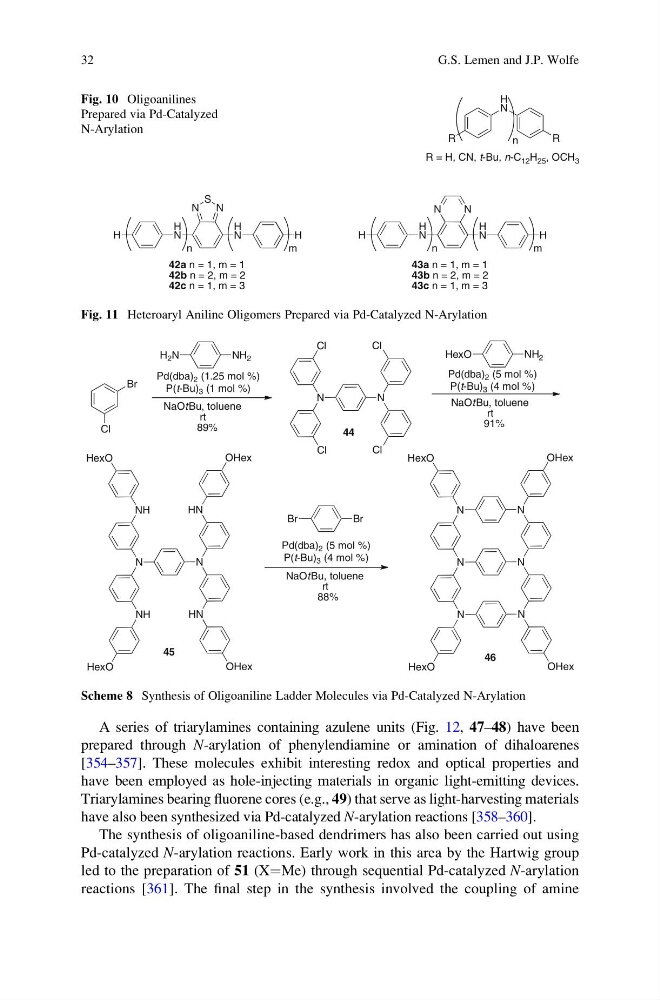
Fig. 10 Oligoanilines
Prepared via Pd-Catalyzed
N-Arylation
H
N
H
N
N
S
N
H
N
H
N
N
N
42a n = 1, m = 1
42b n = 2, m = 2
42c n = 1, m = 3
43a n = 1, m = 1
43b n = 2, m = 2
43c n = 1, m = 3
H
H
n
m
H
H
n
m
Fig. 11 Heteroaryl Aniline Oligomers Prepared via Pd-Catalyzed N-Arylation
HexO
N
N
N
OHex
N
N
N
HexO
OHex
HexO
NH
HN
N
OHex
N
NH
HN
HexO
OHex
Br
Br
NaOtBu, toluene
rt
Cl
Cl
N
N
Cl
Cl
NH 2
HexO
NaOtBu, toluene
rt
NaOtBu, toluene
rt
NH 2
H 2 N
Br
Cl
89%
44
45
91%
46
88%
Pd(dba) 2 (1.25 mol %)
P(t-Bu) 3 (1 mol %)
Pd(dba) 2 (5 mol %)
P(t-Bu) 3 (4 mol %)
Pd(dba) 2 (5 mol %)
P(t-Bu) 3 (4 mol %)
Scheme 8 Synthesis of Oligoaniline Ladder Molecules via Pd-Catalyzed N-Arylation
32
G.S. Lemen and J.P. Wolfe
prepared through N-arylation of phenylendiamine or amination of dihaloarenes
[354–357]. These molecules exhibit interesting redox and optical properties and
have been employed as hole-injecting materials in organic light-emitting devices.
Triarylamines bearing fluorene cores (e.g., 49) that serve as light-harvesting materials
have also been synthesized via Pd-catalyzed N-arylation reactions [358–360].
The synthesis of oligoaniline-based dendrimers has also been carried out using
Pd-catalyzed N-arylation reactions. Early work in this area by the Hartwig group
led to the preparation of 51 (X¼Me) through sequential Pd-catalyzed N-arylation
reactions [361]. The final step in the synthesis involved the coupling of amine
H
N
R
R
n
R = H, CN, t-Bu, n-C 12 H 25 , OCH 3
Fig. 10 Oligoanilines
Prepared via Pd-Catalyzed
N-Arylation
H
N
H
N
N
S
N
H
N
H
N
N
N
42a n = 1, m = 1
42b n = 2, m = 2
42c n = 1, m = 3
43a n = 1, m = 1
43b n = 2, m = 2
43c n = 1, m = 3
H
H
n
m
H
H
n
m
Fig. 11 Heteroaryl Aniline Oligomers Prepared via Pd-Catalyzed N-Arylation
HexO
N
N
N
OHex
N
N
N
HexO
OHex
HexO
NH
HN
N
OHex
N
NH
HN
HexO
OHex
Br
Br
NaOtBu, toluene
rt
Cl
Cl
N
N
Cl
Cl
NH 2
HexO
NaOtBu, toluene
rt
NaOtBu, toluene
rt
NH 2
H 2 N
Br
Cl
89%
44
45
91%
46
88%
Pd(dba) 2 (1.25 mol %)
P(t-Bu) 3 (1 mol %)
Pd(dba) 2 (5 mol %)
P(t-Bu) 3 (4 mol %)
Pd(dba) 2 (5 mol %)
P(t-Bu) 3 (4 mol %)
Scheme 8 Synthesis of Oligoaniline Ladder Molecules via Pd-Catalyzed N-Arylation
32
G.S. Lemen and J.P. Wolfe