

synthesis involved the coupling of 1,3- and 1,4-dibromobenzene derivatives with
piperazine or alkyl-linked bis-piperidines [340]. These early experiments, which
employed a Pd/P(o-tol) 3 catalyst system, did not afford high molecular weight
materials (M n ¼ 4.5 Â 10
–3 Da), but illustrated the potential for oligomer formation
with this method. Early work in this area by Buchwald led to the synthesis of
oligoanilines with well-defined lengths (Fig. 10) [341, 342], as well as the synthesis
of high molecular weight polyaniline through Pd-catalyzed N-arylation chemistry
[343].
Due to the utility of the methods and the significance of the materials, the use of
Pd-catalyzed N-arylation reactions in oligoaniline and polyaniline synthesis has
remained an active area of research [344, 345]. For example, in recent work
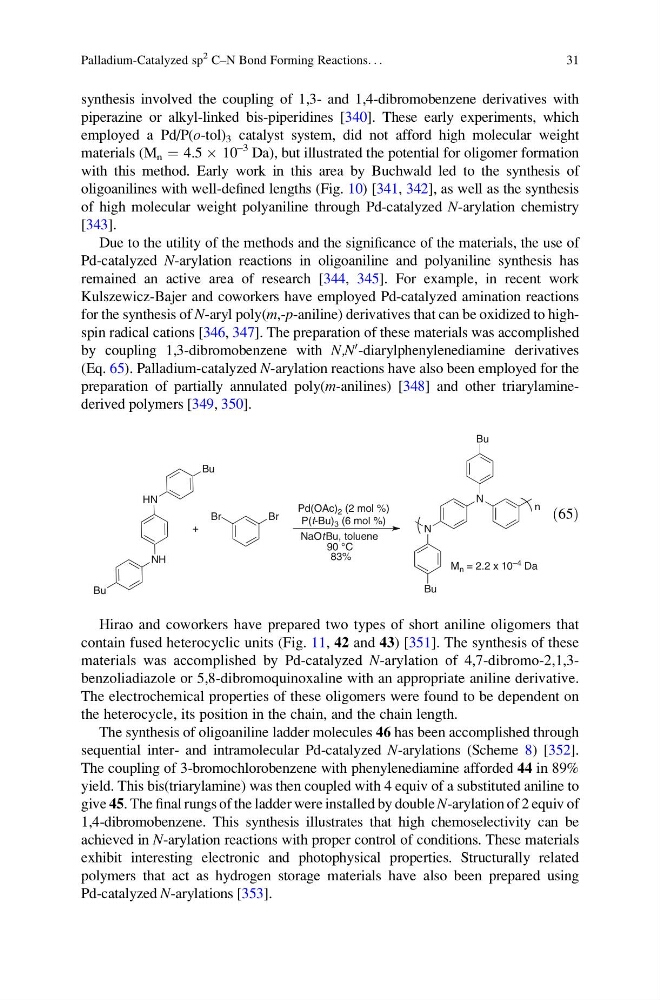
Kulszewicz-Bajer and coworkers have employed Pd-catalyzed amination reactions
for the synthesis of N-aryl poly(m,-p-aniline) derivatives that can be oxidized to highspin radical cations [346, 347]. The preparation of these materials was accomplished
by coupling 1,3-dibromobenzene with N,N
0 -diarylphenylenediamine derivatives
(Eq. 65). Palladium-catalyzed N-arylation reactions have also been employed for the
preparation of partially annulated poly(m-anilines) [348] and other triarylaminederived polymers [349, 350].
N
N
Bu
Bu
HN
NH
Bu
Bu
+
Br
Br
Pd(OAc) 2 (2 mol %)
P(t-Bu) 3 (6 mol %)
n
83%
M n = 2.2 x 10 –4 Da
NaOtBu, toluene
90 °C
ð65Þ
Hirao and coworkers have prepared two types of short aniline oligomers that
contain fused heterocyclic units (Fig. 11, 42 and 43) [351]. The synthesis of these
materials was accomplished by Pd-catalyzed N-arylation of 4,7-dibromo-2,1,3benzoliadiazole or 5,8-dibromoquinoxaline with an appropriate aniline derivative.
The electrochemical properties of these oligomers were found to be dependent on
the heterocycle, its position in the chain, and the chain length.
The synthesis of oligoaniline ladder molecules 46 has been accomplished through
sequential inter- and intramolecular Pd-catalyzed N-arylations (Scheme 8) [352].
The coupling of 3-bromochlorobenzene with phenylenediamine afforded 44 in 89%
yield. This bis(triarylamine) was then coupled with 4 equiv of a substituted aniline to
give 45. The final rungs of the ladder were installed by double N-arylation of 2 equiv of
1,4-dibromobenzene. This synthesis illustrates that high chemoselectivity can be
achieved in N-arylation reactions with proper control of conditions. These materials
exhibit interesting electronic and photophysical properties. Structurally related
polymers that act as hydrogen storage materials have also been prepared using
Pd-catalyzed N-arylations [353].
Palladium-Catalyzed sp
2 C–N Bond Forming Reactions. . .
31
piperazine or alkyl-linked bis-piperidines [340]. These early experiments, which
employed a Pd/P(o-tol) 3 catalyst system, did not afford high molecular weight
materials (M n ¼ 4.5 Â 10
–3 Da), but illustrated the potential for oligomer formation
with this method. Early work in this area by Buchwald led to the synthesis of
oligoanilines with well-defined lengths (Fig. 10) [341, 342], as well as the synthesis
of high molecular weight polyaniline through Pd-catalyzed N-arylation chemistry
[343].
Due to the utility of the methods and the significance of the materials, the use of
Pd-catalyzed N-arylation reactions in oligoaniline and polyaniline synthesis has
remained an active area of research [344, 345]. For example, in recent work
Kulszewicz-Bajer and coworkers have employed Pd-catalyzed amination reactions
for the synthesis of N-aryl poly(m,-p-aniline) derivatives that can be oxidized to highspin radical cations [346, 347]. The preparation of these materials was accomplished
by coupling 1,3-dibromobenzene with N,N
0 -diarylphenylenediamine derivatives
(Eq. 65). Palladium-catalyzed N-arylation reactions have also been employed for the
preparation of partially annulated poly(m-anilines) [348] and other triarylaminederived polymers [349, 350].
N
N
Bu
Bu
HN
NH
Bu
Bu
+
Br
Br
Pd(OAc) 2 (2 mol %)
P(t-Bu) 3 (6 mol %)
n
83%
M n = 2.2 x 10 –4 Da
NaOtBu, toluene
90 °C
ð65Þ
Hirao and coworkers have prepared two types of short aniline oligomers that
contain fused heterocyclic units (Fig. 11, 42 and 43) [351]. The synthesis of these
materials was accomplished by Pd-catalyzed N-arylation of 4,7-dibromo-2,1,3benzoliadiazole or 5,8-dibromoquinoxaline with an appropriate aniline derivative.
The electrochemical properties of these oligomers were found to be dependent on
the heterocycle, its position in the chain, and the chain length.
The synthesis of oligoaniline ladder molecules 46 has been accomplished through
sequential inter- and intramolecular Pd-catalyzed N-arylations (Scheme 8) [352].
The coupling of 3-bromochlorobenzene with phenylenediamine afforded 44 in 89%
yield. This bis(triarylamine) was then coupled with 4 equiv of a substituted aniline to
give 45. The final rungs of the ladder were installed by double N-arylation of 2 equiv of
1,4-dibromobenzene. This synthesis illustrates that high chemoselectivity can be
achieved in N-arylation reactions with proper control of conditions. These materials
exhibit interesting electronic and photophysical properties. Structurally related
polymers that act as hydrogen storage materials have also been prepared using
Pd-catalyzed N-arylations [353].
Palladium-Catalyzed sp
2 C–N Bond Forming Reactions. . .
31