

Br
NH 2
+
Ar N
H
Ar
78%, 18:1
BnO
BnO
Pd 2 (dba) 3 (1 mol %)
L (5 mol %)
L =
Me 2 N
Pt-Bu 2
NaOtBu
NH 3 , dioxane
80 ºC
ð39Þ
3.3.4 Diamines as Nucleophiles
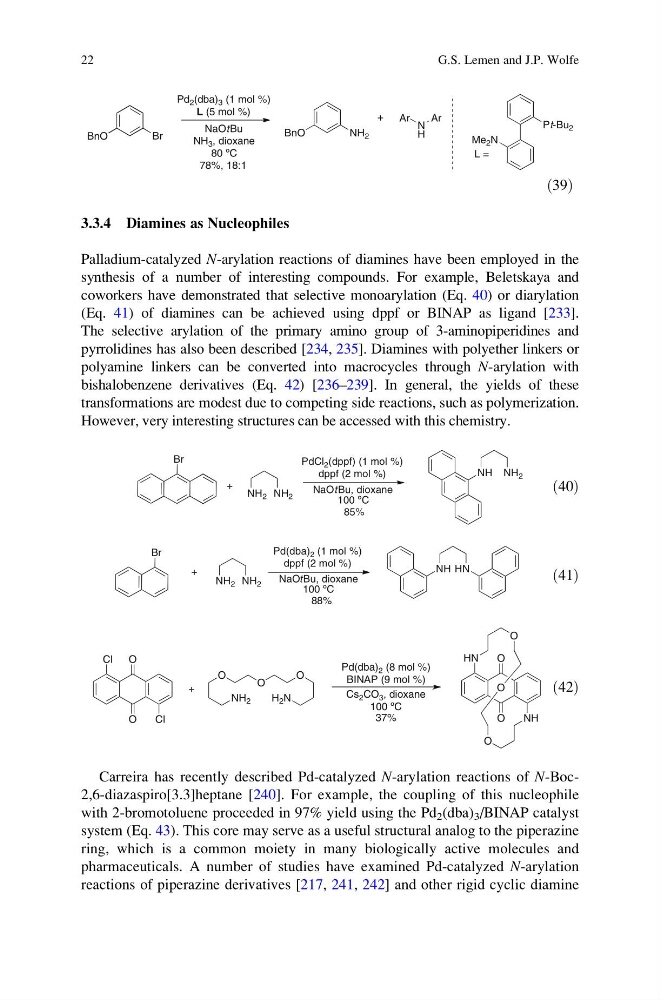
Palladium-catalyzed N-arylation reactions of diamines have been employed in the
synthesis of a number of interesting compounds. For example, Beletskaya and
coworkers have demonstrated that selective monoarylation (Eq. 40) or diarylation
(Eq. 41) of diamines can be achieved using dppf or BINAP as ligand [233].
The selective arylation of the primary amino group of 3-aminopiperidines and
pyrrolidines has also been described [234, 235]. Diamines with polyether linkers or
polyamine linkers can be converted into macrocycles through N-arylation with
bishalobenzene derivatives (Eq. 42) [236–239]. In general, the yields of these
transformations are modest due to competing side reactions, such as polymerization.
However, very interesting structures can be accessed with this chemistry.
Br
NH 2 NH 2
+
PdCl 2 (dppf) (1 mol %)
dppf (2 mol %)
NH NH 2
85%
NaOt Bu, dioxane
100 ºC
ð40Þ
Br
NH 2 NH 2
+
Pd(dba) 2 (1 mol %)
dppf (2 mol %)
NH HN
88%
NaOtBu, dioxane
100 ºC
ð41Þ
Cl
Cl
O
O
NH 2
O
O
H 2 N
O
+
Pd(dba) 2 (8 mol %)
BINAP (9 mol %)
HN
O
NH
O
O
O
O
37%
Cs 2 CO 3 , dioxane
100 ºC
ð42Þ
Carreira has recently described Pd-catalyzed N-arylation reactions of N-Boc2,6-diazaspiro[3.3]heptane [240]. For example, the coupling of this nucleophile
with 2-bromotoluene proceeded in 97% yield using the Pd 2 (dba) 3 /BINAP catalyst
system (Eq. 43). This core may serve as a useful structural analog to the piperazine
ring, which is a common moiety in many biologically active molecules and
pharmaceuticals. A number of studies have examined Pd-catalyzed N-arylation
reactions of piperazine derivatives [217, 241, 242] and other rigid cyclic diamine
22
G.S. Lemen and J.P. Wolfe
NH 2
+
Ar N
H
Ar
78%, 18:1
BnO
BnO
Pd 2 (dba) 3 (1 mol %)
L (5 mol %)
L =
Me 2 N
Pt-Bu 2
NaOtBu
NH 3 , dioxane
80 ºC
ð39Þ
3.3.4 Diamines as Nucleophiles
Palladium-catalyzed N-arylation reactions of diamines have been employed in the
synthesis of a number of interesting compounds. For example, Beletskaya and
coworkers have demonstrated that selective monoarylation (Eq. 40) or diarylation
(Eq. 41) of diamines can be achieved using dppf or BINAP as ligand [233].
The selective arylation of the primary amino group of 3-aminopiperidines and
pyrrolidines has also been described [234, 235]. Diamines with polyether linkers or
polyamine linkers can be converted into macrocycles through N-arylation with
bishalobenzene derivatives (Eq. 42) [236–239]. In general, the yields of these
transformations are modest due to competing side reactions, such as polymerization.
However, very interesting structures can be accessed with this chemistry.
Br
NH 2 NH 2
+
PdCl 2 (dppf) (1 mol %)
dppf (2 mol %)
NH NH 2
85%
NaOt Bu, dioxane
100 ºC
ð40Þ
Br
NH 2 NH 2
+
Pd(dba) 2 (1 mol %)
dppf (2 mol %)
NH HN
88%
NaOtBu, dioxane
100 ºC
ð41Þ
Cl
Cl
O
O
NH 2
O
O
H 2 N
O
+
Pd(dba) 2 (8 mol %)
BINAP (9 mol %)
HN
O
NH
O
O
O
O
37%
Cs 2 CO 3 , dioxane
100 ºC
ð42Þ
Carreira has recently described Pd-catalyzed N-arylation reactions of N-Boc2,6-diazaspiro[3.3]heptane [240]. For example, the coupling of this nucleophile
with 2-bromotoluene proceeded in 97% yield using the Pd 2 (dba) 3 /BINAP catalyst
system (Eq. 43). This core may serve as a useful structural analog to the piperazine
ring, which is a common moiety in many biologically active molecules and
pharmaceuticals. A number of studies have examined Pd-catalyzed N-arylation
reactions of piperazine derivatives [217, 241, 242] and other rigid cyclic diamine
22
G.S. Lemen and J.P. Wolfe