

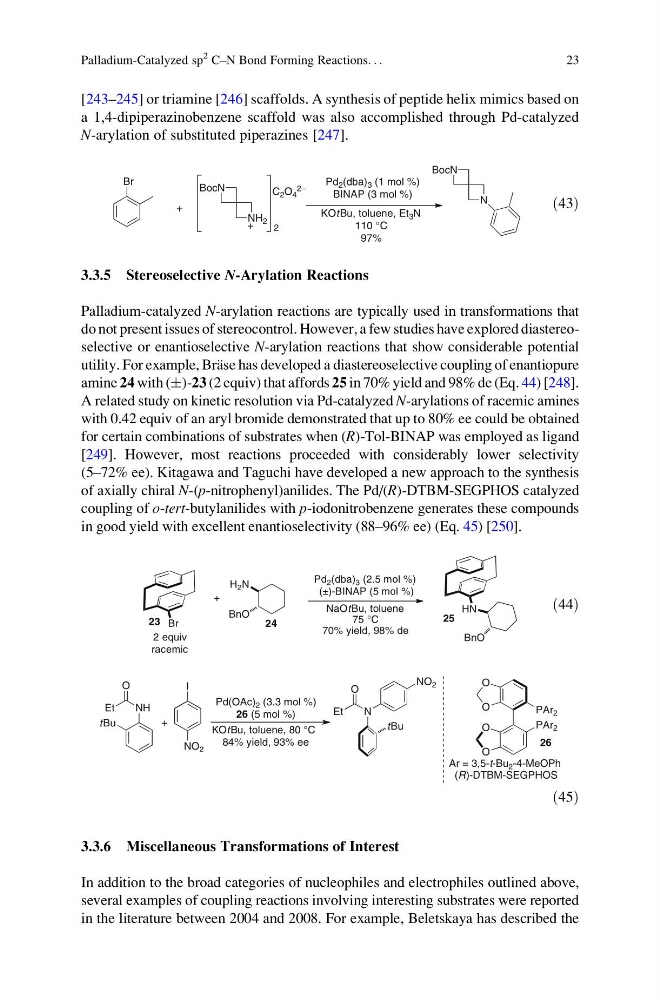
[243–245] or triamine [246] scaffolds. A synthesis of peptide helix mimics based on
a 1,4-dipiperazinobenzene scaffold was also accomplished through Pd-catalyzed
N-arylation of substituted piperazines [247].
BocN
NH 2
+
C 2 O 4
2–
BocN
N
+
Br
Pd 2 (dba) 3 (1 mol %)
BINAP (3 mol %)
KOtBu, toluene, Et 3 N
110 °C
97%
2
ð43Þ
3.3.5 Stereoselective N-Arylation Reactions
Palladium-catalyzed N-arylation reactions are typically used in transformations that
do not present issues of stereocontrol. However, a few studies have explored diastereoselective or enantioselective N-arylation reactions that show considerable potential
utility. For example, Bra ¨se has developed a diastereoselective coupling of enantiopure
amine 24 with (Æ)-23 (2 equiv) that affords 25 in 70% yield and 98% de (Eq. 44) [248].
A related study on kinetic resolution via Pd-catalyzed N-arylations of racemic amines
with 0.42 equiv of an aryl bromide demonstrated that up to 80% ee could be obtained
for certain combinations of substrates when (R)-Tol-BINAP was employed as ligand
[249]. However, most reactions proceeded with considerably lower selectivity
(5–72% ee). Kitagawa and Taguchi have developed a new approach to the synthesis
of axially chiral N-(p-nitrophenyl)anilides. The Pd/(R)-DTBM-SEGPHOS catalyzed
coupling of o-tert-butylanilides with p-iodonitrobenzene generates these compounds
in good yield with excellent enantioselectivity (88–96% ee) (Eq. 45) [250].
Br
+
HN
Pd 2 (dba) 3 (2.5 mol %)
(±)-BINAP (5 mol %)
2 equiv
NaOtBu, toluene
75 °C
70% yield, 98% de
racemic
23
H 2 N
BnO
BnO
24
25
ð44Þ
O
O
O
O
PAr 2
PAr 2
(R)-DTBM-SEGPHOS
Ar = 3,5-t-Bu 2 -4-MeOPh
tBu
NH
O
Et
+
I
NO 2
Pd(OAc) 2 (3.3 mol %)
26 (5 mol %)
KOtBu, toluene, 80 °C
84% yield, 93% ee
N
O
Et
tBu
NO 2
26
ð45Þ
3.3.6 Miscellaneous Transformations of Interest
In addition to the broad categories of nucleophiles and electrophiles outlined above,
several examples of coupling reactions involving interesting substrates were reported
in the literature between 2004 and 2008. For example, Beletskaya has described the
Palladium-Catalyzed sp
2 C–N Bond Forming Reactions. . .
23
a 1,4-dipiperazinobenzene scaffold was also accomplished through Pd-catalyzed
N-arylation of substituted piperazines [247].
BocN
NH 2
+
C 2 O 4
2–
BocN
N
+
Br
Pd 2 (dba) 3 (1 mol %)
BINAP (3 mol %)
KOtBu, toluene, Et 3 N
110 °C
97%
2
ð43Þ
3.3.5 Stereoselective N-Arylation Reactions
Palladium-catalyzed N-arylation reactions are typically used in transformations that
do not present issues of stereocontrol. However, a few studies have explored diastereoselective or enantioselective N-arylation reactions that show considerable potential
utility. For example, Bra ¨se has developed a diastereoselective coupling of enantiopure
amine 24 with (Æ)-23 (2 equiv) that affords 25 in 70% yield and 98% de (Eq. 44) [248].
A related study on kinetic resolution via Pd-catalyzed N-arylations of racemic amines
with 0.42 equiv of an aryl bromide demonstrated that up to 80% ee could be obtained
for certain combinations of substrates when (R)-Tol-BINAP was employed as ligand
[249]. However, most reactions proceeded with considerably lower selectivity
(5–72% ee). Kitagawa and Taguchi have developed a new approach to the synthesis
of axially chiral N-(p-nitrophenyl)anilides. The Pd/(R)-DTBM-SEGPHOS catalyzed
coupling of o-tert-butylanilides with p-iodonitrobenzene generates these compounds
in good yield with excellent enantioselectivity (88–96% ee) (Eq. 45) [250].
Br
+
HN
Pd 2 (dba) 3 (2.5 mol %)
(±)-BINAP (5 mol %)
2 equiv
NaOtBu, toluene
75 °C
70% yield, 98% de
racemic
23
H 2 N
BnO
BnO
24
25
ð44Þ
O
O
O
O
PAr 2
PAr 2
(R)-DTBM-SEGPHOS
Ar = 3,5-t-Bu 2 -4-MeOPh
tBu
NH
O
Et
+
I
NO 2
Pd(OAc) 2 (3.3 mol %)
26 (5 mol %)
KOtBu, toluene, 80 °C
84% yield, 93% ee
N
O
Et
tBu
NO 2
26
ð45Þ
3.3.6 Miscellaneous Transformations of Interest
In addition to the broad categories of nucleophiles and electrophiles outlined above,
several examples of coupling reactions involving interesting substrates were reported
in the literature between 2004 and 2008. For example, Beletskaya has described the
Palladium-Catalyzed sp
2 C–N Bond Forming Reactions. . .
23