

Ureas and sulfonamides have occasionally been employed as ammonia surrogates.
For example, 2-(trimethylsilyl)ethanesulfonyl amide (SES-NH 2 ) can be arylated with
electron-poor or electron-neutral aryl halides in the presence of Cs 2 CO 3 and a catalyst
composed of Pd(OAc) 2 /Xantphos (Eq. 37) [227]. The SES group can subsequently be
cleaved with CsF, which allows other sensitive functional groups to remain intact.
Beletskaya has reported use of urea as an NH 3 equivalent in the generation of
symmetrical di- and triarylamines [228, 229]. The authors found that para- and
meta-substituted aryl halides afforded triarylated products, whereas diarylated anilines
were generated when ortho substituted aryl halides were employed (Eq. 38). These
results are similar to those reported by Buchwald for N-arylation reactions of lithium
amide [230].
Cl
NO 2
+
Me 3 Si
S NH 2
O O
Pd(OAc) 2 (3 mol %)
Xantphos (6 mol %)
H
N
NO 2
SES
73%
Cs 2 CO 3 , dioxane
120 ºC
ð37Þ
Br
H 2 N
NH 2
O
+
Pd 2 (dba) 3 (2 mol %)
P(t-Bu) 3
. HBF 4 (6 mol %)
N
83%
KOtBu, dioxane
100 ºC
ð38Þ
Despite the utility of the ammonia surrogates described above, the use of protected
ammonia derivatives is inherently inefficient with respect to atom economy, and added
steps are required for deprotection. However, recent studies with highly active palladium catalysts have illustrated that ammonia can be efficiently monoarylated under
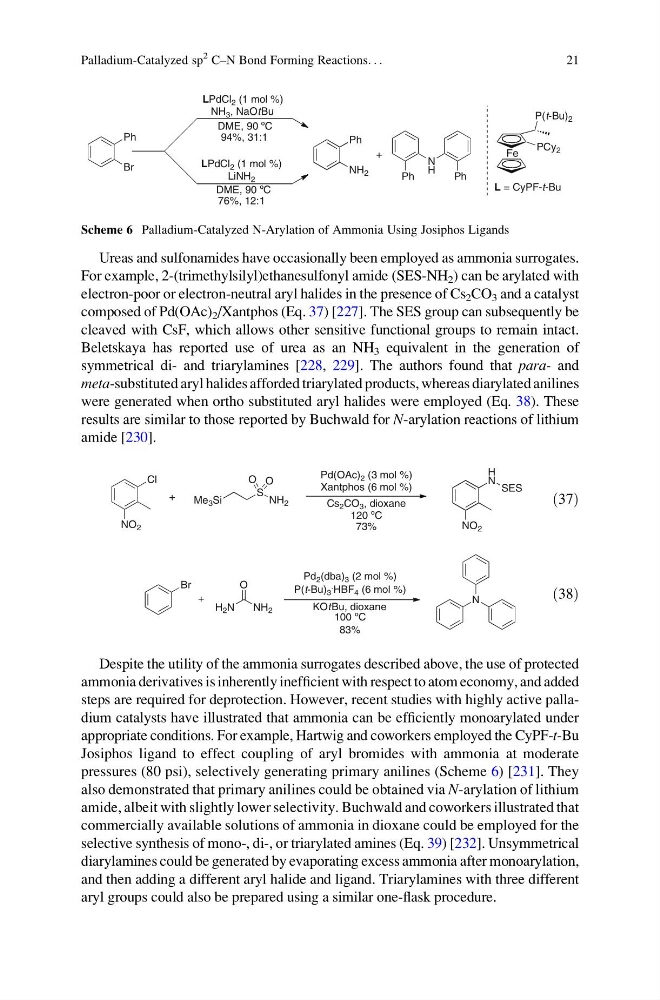
appropriate conditions. For example, Hartwig and coworkers employed the CyPF-t-Bu
Josiphos ligand to effect coupling of aryl bromides with ammonia at moderate
pressures (80 psi), selectively generating primary anilines (Scheme 6) [231]. They
also demonstrated that primary anilines could be obtained via N-arylation of lithium
amide, albeit with slightly lower selectivity. Buchwald and coworkers illustrated that
commercially available solutions of ammonia in dioxane could be employed for the
selective synthesis of mono-, di-, or triarylated amines (Eq. 39) [232]. Unsymmetrical
diarylamines could be generated by evaporating excess ammonia after monoarylation,
and then adding a different aryl halide and ligand. Triarylamines with three different
aryl groups could also be prepared using a similar one-flask procedure.
Ph
Br
LPdCl 2 (1 mol %)
NH 3 , NaOtBu
LPdCl 2 (1 mol %)
LiNH 2
Ph
NH 2
+
N
H
Ph
Ph
94%, 31:1
76%, 12:1
Fe
PCy 2
P(t-Bu) 2
L = CyPF-t-Bu
DME, 90 ºC
DME, 90 ºC
Scheme 6 Palladium-Catalyzed N-Arylation of Ammonia Using Josiphos Ligands
Palladium-Catalyzed sp
2 C–N Bond Forming Reactions. . .
21
For example, 2-(trimethylsilyl)ethanesulfonyl amide (SES-NH 2 ) can be arylated with
electron-poor or electron-neutral aryl halides in the presence of Cs 2 CO 3 and a catalyst
composed of Pd(OAc) 2 /Xantphos (Eq. 37) [227]. The SES group can subsequently be
cleaved with CsF, which allows other sensitive functional groups to remain intact.
Beletskaya has reported use of urea as an NH 3 equivalent in the generation of
symmetrical di- and triarylamines [228, 229]. The authors found that para- and
meta-substituted aryl halides afforded triarylated products, whereas diarylated anilines
were generated when ortho substituted aryl halides were employed (Eq. 38). These
results are similar to those reported by Buchwald for N-arylation reactions of lithium
amide [230].
Cl
NO 2
+
Me 3 Si
S NH 2
O O
Pd(OAc) 2 (3 mol %)
Xantphos (6 mol %)
H
N
NO 2
SES
73%
Cs 2 CO 3 , dioxane
120 ºC
ð37Þ
Br
H 2 N
NH 2
O
+
Pd 2 (dba) 3 (2 mol %)
P(t-Bu) 3
. HBF 4 (6 mol %)
N
83%
KOtBu, dioxane
100 ºC
ð38Þ
Despite the utility of the ammonia surrogates described above, the use of protected
ammonia derivatives is inherently inefficient with respect to atom economy, and added
steps are required for deprotection. However, recent studies with highly active palladium catalysts have illustrated that ammonia can be efficiently monoarylated under
appropriate conditions. For example, Hartwig and coworkers employed the CyPF-t-Bu
Josiphos ligand to effect coupling of aryl bromides with ammonia at moderate
pressures (80 psi), selectively generating primary anilines (Scheme 6) [231]. They
also demonstrated that primary anilines could be obtained via N-arylation of lithium
amide, albeit with slightly lower selectivity. Buchwald and coworkers illustrated that
commercially available solutions of ammonia in dioxane could be employed for the
selective synthesis of mono-, di-, or triarylated amines (Eq. 39) [232]. Unsymmetrical
diarylamines could be generated by evaporating excess ammonia after monoarylation,
and then adding a different aryl halide and ligand. Triarylamines with three different
aryl groups could also be prepared using a similar one-flask procedure.
Ph
Br
LPdCl 2 (1 mol %)
NH 3 , NaOtBu
LPdCl 2 (1 mol %)
LiNH 2
Ph
NH 2
+
N
H
Ph
Ph
94%, 31:1
76%, 12:1
Fe
PCy 2
P(t-Bu) 2
L = CyPF-t-Bu
DME, 90 ºC
DME, 90 ºC
Scheme 6 Palladium-Catalyzed N-Arylation of Ammonia Using Josiphos Ligands
Palladium-Catalyzed sp
2 C–N Bond Forming Reactions. . .
21