

3.3.3 Ammonia and Ammonia Surrogates
Primary anilines are useful building blocks with applications in many areas of
chemistry. As such, Pd-catalyzed N-arylation reactions of ammonia have been of
longstanding interest [221, 222]. However, coupling of ammonia has proven
challenging due to its volatility and its propensity to generate catalytically inactive
palladium complexes. Thus, a considerable number of studies have focused on the
use of ammonia surrogates in Pd-catalyzed amination reactions. These include
benzophenone imine, allylamine, benzylamine, trimethylsilylamine, lithium
hexamethyldisilylazide, and lithium amide [9, 223]. In many instances use of
these ammonia surrogates adds an additional synthetic step (protecting group
cleavage) as well as additional purification steps (after coupling and after
deprotection). The use of silyl protecting groups allows for deprotection with a
simple acidic workup. However, LiHMDS is strongly basic, which limits functional
group tolerance. In order to address this limitation, Hartwig and coworkers have
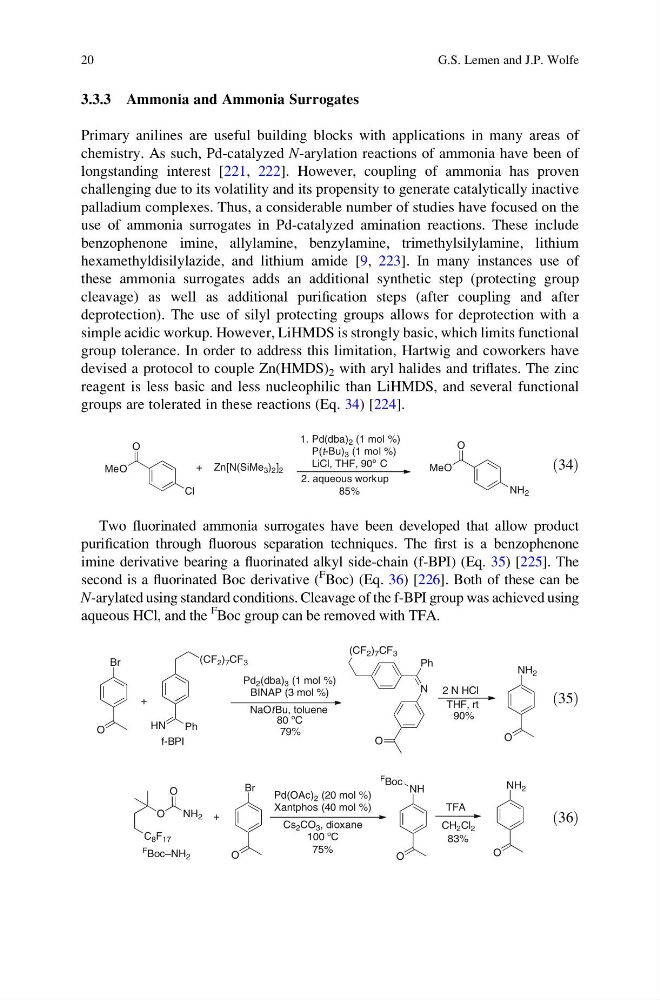
devised a protocol to couple Zn(HMDS) 2 with aryl halides and triflates. The zinc
reagent is less basic and less nucleophilic than LiHMDS, and several functional
groups are tolerated in these reactions (Eq. 34) [224].
Cl
MeO
O
+ Zn[N(SiMe 3 ) 2 ] 2
1. Pd(dba) 2 (1 mol %)
P(t-Bu) 3 (1 mol %)
LiCl, THF, 90º C
NH 2
MeO
O
85%
2. aqueous workup
ð34Þ
Two fluorinated ammonia surrogates have been developed that allow product
purification through fluorous separation techniques. The first is a benzophenone
imine derivative bearing a fluorinated alkyl side-chain (f-BPI) (Eq. 35) [225]. The
second is a fluorinated Boc derivative (
F
Boc) (Eq. 36) [226]. Both of these can be
N-arylated using standard conditions. Cleavage of the f-BPI group was achieved using
aqueous HCl, and the
F
Boc group can be removed with TFA.
O
Br
Pd 2 (dba) 3 (1 mol %)
BINAP (3 mol %)
O
N
Ph
(CF 2 ) 7 CF 3
79%
HN
Ph
(CF 2 ) 7 CF 3
f-BPI
+
NaOtBu, toluene
80 ºC
2 N HCl
O
NH 2
90%
THF, rt
ð35Þ
O
O
NH 2
C 8 F 17
O
Br
Pd(OAc) 2 (20 mol %)
Xantphos (40 mol %)
O
NH
F Boc
75%
TFA
O
NH 2
83%
CH 2 Cl 2
Cs 2 CO 3 , dioxane
100 ºC
+
F Boc NH 2
ð36Þ
20
G.S. Lemen and J.P. Wolfe
Primary anilines are useful building blocks with applications in many areas of
chemistry. As such, Pd-catalyzed N-arylation reactions of ammonia have been of
longstanding interest [221, 222]. However, coupling of ammonia has proven
challenging due to its volatility and its propensity to generate catalytically inactive
palladium complexes. Thus, a considerable number of studies have focused on the
use of ammonia surrogates in Pd-catalyzed amination reactions. These include
benzophenone imine, allylamine, benzylamine, trimethylsilylamine, lithium
hexamethyldisilylazide, and lithium amide [9, 223]. In many instances use of
these ammonia surrogates adds an additional synthetic step (protecting group
cleavage) as well as additional purification steps (after coupling and after
deprotection). The use of silyl protecting groups allows for deprotection with a
simple acidic workup. However, LiHMDS is strongly basic, which limits functional
group tolerance. In order to address this limitation, Hartwig and coworkers have
devised a protocol to couple Zn(HMDS) 2 with aryl halides and triflates. The zinc
reagent is less basic and less nucleophilic than LiHMDS, and several functional
groups are tolerated in these reactions (Eq. 34) [224].
Cl
MeO
O
+ Zn[N(SiMe 3 ) 2 ] 2
1. Pd(dba) 2 (1 mol %)
P(t-Bu) 3 (1 mol %)
LiCl, THF, 90º C
NH 2
MeO
O
85%
2. aqueous workup
ð34Þ
Two fluorinated ammonia surrogates have been developed that allow product
purification through fluorous separation techniques. The first is a benzophenone
imine derivative bearing a fluorinated alkyl side-chain (f-BPI) (Eq. 35) [225]. The
second is a fluorinated Boc derivative (
F
Boc) (Eq. 36) [226]. Both of these can be
N-arylated using standard conditions. Cleavage of the f-BPI group was achieved using
aqueous HCl, and the
F
Boc group can be removed with TFA.
O
Br
Pd 2 (dba) 3 (1 mol %)
BINAP (3 mol %)
O
N
Ph
(CF 2 ) 7 CF 3
79%
HN
Ph
(CF 2 ) 7 CF 3
f-BPI
+
NaOtBu, toluene
80 ºC
2 N HCl
O
NH 2
90%
THF, rt
ð35Þ
O
O
NH 2
C 8 F 17
O
Br
Pd(OAc) 2 (20 mol %)
Xantphos (40 mol %)
O
NH
F Boc
75%
TFA
O
NH 2
83%
CH 2 Cl 2
Cs 2 CO 3 , dioxane
100 ºC
+
F Boc NH 2
ð36Þ
20
G.S. Lemen and J.P. Wolfe