

It is worthy of note that in addition to triolborates and trifluoroborates [279],
boronic esters and the triphenylboroxine have also been used in place of arylboronic
acids. The performances of the systems, first described by Chan and Lam, were
however not overwhelming and the copper was used in stoichiometric amount
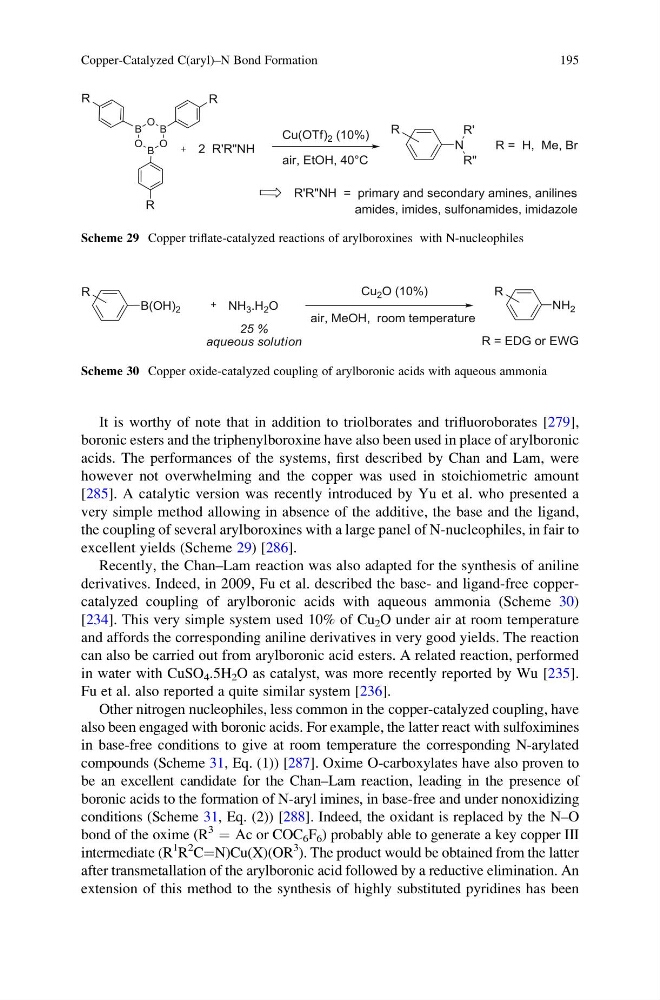
[285]. A catalytic version was recently introduced by Yu et al. who presented a
very simple method allowing in absence of the additive, the base and the ligand,
the coupling of several arylboroxines with a large panel of N-nucleophiles, in fair to
excellent yields (Scheme 29) [286].
Recently, the Chan–Lam reaction was also adapted for the synthesis of aniline
derivatives. Indeed, in 2009, Fu et al. described the base- and ligand-free coppercatalyzed coupling of arylboronic acids with aqueous ammonia (Scheme 30)
[234]. This very simple system used 10% of Cu 2 O under air at room temperature
and affords the corresponding aniline derivatives in very good yields. The reaction
can also be carried out from arylboronic acid esters. A related reaction, performed
in water with CuSO 4 .5H 2 O as catalyst, was more recently reported by Wu [235].
Fu et al. also reported a quite similar system [236].
Other nitrogen nucleophiles, less common in the copper-catalyzed coupling, have
also been engaged with boronic acids. For example, the latter react with sulfoximines
in base-free conditions to give at room temperature the corresponding N-arylated
compounds (Scheme 31, Eq. (1)) [287]. Oxime O-carboxylates have also proven to
be an excellent candidate for the Chan–Lam reaction, leading in the presence of
boronic acids to the formation of N-aryl imines, in base-free and under nonoxidizing
conditions (Scheme 31, Eq. (2)) [288]. Indeed, the oxidant is replaced by the N–O
bond of the oxime (R
3
¼ Ac or COC 6 F 6 ) probably able to generate a key copper III
intermediate (R
1
R
2
C¼N)Cu(X)(OR
3
). The product would be obtained from the latter
after transmetallation of the arylboronic acid followed by a reductive elimination. An
extension of this method to the synthesis of highly substituted pyridines has been
Scheme 29 Copper triflate-catalyzed reactions of arylboroxines with N-nucleophiles
Scheme 30 Copper oxide-catalyzed coupling of arylboronic acids with aqueous ammonia
Copper-Catalyzed C(aryl)–N Bond Formation
195
boronic esters and the triphenylboroxine have also been used in place of arylboronic
acids. The performances of the systems, first described by Chan and Lam, were
however not overwhelming and the copper was used in stoichiometric amount
[285]. A catalytic version was recently introduced by Yu et al. who presented a
very simple method allowing in absence of the additive, the base and the ligand,
the coupling of several arylboroxines with a large panel of N-nucleophiles, in fair to
excellent yields (Scheme 29) [286].
Recently, the Chan–Lam reaction was also adapted for the synthesis of aniline
derivatives. Indeed, in 2009, Fu et al. described the base- and ligand-free coppercatalyzed coupling of arylboronic acids with aqueous ammonia (Scheme 30)
[234]. This very simple system used 10% of Cu 2 O under air at room temperature
and affords the corresponding aniline derivatives in very good yields. The reaction
can also be carried out from arylboronic acid esters. A related reaction, performed
in water with CuSO 4 .5H 2 O as catalyst, was more recently reported by Wu [235].
Fu et al. also reported a quite similar system [236].
Other nitrogen nucleophiles, less common in the copper-catalyzed coupling, have
also been engaged with boronic acids. For example, the latter react with sulfoximines
in base-free conditions to give at room temperature the corresponding N-arylated
compounds (Scheme 31, Eq. (1)) [287]. Oxime O-carboxylates have also proven to
be an excellent candidate for the Chan–Lam reaction, leading in the presence of
boronic acids to the formation of N-aryl imines, in base-free and under nonoxidizing
conditions (Scheme 31, Eq. (2)) [288]. Indeed, the oxidant is replaced by the N–O
bond of the oxime (R
3
¼ Ac or COC 6 F 6 ) probably able to generate a key copper III
intermediate (R
1
R
2
C¼N)Cu(X)(OR
3
). The product would be obtained from the latter
after transmetallation of the arylboronic acid followed by a reductive elimination. An
extension of this method to the synthesis of highly substituted pyridines has been
Scheme 29 Copper triflate-catalyzed reactions of arylboroxines with N-nucleophiles
Scheme 30 Copper oxide-catalyzed coupling of arylboronic acids with aqueous ammonia
Copper-Catalyzed C(aryl)–N Bond Formation
195