

After these first reports on the catalytic version of the Chan–Lam reaction, a lot
of other research groups presented efficient systems for the coupling of a wide range
of nitrogen nucleophiles. Even if it is difficult to choose amongst them, we will
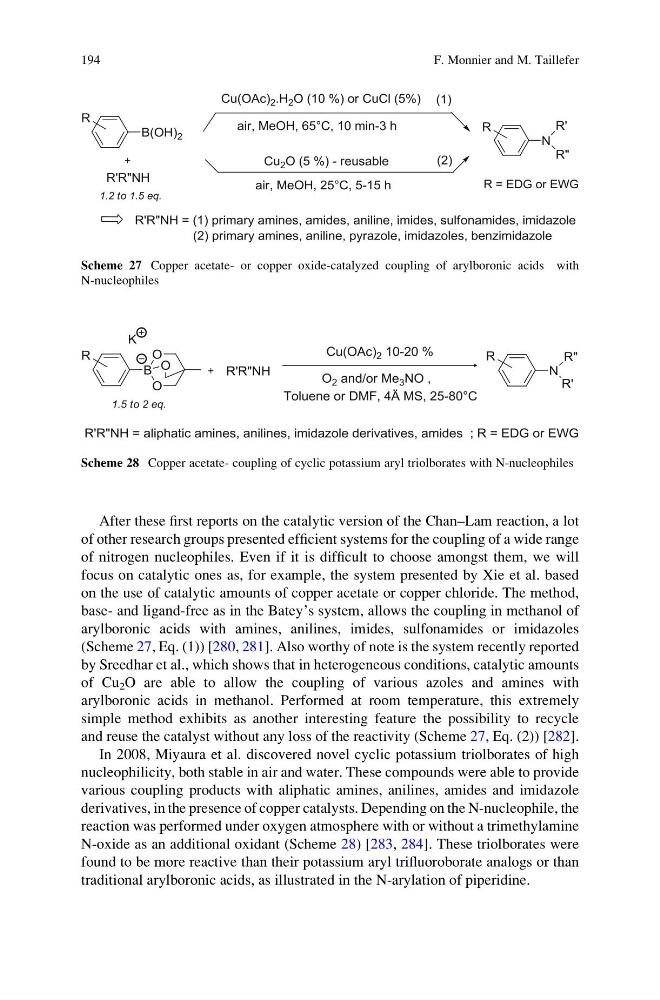
focus on catalytic ones as, for example, the system presented by Xie et al. based
on the use of catalytic amounts of copper acetate or copper chloride. The method,
base- and ligand-free as in the Batey’s system, allows the coupling in methanol of
arylboronic acids with amines, anilines, imides, sulfonamides or imidazoles
(Scheme 27, Eq. (1)) [280, 281]. Also worthy of note is the system recently reported
by Sreedhar et al., which shows that in heterogeneous conditions, catalytic amounts
of Cu 2 O are able to allow the coupling of various azoles and amines with
arylboronic acids in methanol. Performed at room temperature, this extremely
simple method exhibits as another interesting feature the possibility to recycle
and reuse the catalyst without any loss of the reactivity (Scheme 27, Eq. (2)) [282].
In 2008, Miyaura et al. discovered novel cyclic potassium triolborates of high
nucleophilicity, both stable in air and water. These compounds were able to provide
various coupling products with aliphatic amines, anilines, amides and imidazole
derivatives, in the presence of copper catalysts. Depending on the N-nucleophile, the
reaction was performed under oxygen atmosphere with or without a trimethylamine
N-oxide as an additional oxidant (Scheme 28) [283, 284]. These triolborates were
found to be more reactive than their potassium aryl trifluoroborate analogs or than
traditional arylboronic acids, as illustrated in the N-arylation of piperidine.
Scheme 27 Copper acetate- or copper oxide-catalyzed coupling of arylboronic acids with
N-nucleophiles
Scheme 28 Copper acetate- coupling of cyclic potassium aryl triolborates with N-nucleophiles
194
F. Monnier and M. Taillefer
of other research groups presented efficient systems for the coupling of a wide range
of nitrogen nucleophiles. Even if it is difficult to choose amongst them, we will
focus on catalytic ones as, for example, the system presented by Xie et al. based
on the use of catalytic amounts of copper acetate or copper chloride. The method,
base- and ligand-free as in the Batey’s system, allows the coupling in methanol of
arylboronic acids with amines, anilines, imides, sulfonamides or imidazoles
(Scheme 27, Eq. (1)) [280, 281]. Also worthy of note is the system recently reported
by Sreedhar et al., which shows that in heterogeneous conditions, catalytic amounts
of Cu 2 O are able to allow the coupling of various azoles and amines with
arylboronic acids in methanol. Performed at room temperature, this extremely
simple method exhibits as another interesting feature the possibility to recycle
and reuse the catalyst without any loss of the reactivity (Scheme 27, Eq. (2)) [282].
In 2008, Miyaura et al. discovered novel cyclic potassium triolborates of high
nucleophilicity, both stable in air and water. These compounds were able to provide
various coupling products with aliphatic amines, anilines, amides and imidazole
derivatives, in the presence of copper catalysts. Depending on the N-nucleophile, the
reaction was performed under oxygen atmosphere with or without a trimethylamine
N-oxide as an additional oxidant (Scheme 28) [283, 284]. These triolborates were
found to be more reactive than their potassium aryl trifluoroborate analogs or than
traditional arylboronic acids, as illustrated in the N-arylation of piperidine.
Scheme 27 Copper acetate- or copper oxide-catalyzed coupling of arylboronic acids with
N-nucleophiles
Scheme 28 Copper acetate- coupling of cyclic potassium aryl triolborates with N-nucleophiles
194
F. Monnier and M. Taillefer