

sieves increases the yields of coupling products, avoiding the formation of side
products such as phenols or diaryl ethers arising from the arylation of water. The
latter would be generated through the triarylboroxine formation from the
corresponding arylboronic acid [267, 268, 274, 275].
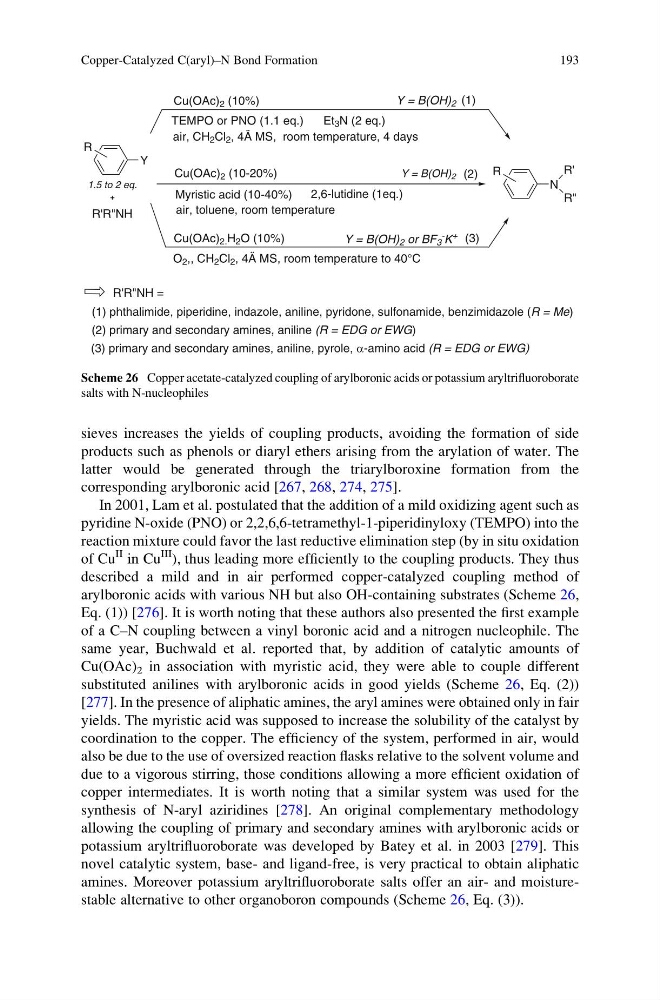
In 2001, Lam et al. postulated that the addition of a mild oxidizing agent such as
pyridine N-oxide (PNO) or 2,2,6,6-tetramethyl-1-piperidinyloxy (TEMPO) into the
reaction mixture could favor the last reductive elimination step (by in situ oxidation
of Cu
II in Cu
III ), thus leading more efficiently to the coupling products. They thus
described a mild and in air performed copper-catalyzed coupling method of
arylboronic acids with various NH but also OH-containing substrates (Scheme 26,
Eq. (1)) [276]. It is worth noting that these authors also presented the first example
of a C–N coupling between a vinyl boronic acid and a nitrogen nucleophile. The
same year, Buchwald et al. reported that, by addition of catalytic amounts of
Cu(OAc) 2 in association with myristic acid, they were able to couple different
substituted anilines with arylboronic acids in good yields (Scheme 26, Eq. (2))
[277]. In the presence of aliphatic amines, the aryl amines were obtained only in fair
yields. The myristic acid was supposed to increase the solubility of the catalyst by
coordination to the copper. The efficiency of the system, performed in air, would
also be due to the use of oversized reaction flasks relative to the solvent volume and
due to a vigorous stirring, those conditions allowing a more efficient oxidation of
copper intermediates. It is worth noting that a similar system was used for the
synthesis of N-aryl aziridines [278]. An original complementary methodology
allowing the coupling of primary and secondary amines with arylboronic acids or
potassium aryltrifluoroborate was developed by Batey et al. in 2003 [279]. This
novel catalytic system, base- and ligand-free, is very practical to obtain aliphatic
amines. Moreover potassium aryltrifluoroborate salts offer an air- and moisturestable alternative to other organoboron compounds (Scheme 26, Eq. (3)).
Cu(OAc) 2. H 2 O (10%)
R'R"NH
Y = B(OH) 2 or BF 3
-
K
+
Cu(OAc) 2 (10-20%)
Y
R
R
2,6-lutidine (1eq.)
N
R"
Cu(OAc) 2 (10%)
TEMPO or PNO (1.1 eq.)
O 2 ,, CH 2 Cl 2 , 4Ä MS, room temperature to 40°C
Y = B(OH) 2
air, toluene, room temperature
air, CH 2 Cl 2 , 4Ä MS, room temperature, 4 days
Et 3 N (2 eq.)
R'
Y = B(OH) 2
(1)
(3)
(2)
Myristic acid (10-40%)
R'R"NH =
(2) primary and secondary amines, aniline (R = EDG or EWG)
(3) primary and secondary amines, aniline, pyrole, α-amino acid (R = EDG or EWG)
(1) phthalimide, piperidine, indazole, aniline, pyridone, sulfonamide, benzimidazole (R = Me)
1.5 to 2 eq.
Scheme 26 Copper acetate-catalyzed coupling of arylboronic acids or potassium aryltrifluoroborate
salts with N-nucleophiles
Copper-Catalyzed C(aryl)–N Bond Formation
193
products such as phenols or diaryl ethers arising from the arylation of water. The
latter would be generated through the triarylboroxine formation from the
corresponding arylboronic acid [267, 268, 274, 275].
In 2001, Lam et al. postulated that the addition of a mild oxidizing agent such as
pyridine N-oxide (PNO) or 2,2,6,6-tetramethyl-1-piperidinyloxy (TEMPO) into the
reaction mixture could favor the last reductive elimination step (by in situ oxidation
of Cu
II in Cu
III ), thus leading more efficiently to the coupling products. They thus
described a mild and in air performed copper-catalyzed coupling method of
arylboronic acids with various NH but also OH-containing substrates (Scheme 26,
Eq. (1)) [276]. It is worth noting that these authors also presented the first example
of a C–N coupling between a vinyl boronic acid and a nitrogen nucleophile. The
same year, Buchwald et al. reported that, by addition of catalytic amounts of
Cu(OAc) 2 in association with myristic acid, they were able to couple different
substituted anilines with arylboronic acids in good yields (Scheme 26, Eq. (2))
[277]. In the presence of aliphatic amines, the aryl amines were obtained only in fair
yields. The myristic acid was supposed to increase the solubility of the catalyst by
coordination to the copper. The efficiency of the system, performed in air, would
also be due to the use of oversized reaction flasks relative to the solvent volume and
due to a vigorous stirring, those conditions allowing a more efficient oxidation of
copper intermediates. It is worth noting that a similar system was used for the
synthesis of N-aryl aziridines [278]. An original complementary methodology
allowing the coupling of primary and secondary amines with arylboronic acids or
potassium aryltrifluoroborate was developed by Batey et al. in 2003 [279]. This
novel catalytic system, base- and ligand-free, is very practical to obtain aliphatic
amines. Moreover potassium aryltrifluoroborate salts offer an air- and moisturestable alternative to other organoboron compounds (Scheme 26, Eq. (3)).
Cu(OAc) 2. H 2 O (10%)
R'R"NH
Y = B(OH) 2 or BF 3
-
K
+
Cu(OAc) 2 (10-20%)
Y
R
R
2,6-lutidine (1eq.)
N
R"
Cu(OAc) 2 (10%)
TEMPO or PNO (1.1 eq.)
O 2 ,, CH 2 Cl 2 , 4Ä MS, room temperature to 40°C
Y = B(OH) 2
air, toluene, room temperature
air, CH 2 Cl 2 , 4Ä MS, room temperature, 4 days
Et 3 N (2 eq.)
R'
Y = B(OH) 2
(1)
(3)
(2)
Myristic acid (10-40%)
R'R"NH =
(2) primary and secondary amines, aniline (R = EDG or EWG)
(3) primary and secondary amines, aniline, pyrole, α-amino acid (R = EDG or EWG)
(1) phthalimide, piperidine, indazole, aniline, pyridone, sulfonamide, benzimidazole (R = Me)
1.5 to 2 eq.
Scheme 26 Copper acetate-catalyzed coupling of arylboronic acids or potassium aryltrifluoroborate
salts with N-nucleophiles
Copper-Catalyzed C(aryl)–N Bond Formation
193