

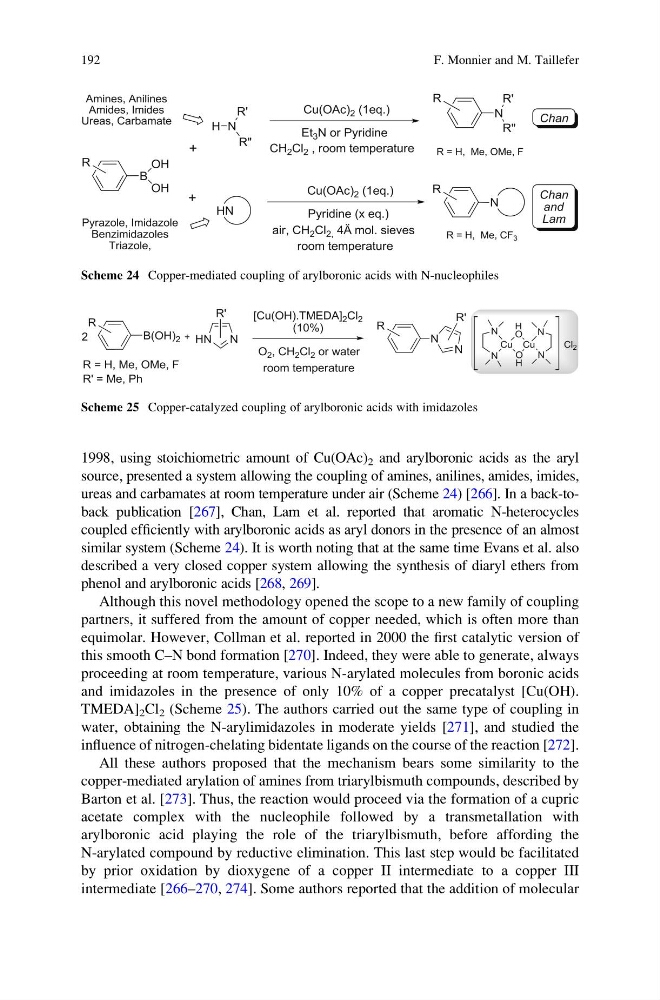
1998, using stoichiometric amount of Cu(OAc) 2 and arylboronic acids as the aryl
source, presented a system allowing the coupling of amines, anilines, amides, imides,
ureas and carbamates at room temperature under air (Scheme 24) [266]. In a back-toback publication [267], Chan, Lam et al. reported that aromatic N-heterocycles
coupled efficiently with arylboronic acids as aryl donors in the presence of an almost
similar system (Scheme 24). It is worth noting that at the same time Evans et al. also
described a very closed copper system allowing the synthesis of diaryl ethers from
phenol and arylboronic acids [268, 269].
Although this novel methodology opened the scope to a new family of coupling
partners, it suffered from the amount of copper needed, which is often more than
equimolar. However, Collman et al. reported in 2000 the first catalytic version of
this smooth C–N bond formation [270]. Indeed, they were able to generate, always
proceeding at room temperature, various N-arylated molecules from boronic acids
and imidazoles in the presence of only 10% of a copper precatalyst [Cu(OH).
TMEDA] 2 Cl 2 (Scheme 25). The authors carried out the same type of coupling in
water, obtaining the N-arylimidazoles in moderate yields [271], and studied the
influence of nitrogen-chelating bidentate ligands on the course of the reaction [272].
All these authors proposed that the mechanism bears some similarity to the
copper-mediated arylation of amines from triarylbismuth compounds, described by
Barton et al. [273]. Thus, the reaction would proceed via the formation of a cupric
acetate complex with the nucleophile followed by a transmetallation with
arylboronic acid playing the role of the triarylbismuth, before affording the
N-arylated compound by reductive elimination. This last step would be facilitated
by prior oxidation by dioxygene of a copper II intermediate to a copper III
intermediate [266–270, 274]. Some authors reported that the addition of molecular
Scheme 25 Copper-catalyzed coupling of arylboronic acids with imidazoles
Scheme 24 Copper-mediated coupling of arylboronic acids with N-nucleophiles
192
F. Monnier and M. Taillefer
source, presented a system allowing the coupling of amines, anilines, amides, imides,
ureas and carbamates at room temperature under air (Scheme 24) [266]. In a back-toback publication [267], Chan, Lam et al. reported that aromatic N-heterocycles
coupled efficiently with arylboronic acids as aryl donors in the presence of an almost
similar system (Scheme 24). It is worth noting that at the same time Evans et al. also
described a very closed copper system allowing the synthesis of diaryl ethers from
phenol and arylboronic acids [268, 269].
Although this novel methodology opened the scope to a new family of coupling
partners, it suffered from the amount of copper needed, which is often more than
equimolar. However, Collman et al. reported in 2000 the first catalytic version of
this smooth C–N bond formation [270]. Indeed, they were able to generate, always
proceeding at room temperature, various N-arylated molecules from boronic acids
and imidazoles in the presence of only 10% of a copper precatalyst [Cu(OH).
TMEDA] 2 Cl 2 (Scheme 25). The authors carried out the same type of coupling in
water, obtaining the N-arylimidazoles in moderate yields [271], and studied the
influence of nitrogen-chelating bidentate ligands on the course of the reaction [272].
All these authors proposed that the mechanism bears some similarity to the
copper-mediated arylation of amines from triarylbismuth compounds, described by
Barton et al. [273]. Thus, the reaction would proceed via the formation of a cupric
acetate complex with the nucleophile followed by a transmetallation with
arylboronic acid playing the role of the triarylbismuth, before affording the
N-arylated compound by reductive elimination. This last step would be facilitated
by prior oxidation by dioxygene of a copper II intermediate to a copper III
intermediate [266–270, 274]. Some authors reported that the addition of molecular
Scheme 25 Copper-catalyzed coupling of arylboronic acids with imidazoles
Scheme 24 Copper-mediated coupling of arylboronic acids with N-nucleophiles
192
F. Monnier and M. Taillefer