

hydroxylamines which are valuable intermediates, for example, in nitrone and
aziridine synthesis. The products could be N- or O-deprotected thus affording the
further possibility of a selective N- or O-functionalization (Scheme 21).
2.4.3 Coupling Reactions of Aryl Halides with Nitrite Salts
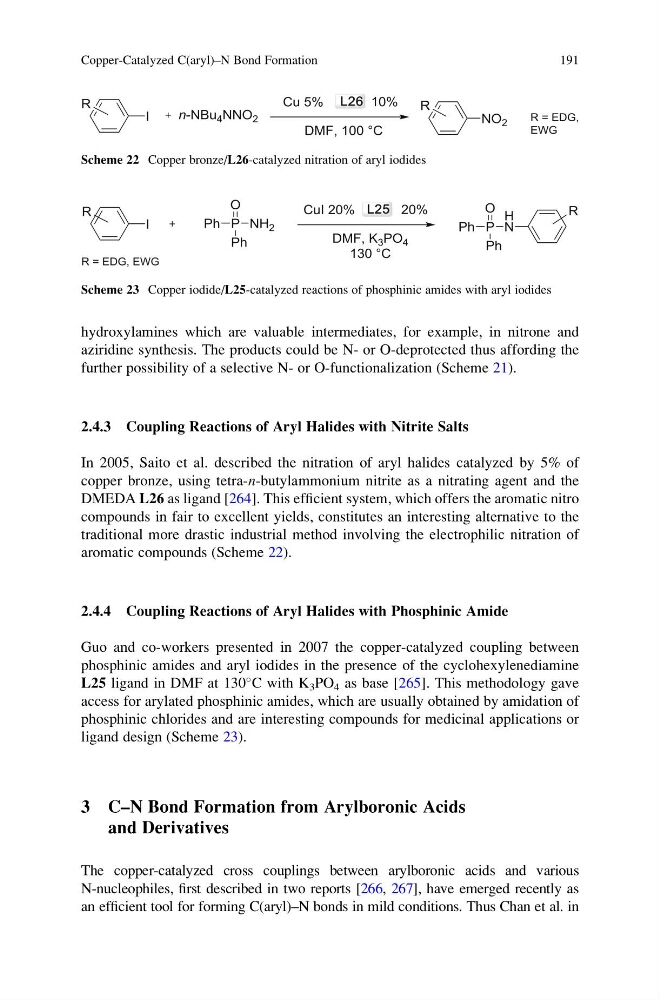
In 2005, Saito et al. described the nitration of aryl halides catalyzed by 5% of
copper bronze, using tetra-n-butylammonium nitrite as a nitrating agent and the
DMEDA L26 as ligand [264]. This efficient system, which offers the aromatic nitro
compounds in fair to excellent yields, constitutes an interesting alternative to the
traditional more drastic industrial method involving the electrophilic nitration of
aromatic compounds (Scheme 22).
2.4.4 Coupling Reactions of Aryl Halides with Phosphinic Amide
Guo and co-workers presented in 2007 the copper-catalyzed coupling between
phosphinic amides and aryl iodides in the presence of the cyclohexylenediamine
L25 ligand in DMF at 130
C with K 3 PO 4 as base [265]. This methodology gave
access for arylated phosphinic amides, which are usually obtained by amidation of
phosphinic chlorides and are interesting compounds for medicinal applications or
ligand design (Scheme 23).
3 C–N Bond Formation from Arylboronic Acids
and Derivatives
The copper-catalyzed cross couplings between arylboronic acids and various
N-nucleophiles, first described in two reports [266, 267], have emerged recently as
an efficient tool for forming C(aryl)–N bonds in mild conditions. Thus Chan et al. in
Scheme 22 Copper bronze/L26-catalyzed nitration of aryl iodides
Scheme 23 Copper iodide/L25-catalyzed reactions of phosphinic amides with aryl iodides
Copper-Catalyzed C(aryl)–N Bond Formation
191
aziridine synthesis. The products could be N- or O-deprotected thus affording the
further possibility of a selective N- or O-functionalization (Scheme 21).
2.4.3 Coupling Reactions of Aryl Halides with Nitrite Salts
In 2005, Saito et al. described the nitration of aryl halides catalyzed by 5% of
copper bronze, using tetra-n-butylammonium nitrite as a nitrating agent and the
DMEDA L26 as ligand [264]. This efficient system, which offers the aromatic nitro
compounds in fair to excellent yields, constitutes an interesting alternative to the
traditional more drastic industrial method involving the electrophilic nitration of
aromatic compounds (Scheme 22).
2.4.4 Coupling Reactions of Aryl Halides with Phosphinic Amide
Guo and co-workers presented in 2007 the copper-catalyzed coupling between
phosphinic amides and aryl iodides in the presence of the cyclohexylenediamine
L25 ligand in DMF at 130
C with K 3 PO 4 as base [265]. This methodology gave
access for arylated phosphinic amides, which are usually obtained by amidation of
phosphinic chlorides and are interesting compounds for medicinal applications or
ligand design (Scheme 23).
3 C–N Bond Formation from Arylboronic Acids
and Derivatives
The copper-catalyzed cross couplings between arylboronic acids and various
N-nucleophiles, first described in two reports [266, 267], have emerged recently as
an efficient tool for forming C(aryl)–N bonds in mild conditions. Thus Chan et al. in
Scheme 22 Copper bronze/L26-catalyzed nitration of aryl iodides
Scheme 23 Copper iodide/L25-catalyzed reactions of phosphinic amides with aryl iodides
Copper-Catalyzed C(aryl)–N Bond Formation
191