

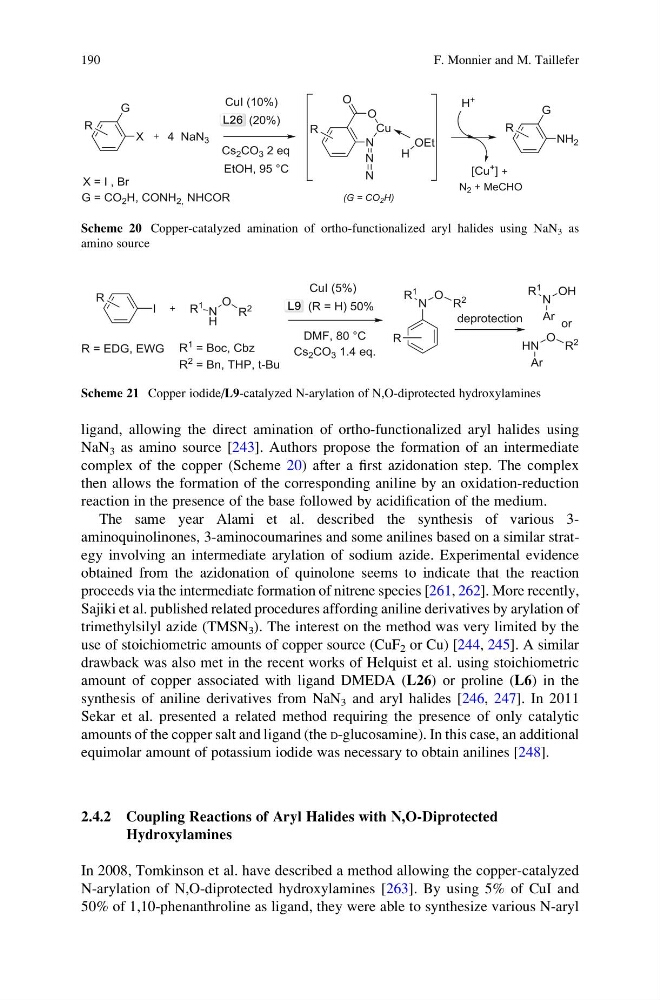
ligand, allowing the direct amination of ortho-functionalized aryl halides using
NaN 3 as amino source [243]. Authors propose the formation of an intermediate
complex of the copper (Scheme 20) after a first azidonation step. The complex
then allows the formation of the corresponding aniline by an oxidation-reduction
reaction in the presence of the base followed by acidification of the medium.
The same year Alami et al. described the synthesis of various 3aminoquinolinones, 3-aminocoumarines and some anilines based on a similar strategy involving an intermediate arylation of sodium azide. Experimental evidence
obtained from the azidonation of quinolone seems to indicate that the reaction
proceeds via the intermediate formation of nitrene species [261, 262]. More recently,
Sajiki et al. published related procedures affording aniline derivatives by arylation of
trimethylsilyl azide (TMSN 3 ). The interest on the method was very limited by the
use of stoichiometric amounts of copper source (CuF 2 or Cu) [244, 245]. A similar
drawback was also met in the recent works of Helquist et al. using stoichiometric
amount of copper associated with ligand DMEDA (L26) or proline (L6) in the
synthesis of aniline derivatives from NaN 3 and aryl halides [246, 247]. In 2011
Sekar et al. presented a related method requiring the presence of only catalytic
amounts of the copper salt and ligand (the D-glucosamine). In this case, an additional
equimolar amount of potassium iodide was necessary to obtain anilines [248].
2.4.2 Coupling Reactions of Aryl Halides with N,O-Diprotected
Hydroxylamines
In 2008, Tomkinson et al. have described a method allowing the copper-catalyzed
N-arylation of N,O-diprotected hydroxylamines [263]. By using 5% of CuI and
50% of 1,10-phenanthroline as ligand, they were able to synthesize various N-aryl
Scheme 21 Copper iodide/L9-catalyzed N-arylation of N,O-diprotected hydroxylamines
Scheme 20 Copper-catalyzed amination of ortho-functionalized aryl halides using NaN 3 as
amino source
190
F. Monnier and M. Taillefer
NaN 3 as amino source [243]. Authors propose the formation of an intermediate
complex of the copper (Scheme 20) after a first azidonation step. The complex
then allows the formation of the corresponding aniline by an oxidation-reduction
reaction in the presence of the base followed by acidification of the medium.
The same year Alami et al. described the synthesis of various 3aminoquinolinones, 3-aminocoumarines and some anilines based on a similar strategy involving an intermediate arylation of sodium azide. Experimental evidence
obtained from the azidonation of quinolone seems to indicate that the reaction
proceeds via the intermediate formation of nitrene species [261, 262]. More recently,
Sajiki et al. published related procedures affording aniline derivatives by arylation of
trimethylsilyl azide (TMSN 3 ). The interest on the method was very limited by the
use of stoichiometric amounts of copper source (CuF 2 or Cu) [244, 245]. A similar
drawback was also met in the recent works of Helquist et al. using stoichiometric
amount of copper associated with ligand DMEDA (L26) or proline (L6) in the
synthesis of aniline derivatives from NaN 3 and aryl halides [246, 247]. In 2011
Sekar et al. presented a related method requiring the presence of only catalytic
amounts of the copper salt and ligand (the D-glucosamine). In this case, an additional
equimolar amount of potassium iodide was necessary to obtain anilines [248].
2.4.2 Coupling Reactions of Aryl Halides with N,O-Diprotected
Hydroxylamines
In 2008, Tomkinson et al. have described a method allowing the copper-catalyzed
N-arylation of N,O-diprotected hydroxylamines [263]. By using 5% of CuI and
50% of 1,10-phenanthroline as ligand, they were able to synthesize various N-aryl
Scheme 21 Copper iodide/L9-catalyzed N-arylation of N,O-diprotected hydroxylamines
Scheme 20 Copper-catalyzed amination of ortho-functionalized aryl halides using NaN 3 as
amino source
190
F. Monnier and M. Taillefer