

More recently in 2009, Ham, Molander and co-workers showed the efficiency of
DMEDA L26 as ligand of copper to synthesize potassium azidoaryltrifluoroborates
(Scheme 18, Eq. (3)) [253]. They successfully conducted the Suzuki–Miyaura cross
coupling of the latter with aryl halides in the presence of palladium catalyst and
obtained various azido-functionalized biaryl compounds.
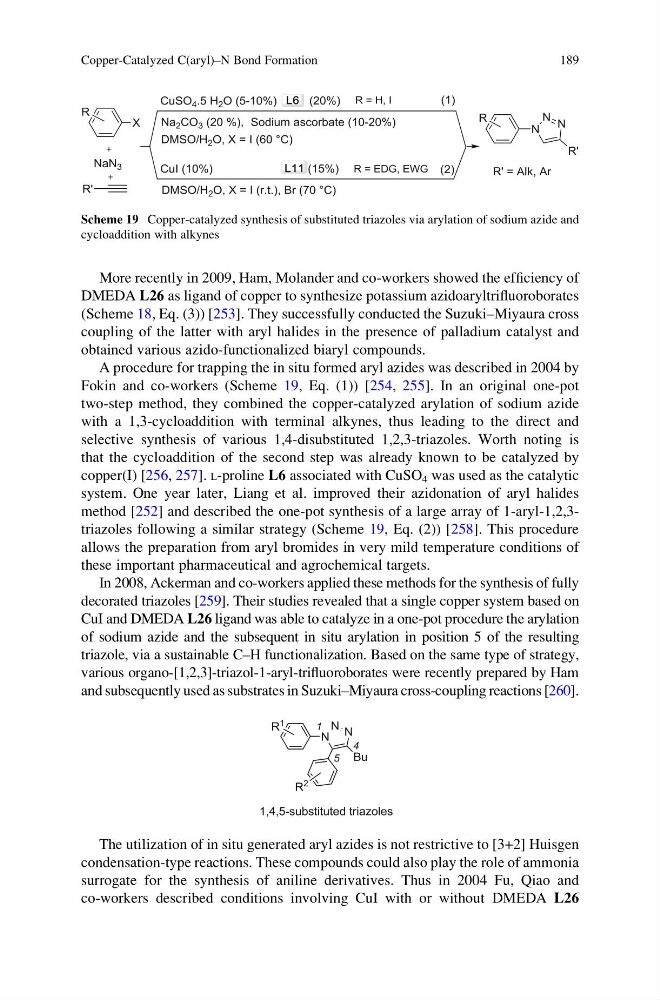
A procedure for trapping the in situ formed aryl azides was described in 2004 by
Fokin and co-workers (Scheme 19, Eq. (1)) [254, 255]. In an original one-pot
two-step method, they combined the copper-catalyzed arylation of sodium azide
with a 1,3-cycloaddition with terminal alkynes, thus leading to the direct and
selective synthesis of various 1,4-disubstituted 1,2,3-triazoles. Worth noting is
that the cycloaddition of the second step was already known to be catalyzed by
copper(I) [256, 257]. L-proline L6 associated with CuSO 4 was used as the catalytic
system. One year later, Liang et al. improved their azidonation of aryl halides
method [252] and described the one-pot synthesis of a large array of 1-aryl-1,2,3triazoles following a similar strategy (Scheme 19, Eq. (2)) [258]. This procedure
allows the preparation from aryl bromides in very mild temperature conditions of
these important pharmaceutical and agrochemical targets.
In 2008, Ackerman and co-workers applied these methods for the synthesis of fully
decorated triazoles [259]. Their studies revealed that a single copper system based on
CuI and DMEDA L26 ligand was able to catalyze in a one-pot procedure the arylation
of sodium azide and the subsequent in situ arylation in position 5 of the resulting
triazole, via a sustainable C–H functionalization. Based on the same type of strategy,
various organo-[1,2,3]-triazol-1-aryl-trifluoroborates were recently prepared by Ham
and subsequently used as substrates in Suzuki–Miyaura cross-coupling reactions [260].
The utilization of in situ generated aryl azides is not restrictive to [3+2] Huisgen
condensation-type reactions. These compounds could also play the role of ammonia
surrogate for the synthesis of aniline derivatives. Thus in 2004 Fu, Qiao and
co-workers described conditions involving CuI with or without DMEDA L26
Scheme 19 Copper-catalyzed synthesis of substituted triazoles via arylation of sodium azide and
cycloaddition with alkynes
Copper-Catalyzed C(aryl)–N Bond Formation
189
DMEDA L26 as ligand of copper to synthesize potassium azidoaryltrifluoroborates
(Scheme 18, Eq. (3)) [253]. They successfully conducted the Suzuki–Miyaura cross
coupling of the latter with aryl halides in the presence of palladium catalyst and
obtained various azido-functionalized biaryl compounds.
A procedure for trapping the in situ formed aryl azides was described in 2004 by
Fokin and co-workers (Scheme 19, Eq. (1)) [254, 255]. In an original one-pot
two-step method, they combined the copper-catalyzed arylation of sodium azide
with a 1,3-cycloaddition with terminal alkynes, thus leading to the direct and
selective synthesis of various 1,4-disubstituted 1,2,3-triazoles. Worth noting is
that the cycloaddition of the second step was already known to be catalyzed by
copper(I) [256, 257]. L-proline L6 associated with CuSO 4 was used as the catalytic
system. One year later, Liang et al. improved their azidonation of aryl halides
method [252] and described the one-pot synthesis of a large array of 1-aryl-1,2,3triazoles following a similar strategy (Scheme 19, Eq. (2)) [258]. This procedure
allows the preparation from aryl bromides in very mild temperature conditions of
these important pharmaceutical and agrochemical targets.
In 2008, Ackerman and co-workers applied these methods for the synthesis of fully
decorated triazoles [259]. Their studies revealed that a single copper system based on
CuI and DMEDA L26 ligand was able to catalyze in a one-pot procedure the arylation
of sodium azide and the subsequent in situ arylation in position 5 of the resulting
triazole, via a sustainable C–H functionalization. Based on the same type of strategy,
various organo-[1,2,3]-triazol-1-aryl-trifluoroborates were recently prepared by Ham
and subsequently used as substrates in Suzuki–Miyaura cross-coupling reactions [260].
The utilization of in situ generated aryl azides is not restrictive to [3+2] Huisgen
condensation-type reactions. These compounds could also play the role of ammonia
surrogate for the synthesis of aniline derivatives. Thus in 2004 Fu, Qiao and
co-workers described conditions involving CuI with or without DMEDA L26
Scheme 19 Copper-catalyzed synthesis of substituted triazoles via arylation of sodium azide and
cycloaddition with alkynes
Copper-Catalyzed C(aryl)–N Bond Formation
189