

challenges still remain to be overcome such as the arylation in mild conditions of
ammonia from aryl chlorides or sulfonates or the comprehension of the mechanism,
a recurrent objective in catalytic Ullmann reactions. However in a very short time
the purpose of discovering sustainable processes as credible alternatives to the
traditional methods has been achieved.
2.4 Miscellaneous Coupling Reactions of Aryl Halides
with N-Nucleophiles
Ullmann-type coupling reactions also offer the possibility to couple N-nucleophiles
such as azide salts, hydroxylamines, nitrite salts, sulfonimidamides or phosphinic
amides.
2.4.1 Coupling Reactions of Aryl Halides with Azides
Since the renaissance of the [3+2] Huisgen cycloaddition [249], the azide group
has attracted many attention because its condensation with alkynes, leading to 1,2,3triazole derivatives, is one of the most powerful tools to reach these compounds which
found various applications, for example, as pharmaceuticals, agrochemicals, or dyes.
The literature concerning the copper-catalyzed arylation of sodium azide
describes the formation, depending on the reaction conditions, of aryl and vinyl
azides, 1-aryl-1,2,3-triazoles or aryl amines.
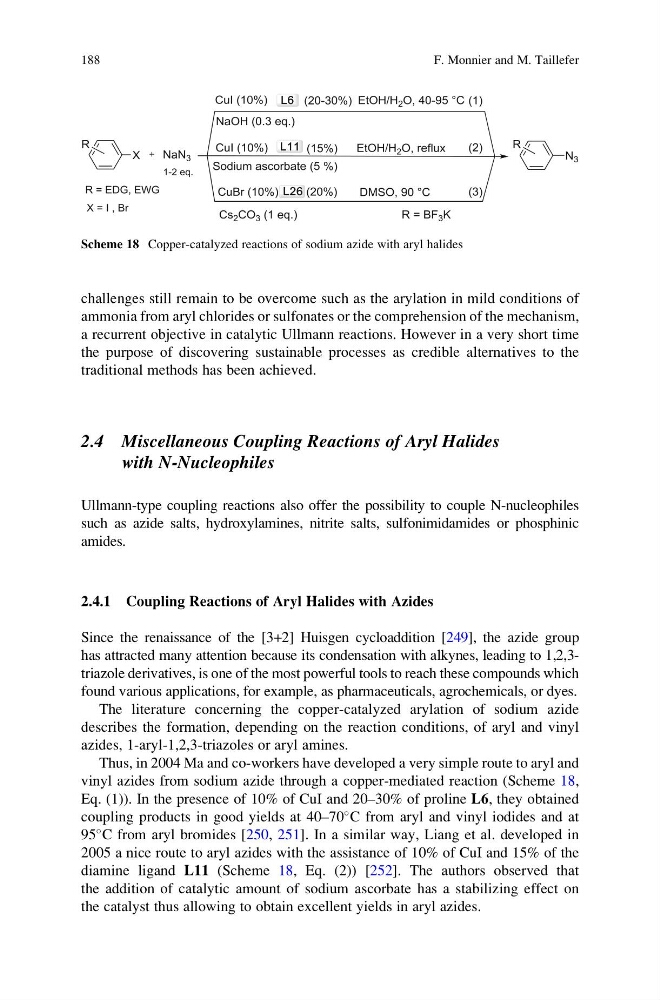
Thus, in 2004 Ma and co-workers have developed a very simple route to aryl and
vinyl azides from sodium azide through a copper-mediated reaction (Scheme 18,
Eq. (1)). In the presence of 10% of CuI and 20–30% of proline L6, they obtained
coupling products in good yields at 40–70
C from aryl and vinyl iodides and at
95
C from aryl bromides [250, 251]. In a similar way, Liang et al. developed in
2005 a nice route to aryl azides with the assistance of 10% of CuI and 15% of the
diamine ligand L11 (Scheme 18, Eq. (2)) [252]. The authors observed that
the addition of catalytic amount of sodium ascorbate has a stabilizing effect on
the catalyst thus allowing to obtain excellent yields in aryl azides.
Scheme 18 Copper-catalyzed reactions of sodium azide with aryl halides
188
F. Monnier and M. Taillefer
ammonia from aryl chlorides or sulfonates or the comprehension of the mechanism,
a recurrent objective in catalytic Ullmann reactions. However in a very short time
the purpose of discovering sustainable processes as credible alternatives to the
traditional methods has been achieved.
2.4 Miscellaneous Coupling Reactions of Aryl Halides
with N-Nucleophiles
Ullmann-type coupling reactions also offer the possibility to couple N-nucleophiles
such as azide salts, hydroxylamines, nitrite salts, sulfonimidamides or phosphinic
amides.
2.4.1 Coupling Reactions of Aryl Halides with Azides
Since the renaissance of the [3+2] Huisgen cycloaddition [249], the azide group
has attracted many attention because its condensation with alkynes, leading to 1,2,3triazole derivatives, is one of the most powerful tools to reach these compounds which
found various applications, for example, as pharmaceuticals, agrochemicals, or dyes.
The literature concerning the copper-catalyzed arylation of sodium azide
describes the formation, depending on the reaction conditions, of aryl and vinyl
azides, 1-aryl-1,2,3-triazoles or aryl amines.
Thus, in 2004 Ma and co-workers have developed a very simple route to aryl and
vinyl azides from sodium azide through a copper-mediated reaction (Scheme 18,
Eq. (1)). In the presence of 10% of CuI and 20–30% of proline L6, they obtained
coupling products in good yields at 40–70
C from aryl and vinyl iodides and at
95
C from aryl bromides [250, 251]. In a similar way, Liang et al. developed in
2005 a nice route to aryl azides with the assistance of 10% of CuI and 15% of the
diamine ligand L11 (Scheme 18, Eq. (2)) [252]. The authors observed that
the addition of catalytic amount of sodium ascorbate has a stabilizing effect on
the catalyst thus allowing to obtain excellent yields in aryl azides.
Scheme 18 Copper-catalyzed reactions of sodium azide with aryl halides
188
F. Monnier and M. Taillefer