

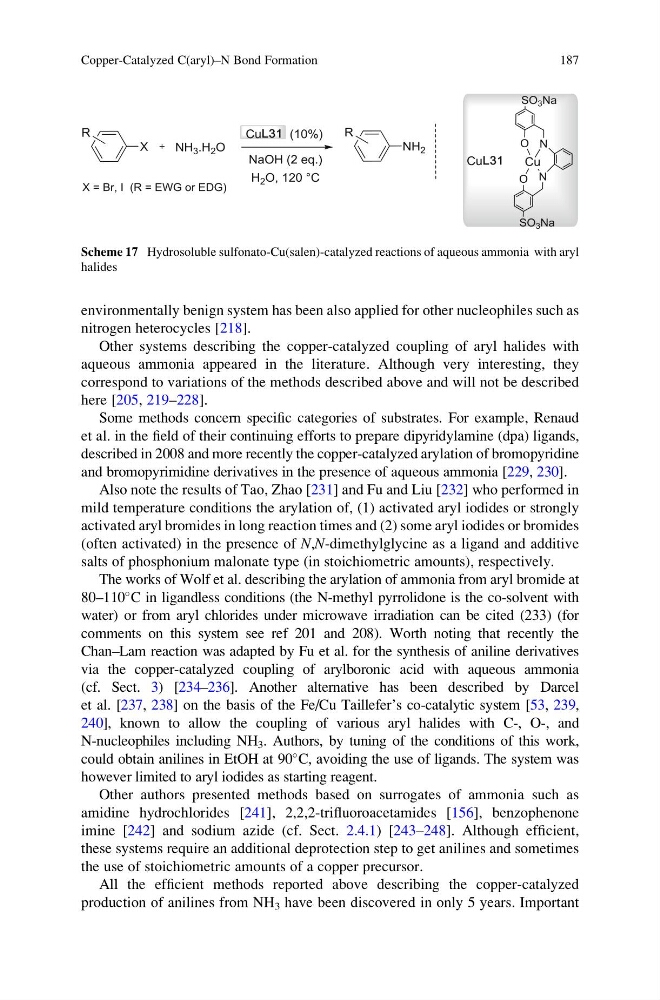
environmentally benign system has been also applied for other nucleophiles such as
nitrogen heterocycles [218].
Other systems describing the copper-catalyzed coupling of aryl halides with
aqueous ammonia appeared in the literature. Although very interesting, they
correspond to variations of the methods described above and will not be described
here [205, 219–228].
Some methods concern specific categories of substrates. For example, Renaud
et al. in the field of their continuing efforts to prepare dipyridylamine (dpa) ligands,
described in 2008 and more recently the copper-catalyzed arylation of bromopyridine
and bromopyrimidine derivatives in the presence of aqueous ammonia [229, 230].
Also note the results of Tao, Zhao [231] and Fu and Liu [232] who performed in
mild temperature conditions the arylation of, (1) activated aryl iodides or strongly
activated aryl bromides in long reaction times and (2) some aryl iodides or bromides
(often activated) in the presence of N,N-dimethylglycine as a ligand and additive
salts of phosphonium malonate type (in stoichiometric amounts), respectively.
The works of Wolf et al. describing the arylation of ammonia from aryl bromide at
80–110
C in ligandless conditions (the N-methyl pyrrolidone is the co-solvent with
water) or from aryl chlorides under microwave irradiation can be cited (233) (for
comments on this system see ref 201 and 208). Worth noting that recently the
Chan–Lam reaction was adapted by Fu et al. for the synthesis of aniline derivatives
via the copper-catalyzed coupling of arylboronic acid with aqueous ammonia
(cf. Sect. 3) [234–236]. Another alternative has been described by Darcel
et al. [237, 238] on the basis of the Fe/Cu Taillefer’s co-catalytic system [53, 239,
240], known to allow the coupling of various aryl halides with C-, O-, and
N-nucleophiles including NH 3 . Authors, by tuning of the conditions of this work,
could obtain anilines in EtOH at 90
C, avoiding the use of ligands. The system was
however limited to aryl iodides as starting reagent.
Other authors presented methods based on surrogates of ammonia such as
amidine hydrochlorides [241], 2,2,2-trifluoroacetamides [156], benzophenone
imine [242] and sodium azide (cf. Sect. 2.4.1) [243–248]. Although efficient,
these systems require an additional deprotection step to get anilines and sometimes
the use of stoichiometric amounts of a copper precursor.
All the efficient methods reported above describing the copper-catalyzed
production of anilines from NH 3 have been discovered in only 5 years. Important
Scheme 17 Hydrosoluble sulfonato-Cu(salen)-catalyzed reactions of aqueous ammonia with aryl
halides
Copper-Catalyzed C(aryl)–N Bond Formation
187
nitrogen heterocycles [218].
Other systems describing the copper-catalyzed coupling of aryl halides with
aqueous ammonia appeared in the literature. Although very interesting, they
correspond to variations of the methods described above and will not be described
here [205, 219–228].
Some methods concern specific categories of substrates. For example, Renaud
et al. in the field of their continuing efforts to prepare dipyridylamine (dpa) ligands,
described in 2008 and more recently the copper-catalyzed arylation of bromopyridine
and bromopyrimidine derivatives in the presence of aqueous ammonia [229, 230].
Also note the results of Tao, Zhao [231] and Fu and Liu [232] who performed in
mild temperature conditions the arylation of, (1) activated aryl iodides or strongly
activated aryl bromides in long reaction times and (2) some aryl iodides or bromides
(often activated) in the presence of N,N-dimethylglycine as a ligand and additive
salts of phosphonium malonate type (in stoichiometric amounts), respectively.
The works of Wolf et al. describing the arylation of ammonia from aryl bromide at
80–110
C in ligandless conditions (the N-methyl pyrrolidone is the co-solvent with
water) or from aryl chlorides under microwave irradiation can be cited (233) (for
comments on this system see ref 201 and 208). Worth noting that recently the
Chan–Lam reaction was adapted by Fu et al. for the synthesis of aniline derivatives
via the copper-catalyzed coupling of arylboronic acid with aqueous ammonia
(cf. Sect. 3) [234–236]. Another alternative has been described by Darcel
et al. [237, 238] on the basis of the Fe/Cu Taillefer’s co-catalytic system [53, 239,
240], known to allow the coupling of various aryl halides with C-, O-, and
N-nucleophiles including NH 3 . Authors, by tuning of the conditions of this work,
could obtain anilines in EtOH at 90
C, avoiding the use of ligands. The system was
however limited to aryl iodides as starting reagent.
Other authors presented methods based on surrogates of ammonia such as
amidine hydrochlorides [241], 2,2,2-trifluoroacetamides [156], benzophenone
imine [242] and sodium azide (cf. Sect. 2.4.1) [243–248]. Although efficient,
these systems require an additional deprotection step to get anilines and sometimes
the use of stoichiometric amounts of a copper precursor.
All the efficient methods reported above describing the copper-catalyzed
production of anilines from NH 3 have been discovered in only 5 years. Important
Scheme 17 Hydrosoluble sulfonato-Cu(salen)-catalyzed reactions of aqueous ammonia with aryl
halides
Copper-Catalyzed C(aryl)–N Bond Formation
187