

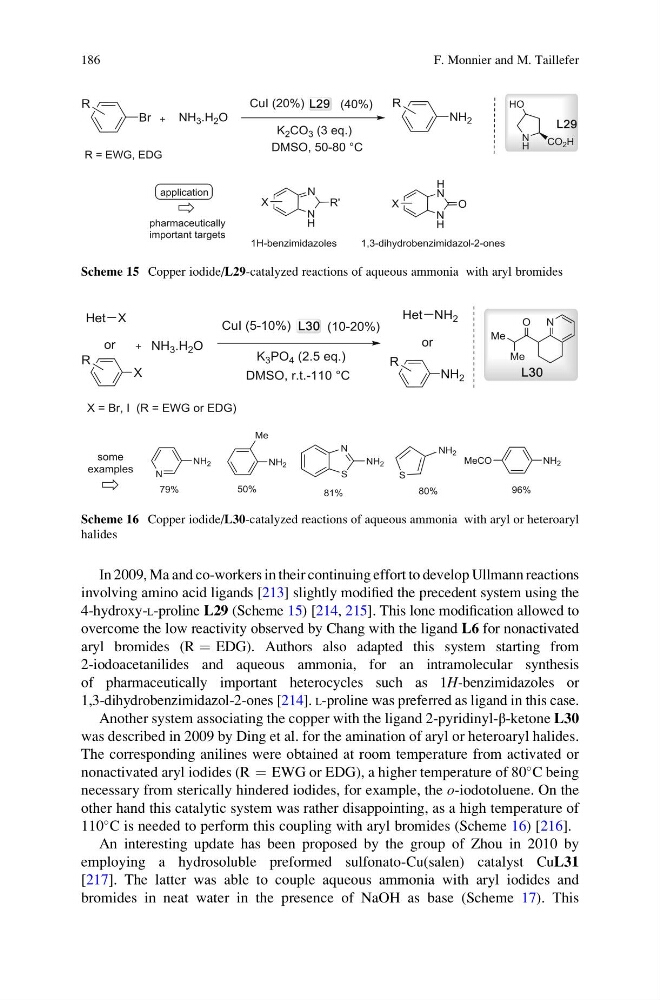
In 2009, Ma and co-workers in their continuing effort to develop Ullmann reactions
involving amino acid ligands [213] slightly modified the precedent system using the
4-hydroxy-L-proline L29 (Scheme 15) [214, 215]. This lone modification allowed to
overcome the low reactivity observed by Chang with the ligand L6 for nonactivated
aryl bromides (R ¼ EDG). Authors also adapted this system starting from
2-iodoacetanilides and aqueous ammonia, for an intramolecular synthesis
of pharmaceutically important heterocycles such as 1H-benzimidazoles or
1,3-dihydrobenzimidazol-2-ones [214]. L-proline was preferred as ligand in this case.
Another system associating the copper with the ligand 2-pyridinyl-β-ketone L30
was described in 2009 by Ding et al. for the amination of aryl or heteroaryl halides.
The corresponding anilines were obtained at room temperature from activated or
nonactivated aryl iodides (R ¼ EWG or EDG), a higher temperature of 80
C being
necessary from sterically hindered iodides, for example, the o-iodotoluene. On the
other hand this catalytic system was rather disappointing, as a high temperature of
110
C is needed to perform this coupling with aryl bromides (Scheme 16) [216].
An interesting update has been proposed by the group of Zhou in 2010 by
employing a hydrosoluble preformed sulfonato-Cu(salen) catalyst CuL31
[217]. The latter was able to couple aqueous ammonia with aryl iodides and
bromides in neat water in the presence of NaOH as base (Scheme 17). This
Scheme 15 Copper iodide/L29-catalyzed reactions of aqueous ammonia with aryl bromides
Scheme 16 Copper iodide/L30-catalyzed reactions of aqueous ammonia with aryl or heteroaryl
halides
186
F. Monnier and M. Taillefer
involving amino acid ligands [213] slightly modified the precedent system using the
4-hydroxy-L-proline L29 (Scheme 15) [214, 215]. This lone modification allowed to
overcome the low reactivity observed by Chang with the ligand L6 for nonactivated
aryl bromides (R ¼ EDG). Authors also adapted this system starting from
2-iodoacetanilides and aqueous ammonia, for an intramolecular synthesis
of pharmaceutically important heterocycles such as 1H-benzimidazoles or
1,3-dihydrobenzimidazol-2-ones [214]. L-proline was preferred as ligand in this case.
Another system associating the copper with the ligand 2-pyridinyl-β-ketone L30
was described in 2009 by Ding et al. for the amination of aryl or heteroaryl halides.
The corresponding anilines were obtained at room temperature from activated or
nonactivated aryl iodides (R ¼ EWG or EDG), a higher temperature of 80
C being
necessary from sterically hindered iodides, for example, the o-iodotoluene. On the
other hand this catalytic system was rather disappointing, as a high temperature of
110
C is needed to perform this coupling with aryl bromides (Scheme 16) [216].
An interesting update has been proposed by the group of Zhou in 2010 by
employing a hydrosoluble preformed sulfonato-Cu(salen) catalyst CuL31
[217]. The latter was able to couple aqueous ammonia with aryl iodides and
bromides in neat water in the presence of NaOH as base (Scheme 17). This
Scheme 15 Copper iodide/L29-catalyzed reactions of aqueous ammonia with aryl bromides
Scheme 16 Copper iodide/L30-catalyzed reactions of aqueous ammonia with aryl or heteroaryl
halides
186
F. Monnier and M. Taillefer