

from 2007, general, selective easy-handling and cheaper methodologies involving
copper catalysts appeared to overcome the challenge of the direct arylation of NH 3 .
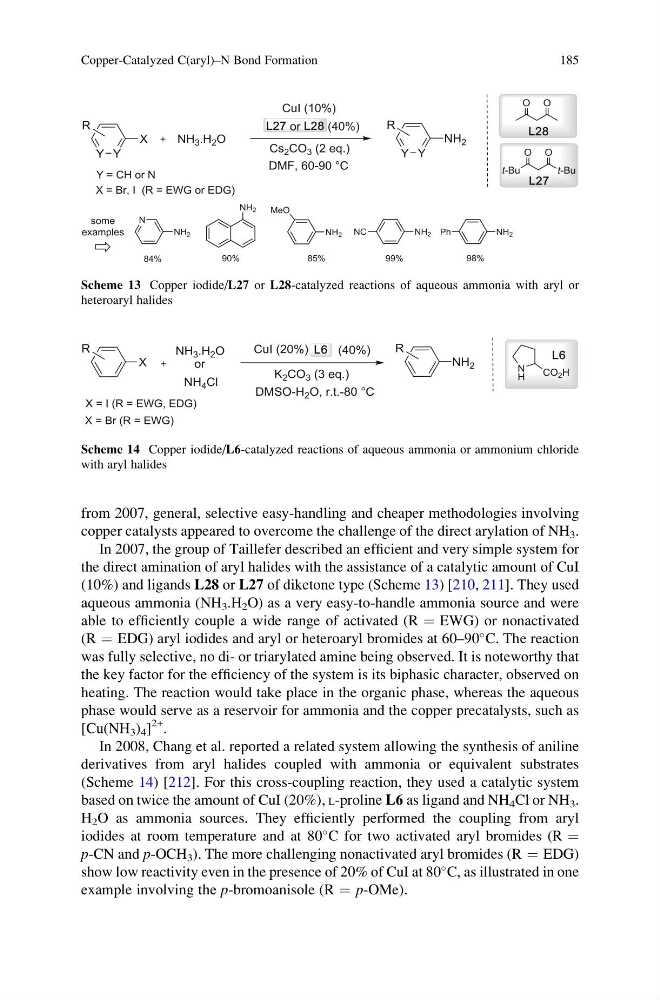
In 2007, the group of Taillefer described an efficient and very simple system for
the direct amination of aryl halides with the assistance of a catalytic amount of CuI
(10%) and ligands L28 or L27 of diketone type (Scheme 13) [210, 211]. They used
aqueous ammonia (NH 3 .H 2 O) as a very easy-to-handle ammonia source and were
able to efficiently couple a wide range of activated (R ¼ EWG) or nonactivated
(R ¼ EDG) aryl iodides and aryl or heteroaryl bromides at 60–90
C. The reaction
was fully selective, no di- or triarylated amine being observed. It is noteworthy that
the key factor for the efficiency of the system is its biphasic character, observed on
heating. The reaction would take place in the organic phase, whereas the aqueous
phase would serve as a reservoir for ammonia and the copper precatalysts, such as
[Cu(NH 3 ) 4 ]
2+ .
In 2008, Chang et al. reported a related system allowing the synthesis of aniline
derivatives from aryl halides coupled with ammonia or equivalent substrates
(Scheme 14) [212]. For this cross-coupling reaction, they used a catalytic system
based on twice the amount of CuI (20%), L-proline L6 as ligand and NH 4 Cl or NH 3 .
H 2 O as ammonia sources. They efficiently performed the coupling from aryl
iodides at room temperature and at 80
C for two activated aryl bromides (R ¼
p-CN and p-OCH 3 ). The more challenging nonactivated aryl bromides (R ¼ EDG)
show low reactivity even in the presence of 20% of CuI at 80
C, as illustrated in one
example involving the p-bromoanisole (R ¼ p-OMe).
Scheme 13 Copper iodide/L27 or L28-catalyzed reactions of aqueous ammonia with aryl or
heteroaryl halides
Scheme 14 Copper iodide/L6-catalyzed reactions of aqueous ammonia or ammonium chloride
with aryl halides
Copper-Catalyzed C(aryl)–N Bond Formation
185
copper catalysts appeared to overcome the challenge of the direct arylation of NH 3 .
In 2007, the group of Taillefer described an efficient and very simple system for
the direct amination of aryl halides with the assistance of a catalytic amount of CuI
(10%) and ligands L28 or L27 of diketone type (Scheme 13) [210, 211]. They used
aqueous ammonia (NH 3 .H 2 O) as a very easy-to-handle ammonia source and were
able to efficiently couple a wide range of activated (R ¼ EWG) or nonactivated
(R ¼ EDG) aryl iodides and aryl or heteroaryl bromides at 60–90
C. The reaction
was fully selective, no di- or triarylated amine being observed. It is noteworthy that
the key factor for the efficiency of the system is its biphasic character, observed on
heating. The reaction would take place in the organic phase, whereas the aqueous
phase would serve as a reservoir for ammonia and the copper precatalysts, such as
[Cu(NH 3 ) 4 ]
2+ .
In 2008, Chang et al. reported a related system allowing the synthesis of aniline
derivatives from aryl halides coupled with ammonia or equivalent substrates
(Scheme 14) [212]. For this cross-coupling reaction, they used a catalytic system
based on twice the amount of CuI (20%), L-proline L6 as ligand and NH 4 Cl or NH 3 .
H 2 O as ammonia sources. They efficiently performed the coupling from aryl
iodides at room temperature and at 80
C for two activated aryl bromides (R ¼
p-CN and p-OCH 3 ). The more challenging nonactivated aryl bromides (R ¼ EDG)
show low reactivity even in the presence of 20% of CuI at 80
C, as illustrated in one
example involving the p-bromoanisole (R ¼ p-OMe).
Scheme 13 Copper iodide/L27 or L28-catalyzed reactions of aqueous ammonia with aryl or
heteroaryl halides
Scheme 14 Copper iodide/L6-catalyzed reactions of aqueous ammonia or ammonium chloride
with aryl halides
Copper-Catalyzed C(aryl)–N Bond Formation
185