

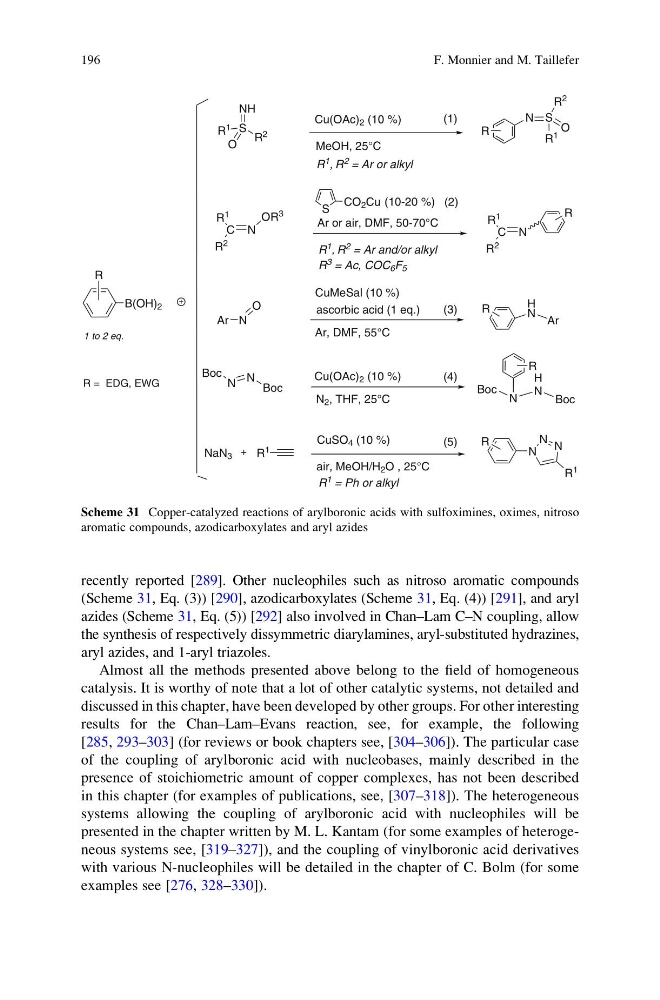
recently reported [289]. Other nucleophiles such as nitroso aromatic compounds
(Scheme 31, Eq. (3)) [290], azodicarboxylates (Scheme 31, Eq. (4)) [291], and aryl
azides (Scheme 31, Eq. (5)) [292] also involved in Chan–Lam C–N coupling, allow
the synthesis of respectively dissymmetric diarylamines, aryl-substituted hydrazines,
aryl azides, and 1-aryl triazoles.
Almost all the methods presented above belong to the field of homogeneous
catalysis. It is worthy of note that a lot of other catalytic systems, not detailed and
discussed in this chapter, have been developed by other groups. For other interesting
results for the Chan–Lam–Evans reaction, see, for example, the following
[285, 293–303] (for reviews or book chapters see, [304–306]). The particular case
of the coupling of arylboronic acid with nucleobases, mainly described in the
presence of stoichiometric amount of copper complexes, has not been described
in this chapter (for examples of publications, see, [307–318]). The heterogeneous
systems allowing the coupling of arylboronic acid with nucleophiles will be
presented in the chapter written by M. L. Kantam (for some examples of heterogeneous systems see, [319–327]), and the coupling of vinylboronic acid derivatives
with various N-nucleophiles will be detailed in the chapter of C. Bolm (for some
examples see [276, 328–330]).
B(OH) 2
R
S
NH
O
R
1
R
2
Cu(OAc) 2 (10 %)
MeOH, 25°C
R
S
N
O
R 1
R
2
Ar or air, DMF, 50-70°C
C
R
1
R
2
N
OR 3
R
3 = Ac, COC 6 F 5
(10-20 %)
C
R
1
R 2
N
R
N
N
Boc
Cu(OAc) 2 (10 %)
N 2 , THF, 25°C
Boc
H
N
N
Boc
Boc
R
1
NaN 3
CuSO 4 (10 %)
air, MeOH/H 2 O , 25°C
N
R
N
N
R
1
R
CuMeSal (10 %)
N
O
Ar
Ar, DMF, 55°C
H
N
R
Ar
ascorbic acid (1 eq.)
1 to 2 eq.
(1)
(2)
S
CO 2 Cu
R
1
, R
2 = Ar and/or alkyl
R
1
, R
2 = Ar or alkyl
(3)
(4)
(5)
R = EDG, EWG
R 1 = Ph or alkyl
Scheme 31 Copper-catalyzed reactions of arylboronic acids with sulfoximines, oximes, nitroso
aromatic compounds, azodicarboxylates and aryl azides
196
F. Monnier and M. Taillefer
(Scheme 31, Eq. (3)) [290], azodicarboxylates (Scheme 31, Eq. (4)) [291], and aryl
azides (Scheme 31, Eq. (5)) [292] also involved in Chan–Lam C–N coupling, allow
the synthesis of respectively dissymmetric diarylamines, aryl-substituted hydrazines,
aryl azides, and 1-aryl triazoles.
Almost all the methods presented above belong to the field of homogeneous
catalysis. It is worthy of note that a lot of other catalytic systems, not detailed and
discussed in this chapter, have been developed by other groups. For other interesting
results for the Chan–Lam–Evans reaction, see, for example, the following
[285, 293–303] (for reviews or book chapters see, [304–306]). The particular case
of the coupling of arylboronic acid with nucleobases, mainly described in the
presence of stoichiometric amount of copper complexes, has not been described
in this chapter (for examples of publications, see, [307–318]). The heterogeneous
systems allowing the coupling of arylboronic acid with nucleophiles will be
presented in the chapter written by M. L. Kantam (for some examples of heterogeneous systems see, [319–327]), and the coupling of vinylboronic acid derivatives
with various N-nucleophiles will be detailed in the chapter of C. Bolm (for some
examples see [276, 328–330]).
B(OH) 2
R
S
NH
O
R
1
R
2
Cu(OAc) 2 (10 %)
MeOH, 25°C
R
S
N
O
R 1
R
2
Ar or air, DMF, 50-70°C
C
R
1
R
2
N
OR 3
R
3 = Ac, COC 6 F 5
(10-20 %)
C
R
1
R 2
N
R
N
N
Boc
Cu(OAc) 2 (10 %)
N 2 , THF, 25°C
Boc
H
N
N
Boc
Boc
R
1
NaN 3
CuSO 4 (10 %)
air, MeOH/H 2 O , 25°C
N
R
N
N
R
1
R
CuMeSal (10 %)
N
O
Ar
Ar, DMF, 55°C
H
N
R
Ar
ascorbic acid (1 eq.)
1 to 2 eq.
(1)
(2)
S
CO 2 Cu
R
1
, R
2 = Ar and/or alkyl
R
1
, R
2 = Ar or alkyl
(3)
(4)
(5)
R = EDG, EWG
R 1 = Ph or alkyl
Scheme 31 Copper-catalyzed reactions of arylboronic acids with sulfoximines, oximes, nitroso
aromatic compounds, azodicarboxylates and aryl azides
196
F. Monnier and M. Taillefer