

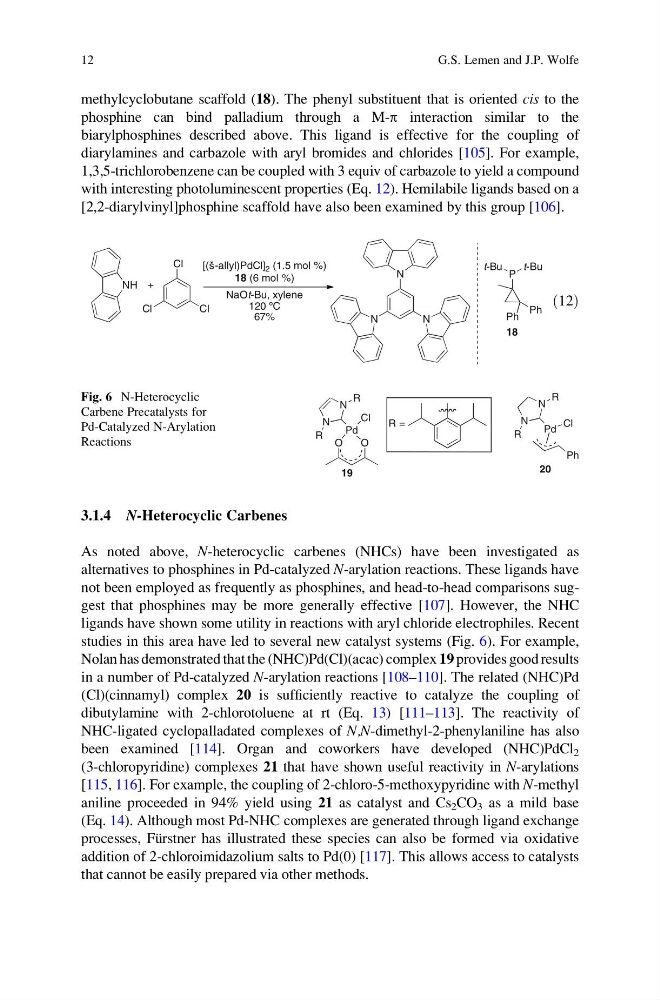
methylcyclobutane scaffold (18). The phenyl substituent that is oriented cis to the
phosphine can bind palladium through a M-p interaction similar to the
biarylphosphines described above. This ligand is effective for the coupling of
diarylamines and carbazole with aryl bromides and chlorides [105]. For example,
1,3,5-trichlorobenzene can be coupled with 3 equiv of carbazole to yield a compound
with interesting photoluminescent properties (Eq. 12). Hemilabile ligands based on a
[2,2-diarylvinyl]phosphine scaffold have also been examined by this group [106].
NH
Cl
Cl
Cl
+
[( -allyl)PdCl] 2 (1.5 mol %)
18 (6 mol %)
N
N
N
67%
P
Ph
Ph
t-Bu
t-Bu
18
NaOt-Bu, xylene
120 ºC
ð12Þ
3.1.4 N-Heterocyclic Carbenes
As noted above, N-heterocyclic carbenes (NHCs) have been investigated as
alternatives to phosphines in Pd-catalyzed N-arylation reactions. These ligands have
not been employed as frequently as phosphines, and head-to-head comparisons suggest that phosphines may be more generally effective [107]. However, the NHC
ligands have shown some utility in reactions with aryl chloride electrophiles. Recent
studies in this area have led to several new catalyst systems (Fig. 6). For example,
Nolan has demonstrated that the (NHC)Pd(Cl)(acac) complex 19 provides good results
in a number of Pd-catalyzed N-arylation reactions [108–110]. The related (NHC)Pd
(Cl)(cinnamyl) complex 20 is sufficiently reactive to catalyze the coupling of
dibutylamine with 2-chlorotoluene at rt (Eq. 13) [111–113]. The reactivity of
NHC-ligated cyclopalladated complexes of N,N-dimethyl-2-phenylaniline has also
been examined [114]. Organ and coworkers have developed (NHC)PdCl 2
(3-chloropyridine) complexes 21 that have shown useful reactivity in N-arylations
[115, 116]. For example, the coupling of 2-chloro-5-methoxypyridine with N-methyl
aniline proceeded in 94% yield using 21 as catalyst and Cs 2 CO 3 as a mild base
(Eq. 14). Although most Pd-NHC complexes are generated through ligand exchange
processes, Fu ¨rstner has illustrated these species can also be formed via oxidative
addition of 2-chloroimidazolium salts to Pd(0) [117]. This allows access to catalysts
that cannot be easily prepared via other methods.
Pd
Cl
N
N
R
R
O
O
19
R =
Pd
N
N
R
R
20
Cl
Ph
Fig. 6 N-Heterocyclic
Carbene Precatalysts for
Pd-Catalyzed N-Arylation
Reactions
12
G.S. Lemen and J.P. Wolfe
phosphine can bind palladium through a M-p interaction similar to the
biarylphosphines described above. This ligand is effective for the coupling of
diarylamines and carbazole with aryl bromides and chlorides [105]. For example,
1,3,5-trichlorobenzene can be coupled with 3 equiv of carbazole to yield a compound
with interesting photoluminescent properties (Eq. 12). Hemilabile ligands based on a
[2,2-diarylvinyl]phosphine scaffold have also been examined by this group [106].
NH
Cl
Cl
Cl
+
[( -allyl)PdCl] 2 (1.5 mol %)
18 (6 mol %)
N
N
N
67%
P
Ph
Ph
t-Bu
t-Bu
18
NaOt-Bu, xylene
120 ºC
ð12Þ
3.1.4 N-Heterocyclic Carbenes
As noted above, N-heterocyclic carbenes (NHCs) have been investigated as
alternatives to phosphines in Pd-catalyzed N-arylation reactions. These ligands have
not been employed as frequently as phosphines, and head-to-head comparisons suggest that phosphines may be more generally effective [107]. However, the NHC
ligands have shown some utility in reactions with aryl chloride electrophiles. Recent
studies in this area have led to several new catalyst systems (Fig. 6). For example,
Nolan has demonstrated that the (NHC)Pd(Cl)(acac) complex 19 provides good results
in a number of Pd-catalyzed N-arylation reactions [108–110]. The related (NHC)Pd
(Cl)(cinnamyl) complex 20 is sufficiently reactive to catalyze the coupling of
dibutylamine with 2-chlorotoluene at rt (Eq. 13) [111–113]. The reactivity of
NHC-ligated cyclopalladated complexes of N,N-dimethyl-2-phenylaniline has also
been examined [114]. Organ and coworkers have developed (NHC)PdCl 2
(3-chloropyridine) complexes 21 that have shown useful reactivity in N-arylations
[115, 116]. For example, the coupling of 2-chloro-5-methoxypyridine with N-methyl
aniline proceeded in 94% yield using 21 as catalyst and Cs 2 CO 3 as a mild base
(Eq. 14). Although most Pd-NHC complexes are generated through ligand exchange
processes, Fu ¨rstner has illustrated these species can also be formed via oxidative
addition of 2-chloroimidazolium salts to Pd(0) [117]. This allows access to catalysts
that cannot be easily prepared via other methods.
Pd
Cl
N
N
R
R
O
O
19
R =
Pd
N
N
R
R
20
Cl
Ph
Fig. 6 N-Heterocyclic
Carbene Precatalysts for
Pd-Catalyzed N-Arylation
Reactions
12
G.S. Lemen and J.P. Wolfe