

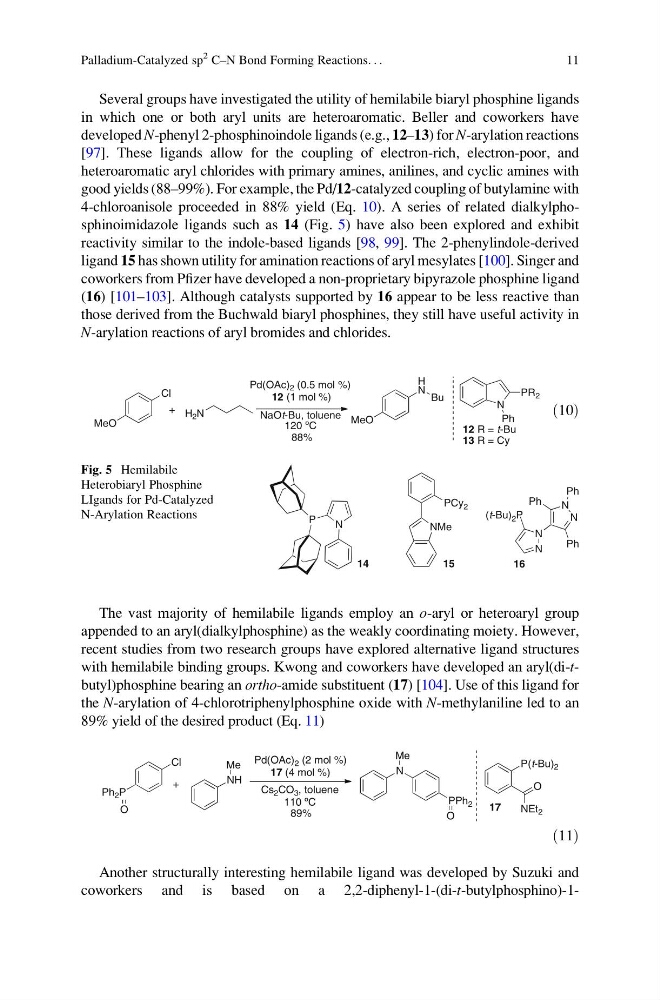
Several groups have investigated the utility of hemilabile biaryl phosphine ligands
in which one or both aryl units are heteroaromatic. Beller and coworkers have
developed N-phenyl 2-phosphinoindole ligands (e.g., 12–13) for N-arylation reactions
[97]. These ligands allow for the coupling of electron-rich, electron-poor, and
heteroaromatic aryl chlorides with primary amines, anilines, and cyclic amines with
good yields (88–99%). For example, the Pd/12-catalyzed coupling of butylamine with
4-chloroanisole proceeded in 88% yield (Eq. 10). A series of related dialkylphosphinoimidazole ligands such as 14 (Fig. 5) have also been explored and exhibit
reactivity similar to the indole-based ligands [98, 99]. The 2-phenylindole-derived
ligand 15 has shown utility for amination reactions of aryl mesylates [100]. Singer and
coworkers from Pfizer have developed a non-proprietary bipyrazole phosphine ligand
(16) [101–103]. Although catalysts supported by 16 appear to be less reactive than
those derived from the Buchwald biaryl phosphines, they still have useful activity in
N-arylation reactions of aryl bromides and chlorides.
Cl
MeO
+ H 2 N
Pd(OAc) 2 (0.5 mol %)
12 (1 mol %)
H
N
MeO
88%
N
Ph
PR 2
12 R = t-Bu
13 R = Cy
Bu
NaOt-Bu, toluene
120 ºC
ð10Þ
The vast majority of hemilabile ligands employ an o-aryl or heteroaryl group
appended to an aryl(dialkylphosphine) as the weakly coordinating moiety. However,
recent studies from two research groups have explored alternative ligand structures
with hemilabile binding groups. Kwong and coworkers have developed an aryl(di-tbutyl)phosphine bearing an ortho-amide substituent (17) [104]. Use of this ligand for
the N-arylation of 4-chlorotriphenylphosphine oxide with N-methylaniline led to an
89% yield of the desired product (Eq. 11)
Cl
Ph 2 P
NH
Me
+
Pd(OAc) 2 (2 mol %)
17 (4 mol %)
N
Me
PPh 2
O
89%
P(t-Bu) 2
NEt 2
O
17
O
Cs 2 CO 3 , toluene
110 ºC
ð11Þ
Another structurally interesting hemilabile ligand was developed by Suzuki and
coworkers and is based on a 2,2-diphenyl-1-(di-t-butylphosphino)-1P
N
14
N
N
Ph
Ph
Ph
N
N
(t-Bu) 2 P
16
NMe
PCy 2
15
Fig. 5 Hemilabile
Heterobiaryl Phosphine
LIgands for Pd-Catalyzed
N-Arylation Reactions
Palladium-Catalyzed sp
2 C–N Bond Forming Reactions. . .
11
in which one or both aryl units are heteroaromatic. Beller and coworkers have
developed N-phenyl 2-phosphinoindole ligands (e.g., 12–13) for N-arylation reactions
[97]. These ligands allow for the coupling of electron-rich, electron-poor, and
heteroaromatic aryl chlorides with primary amines, anilines, and cyclic amines with
good yields (88–99%). For example, the Pd/12-catalyzed coupling of butylamine with
4-chloroanisole proceeded in 88% yield (Eq. 10). A series of related dialkylphosphinoimidazole ligands such as 14 (Fig. 5) have also been explored and exhibit
reactivity similar to the indole-based ligands [98, 99]. The 2-phenylindole-derived
ligand 15 has shown utility for amination reactions of aryl mesylates [100]. Singer and
coworkers from Pfizer have developed a non-proprietary bipyrazole phosphine ligand
(16) [101–103]. Although catalysts supported by 16 appear to be less reactive than
those derived from the Buchwald biaryl phosphines, they still have useful activity in
N-arylation reactions of aryl bromides and chlorides.
Cl
MeO
+ H 2 N
Pd(OAc) 2 (0.5 mol %)
12 (1 mol %)
H
N
MeO
88%
N
Ph
PR 2
12 R = t-Bu
13 R = Cy
Bu
NaOt-Bu, toluene
120 ºC
ð10Þ
The vast majority of hemilabile ligands employ an o-aryl or heteroaryl group
appended to an aryl(dialkylphosphine) as the weakly coordinating moiety. However,
recent studies from two research groups have explored alternative ligand structures
with hemilabile binding groups. Kwong and coworkers have developed an aryl(di-tbutyl)phosphine bearing an ortho-amide substituent (17) [104]. Use of this ligand for
the N-arylation of 4-chlorotriphenylphosphine oxide with N-methylaniline led to an
89% yield of the desired product (Eq. 11)
Cl
Ph 2 P
NH
Me
+
Pd(OAc) 2 (2 mol %)
17 (4 mol %)
N
Me
PPh 2
O
89%
P(t-Bu) 2
NEt 2
O
17
O
Cs 2 CO 3 , toluene
110 ºC
ð11Þ
Another structurally interesting hemilabile ligand was developed by Suzuki and
coworkers and is based on a 2,2-diphenyl-1-(di-t-butylphosphino)-1P
N
14
N
N
Ph
Ph
Ph
N
N
(t-Bu) 2 P
16
NMe
PCy 2
15
Fig. 5 Hemilabile
Heterobiaryl Phosphine
LIgands for Pd-Catalyzed
N-Arylation Reactions
Palladium-Catalyzed sp
2 C–N Bond Forming Reactions. . .
11