

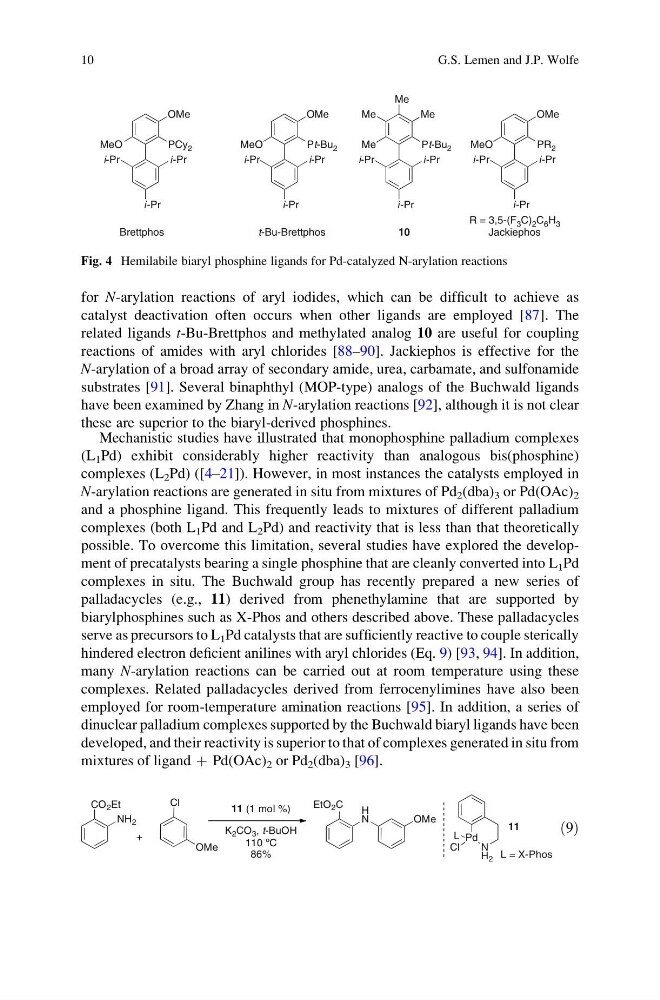
for N-arylation reactions of aryl iodides, which can be difficult to achieve as
catalyst deactivation often occurs when other ligands are employed [87]. The
related ligands t-Bu-Brettphos and methylated analog 10 are useful for coupling
reactions of amides with aryl chlorides [88–90]. Jackiephos is effective for the
N-arylation of a broad array of secondary amide, urea, carbamate, and sulfonamide
substrates [91]. Several binaphthyl (MOP-type) analogs of the Buchwald ligands
have been examined by Zhang in N-arylation reactions [92], although it is not clear
these are superior to the biaryl-derived phosphines.
Mechanistic studies have illustrated that monophosphine palladium complexes
(L 1 Pd) exhibit considerably higher reactivity than analogous bis(phosphine)
complexes (L 2 Pd) ([4–21]). However, in most instances the catalysts employed in
N-arylation reactions are generated in situ from mixtures of Pd 2 (dba) 3 or Pd(OAc) 2
and a phosphine ligand. This frequently leads to mixtures of different palladium
complexes (both L 1 Pd and L 2 Pd) and reactivity that is less than that theoretically
possible. To overcome this limitation, several studies have explored the development of precatalysts bearing a single phosphine that are cleanly converted into L 1 Pd
complexes in situ. The Buchwald group has recently prepared a new series of
palladacycles (e.g., 11) derived from phenethylamine that are supported by
biarylphosphines such as X-Phos and others described above. These palladacycles
serve as precursors to L 1 Pd catalysts that are sufficiently reactive to couple sterically
hindered electron deficient anilines with aryl chlorides (Eq. 9) [93, 94]. In addition,
many N-arylation reactions can be carried out at room temperature using these
complexes. Related palladacycles derived from ferrocenylimines have also been
employed for room-temperature amination reactions [95]. In addition, a series of
dinuclear palladium complexes supported by the Buchwald biaryl ligands have been
developed, and their reactivity is superior to that of complexes generated in situ from
mixtures of ligand þ Pd(OAc) 2 or Pd 2 (dba) 3 [96].
CO 2 Et
NH 2
+
Cl
OMe
11 (1 mol %)
EtO 2 C
H
N
OMe
86%
Pd
N
H 2
Cl
L
L = X-Phos
11
K 2 CO 3 , t-BuOH
110 ºC
ð9Þ
i-Pr
i-Pr
i-Pr
PR 2
OMe
MeO
R = 3,5-(F 3 C) 2 C 6 H 3
Jackiephos
i-Pr
i-Pr
i-Pr
Pt-Bu 2
OMe
MeO
t-Bu-Brettphos
i-Pr
i-Pr
i-Pr
PCy 2
OMe
MeO
Brettphos
i-Pr
i-Pr
i-Pr
Pt-Bu 2
Me
Me
10
Me
Me
Fig. 4 Hemilabile biaryl phosphine ligands for Pd-catalyzed N-arylation reactions
10
G.S. Lemen and J.P. Wolfe
catalyst deactivation often occurs when other ligands are employed [87]. The
related ligands t-Bu-Brettphos and methylated analog 10 are useful for coupling
reactions of amides with aryl chlorides [88–90]. Jackiephos is effective for the
N-arylation of a broad array of secondary amide, urea, carbamate, and sulfonamide
substrates [91]. Several binaphthyl (MOP-type) analogs of the Buchwald ligands
have been examined by Zhang in N-arylation reactions [92], although it is not clear
these are superior to the biaryl-derived phosphines.
Mechanistic studies have illustrated that monophosphine palladium complexes
(L 1 Pd) exhibit considerably higher reactivity than analogous bis(phosphine)
complexes (L 2 Pd) ([4–21]). However, in most instances the catalysts employed in
N-arylation reactions are generated in situ from mixtures of Pd 2 (dba) 3 or Pd(OAc) 2
and a phosphine ligand. This frequently leads to mixtures of different palladium
complexes (both L 1 Pd and L 2 Pd) and reactivity that is less than that theoretically
possible. To overcome this limitation, several studies have explored the development of precatalysts bearing a single phosphine that are cleanly converted into L 1 Pd
complexes in situ. The Buchwald group has recently prepared a new series of
palladacycles (e.g., 11) derived from phenethylamine that are supported by
biarylphosphines such as X-Phos and others described above. These palladacycles
serve as precursors to L 1 Pd catalysts that are sufficiently reactive to couple sterically
hindered electron deficient anilines with aryl chlorides (Eq. 9) [93, 94]. In addition,
many N-arylation reactions can be carried out at room temperature using these
complexes. Related palladacycles derived from ferrocenylimines have also been
employed for room-temperature amination reactions [95]. In addition, a series of
dinuclear palladium complexes supported by the Buchwald biaryl ligands have been
developed, and their reactivity is superior to that of complexes generated in situ from
mixtures of ligand þ Pd(OAc) 2 or Pd 2 (dba) 3 [96].
CO 2 Et
NH 2
+
Cl
OMe
11 (1 mol %)
EtO 2 C
H
N
OMe
86%
Pd
N
H 2
Cl
L
L = X-Phos
11
K 2 CO 3 , t-BuOH
110 ºC
ð9Þ
i-Pr
i-Pr
i-Pr
PR 2
OMe
MeO
R = 3,5-(F 3 C) 2 C 6 H 3
Jackiephos
i-Pr
i-Pr
i-Pr
Pt-Bu 2
OMe
MeO
t-Bu-Brettphos
i-Pr
i-Pr
i-Pr
PCy 2
OMe
MeO
Brettphos
i-Pr
i-Pr
i-Pr
Pt-Bu 2
Me
Me
10
Me
Me
Fig. 4 Hemilabile biaryl phosphine ligands for Pd-catalyzed N-arylation reactions
10
G.S. Lemen and J.P. Wolfe