

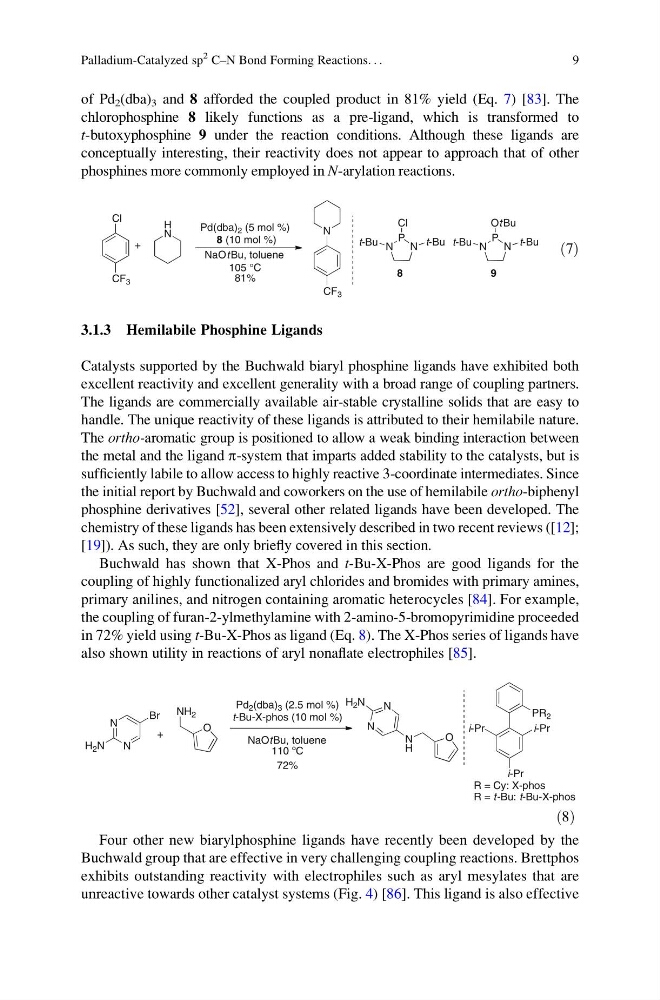
of Pd 2 (dba) 3 and 8 afforded the coupled product in 81% yield (Eq. 7) [83]. The
chlorophosphine 8 likely functions as a pre-ligand, which is transformed to
t-butoxyphosphine 9 under the reaction conditions. Although these ligands are
conceptually interesting, their reactivity does not appear to approach that of other
phosphines more commonly employed in N-arylation reactions.
CF 3
Cl
H
N
+
Pd(dba) 2 (5 mol %)
8 (10 mol %)
NaOt Bu, toluene
105 °C
81%
CF 3
N
N
N
P
Cl
t-Bu
t-Bu
8
N
N
P
Ot Bu
t-Bu
t-Bu
9
ð7Þ
3.1.3 Hemilabile Phosphine Ligands
Catalysts supported by the Buchwald biaryl phosphine ligands have exhibited both
excellent reactivity and excellent generality with a broad range of coupling partners.
The ligands are commercially available air-stable crystalline solids that are easy to
handle. The unique reactivity of these ligands is attributed to their hemilabile nature.
The ortho-aromatic group is positioned to allow a weak binding interaction between
the metal and the ligand p-system that imparts added stability to the catalysts, but is
sufficiently labile to allow access to highly reactive 3-coordinate intermediates. Since
the initial report by Buchwald and coworkers on the use of hemilabile ortho-biphenyl
phosphine derivatives [52], several other related ligands have been developed. The
chemistry of these ligands has been extensively described in two recent reviews ([12];
[19]). As such, they are only briefly covered in this section.
Buchwald has shown that X-Phos and t-Bu-X-Phos are good ligands for the
coupling of highly functionalized aryl chlorides and bromides with primary amines,
primary anilines, and nitrogen containing aromatic heterocycles [84]. For example,
the coupling of furan-2-ylmethylamine with 2-amino-5-bromopyrimidine proceeded
in 72% yield using t-Bu-X-Phos as ligand (Eq. 8). The X-Phos series of ligands have
also shown utility in reactions of aryl nonaflate electrophiles [85].
N
N
H 2 N
Br
+
O
Pd 2 (dba) 3 (2.5 mol %)
t-Bu-X-phos (10 mol %)
O
N
H
N
N
H 2 N
72%
NH 2
i-Pr
i-Pr
i-Pr
PR 2
R = Cy: X-phos
R = t-Bu: t-Bu-X-phos
NaOtBu, toluene
110 ºC
ð8Þ
Four other new biarylphosphine ligands have recently been developed by the
Buchwald group that are effective in very challenging coupling reactions. Brettphos
exhibits outstanding reactivity with electrophiles such as aryl mesylates that are
unreactive towards other catalyst systems (Fig. 4) [86]. This ligand is also effective
Palladium-Catalyzed sp
2 C–N Bond Forming Reactions. . .
9
chlorophosphine 8 likely functions as a pre-ligand, which is transformed to
t-butoxyphosphine 9 under the reaction conditions. Although these ligands are
conceptually interesting, their reactivity does not appear to approach that of other
phosphines more commonly employed in N-arylation reactions.
CF 3
Cl
H
N
+
Pd(dba) 2 (5 mol %)
8 (10 mol %)
NaOt Bu, toluene
105 °C
81%
CF 3
N
N
N
P
Cl
t-Bu
t-Bu
8
N
N
P
Ot Bu
t-Bu
t-Bu
9
ð7Þ
3.1.3 Hemilabile Phosphine Ligands
Catalysts supported by the Buchwald biaryl phosphine ligands have exhibited both
excellent reactivity and excellent generality with a broad range of coupling partners.
The ligands are commercially available air-stable crystalline solids that are easy to
handle. The unique reactivity of these ligands is attributed to their hemilabile nature.
The ortho-aromatic group is positioned to allow a weak binding interaction between
the metal and the ligand p-system that imparts added stability to the catalysts, but is
sufficiently labile to allow access to highly reactive 3-coordinate intermediates. Since
the initial report by Buchwald and coworkers on the use of hemilabile ortho-biphenyl
phosphine derivatives [52], several other related ligands have been developed. The
chemistry of these ligands has been extensively described in two recent reviews ([12];
[19]). As such, they are only briefly covered in this section.
Buchwald has shown that X-Phos and t-Bu-X-Phos are good ligands for the
coupling of highly functionalized aryl chlorides and bromides with primary amines,
primary anilines, and nitrogen containing aromatic heterocycles [84]. For example,
the coupling of furan-2-ylmethylamine with 2-amino-5-bromopyrimidine proceeded
in 72% yield using t-Bu-X-Phos as ligand (Eq. 8). The X-Phos series of ligands have
also shown utility in reactions of aryl nonaflate electrophiles [85].
N
N
H 2 N
Br
+
O
Pd 2 (dba) 3 (2.5 mol %)
t-Bu-X-phos (10 mol %)
O
N
H
N
N
H 2 N
72%
NH 2
i-Pr
i-Pr
i-Pr
PR 2
R = Cy: X-phos
R = t-Bu: t-Bu-X-phos
NaOtBu, toluene
110 ºC
ð8Þ
Four other new biarylphosphine ligands have recently been developed by the
Buchwald group that are effective in very challenging coupling reactions. Brettphos
exhibits outstanding reactivity with electrophiles such as aryl mesylates that are
unreactive towards other catalyst systems (Fig. 4) [86]. This ligand is also effective
Palladium-Catalyzed sp
2 C–N Bond Forming Reactions. . .
9