

3.1.2 Monodentate Phosphines
Following initial reports on the utility of the bulky monodentate ligand P(t-Bu) 3 ,
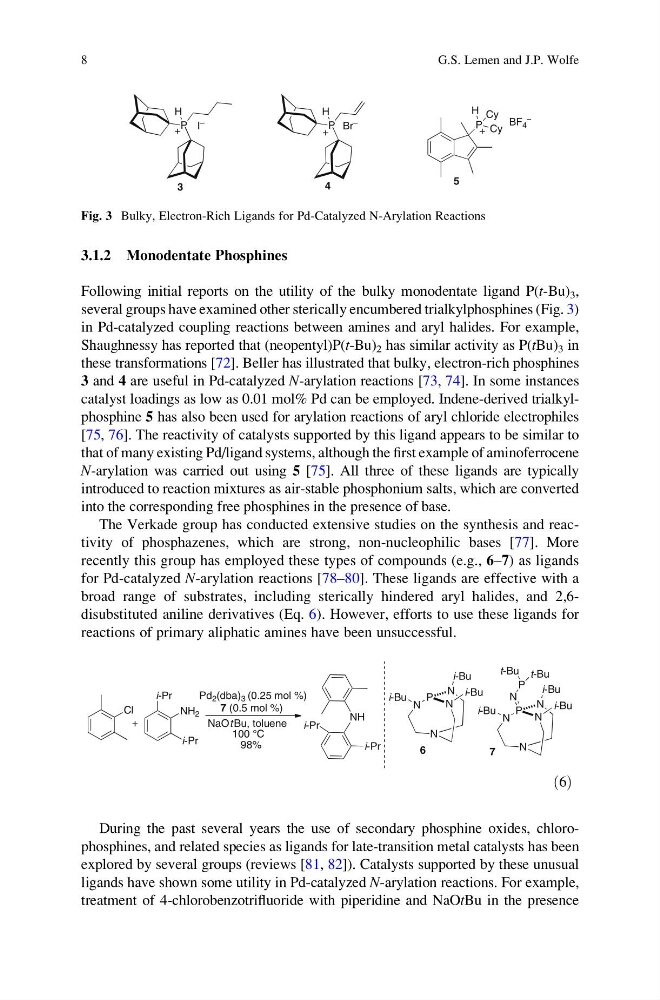
several groups have examined other sterically encumbered trialkylphosphines (Fig. 3)
in Pd-catalyzed coupling reactions between amines and aryl halides. For example,
Shaughnessy has reported that (neopentyl)P(t-Bu) 2 has similar activity as P(tBu) 3 in
these transformations [72]. Beller has illustrated that bulky, electron-rich phosphines
3 and 4 are useful in Pd-catalyzed N-arylation reactions [73, 74]. In some instances
catalyst loadings as low as 0.01 mol% Pd can be employed. Indene-derived trialkylphosphine 5 has also been used for arylation reactions of aryl chloride electrophiles
[75, 76]. The reactivity of catalysts supported by this ligand appears to be similar to
that of many existing Pd/ligand systems, although the first example of aminoferrocene
N-arylation was carried out using 5 [75]. All three of these ligands are typically
introduced to reaction mixtures as air-stable phosphonium salts, which are converted
into the corresponding free phosphines in the presence of base.
The Verkade group has conducted extensive studies on the synthesis and reactivity of phosphazenes, which are strong, non-nucleophilic bases [77]. More
recently this group has employed these types of compounds (e.g., 6–7) as ligands
for Pd-catalyzed N-arylation reactions [78–80]. These ligands are effective with a
broad range of substrates, including sterically hindered aryl halides, and 2,6disubstituted aniline derivatives (Eq. 6). However, efforts to use these ligands for
reactions of primary aliphatic amines have been unsuccessful.
N
P
i-Bu
N
N
N
i-Bu
i-Bu
6
N
P
i-Bu
N
N
N
i-Bu
i-Bu
7
N
P
t-Bu t-Bu
Cl
+
i-Pr
i-Pr
NH 2
Pd 2 (dba) 3 (0.25 mol %)
7 (0.5 mol %)
NH
i-Pr
i-Pr
98%
NaOt Bu, toluene
100 °C
ð6Þ
During the past several years the use of secondary phosphine oxides, chlorophosphines, and related species as ligands for late-transition metal catalysts has been
explored by several groups (reviews [81, 82]). Catalysts supported by these unusual
ligands have shown some utility in Pd-catalyzed N-arylation reactions. For example,
treatment of 4-chlorobenzotrifluoride with piperidine and NaOtBu in the presence
P
H
I –
P
H
Br –
3
4
P
H
Cy
Cy
BF 4
–
5
+
+
+
Fig. 3 Bulky, Electron-Rich Ligands for Pd-Catalyzed N-Arylation Reactions
8
G.S. Lemen and J.P. Wolfe
Following initial reports on the utility of the bulky monodentate ligand P(t-Bu) 3 ,
several groups have examined other sterically encumbered trialkylphosphines (Fig. 3)
in Pd-catalyzed coupling reactions between amines and aryl halides. For example,
Shaughnessy has reported that (neopentyl)P(t-Bu) 2 has similar activity as P(tBu) 3 in
these transformations [72]. Beller has illustrated that bulky, electron-rich phosphines
3 and 4 are useful in Pd-catalyzed N-arylation reactions [73, 74]. In some instances
catalyst loadings as low as 0.01 mol% Pd can be employed. Indene-derived trialkylphosphine 5 has also been used for arylation reactions of aryl chloride electrophiles
[75, 76]. The reactivity of catalysts supported by this ligand appears to be similar to
that of many existing Pd/ligand systems, although the first example of aminoferrocene
N-arylation was carried out using 5 [75]. All three of these ligands are typically
introduced to reaction mixtures as air-stable phosphonium salts, which are converted
into the corresponding free phosphines in the presence of base.
The Verkade group has conducted extensive studies on the synthesis and reactivity of phosphazenes, which are strong, non-nucleophilic bases [77]. More
recently this group has employed these types of compounds (e.g., 6–7) as ligands
for Pd-catalyzed N-arylation reactions [78–80]. These ligands are effective with a
broad range of substrates, including sterically hindered aryl halides, and 2,6disubstituted aniline derivatives (Eq. 6). However, efforts to use these ligands for
reactions of primary aliphatic amines have been unsuccessful.
N
P
i-Bu
N
N
N
i-Bu
i-Bu
6
N
P
i-Bu
N
N
N
i-Bu
i-Bu
7
N
P
t-Bu t-Bu
Cl
+
i-Pr
i-Pr
NH 2
Pd 2 (dba) 3 (0.25 mol %)
7 (0.5 mol %)
NH
i-Pr
i-Pr
98%
NaOt Bu, toluene
100 °C
ð6Þ
During the past several years the use of secondary phosphine oxides, chlorophosphines, and related species as ligands for late-transition metal catalysts has been
explored by several groups (reviews [81, 82]). Catalysts supported by these unusual
ligands have shown some utility in Pd-catalyzed N-arylation reactions. For example,
treatment of 4-chlorobenzotrifluoride with piperidine and NaOtBu in the presence
P
H
I –
P
H
Br –
3
4
P
H
Cy
Cy
BF 4
–
5
+
+
+
Fig. 3 Bulky, Electron-Rich Ligands for Pd-Catalyzed N-Arylation Reactions
8
G.S. Lemen and J.P. Wolfe