

NH
N
Cl
+
20 (1 mol %)
KOt Bu, DME
rt
87%
ð13Þ
N
OMe
Cl
HN
Me
+
21 (4 mol %)
N
Me
N
OMe
94%
N
Pd
Cl
Cl
Cl
N
N
R
R
R =
21
Cs 2 CO 3 , DME
80 ºC
ð14Þ
3.2 Modified Reaction Conditions or Techniques
That Facilitate Pd-Catalyzed N-Arylations
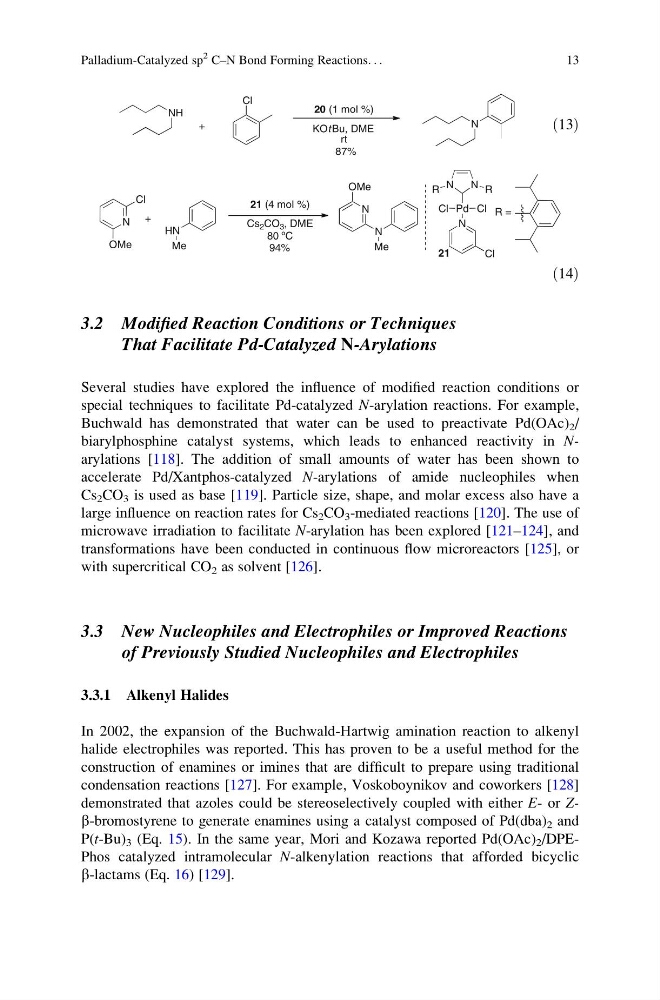
Several studies have explored the influence of modified reaction conditions or
special techniques to facilitate Pd-catalyzed N-arylation reactions. For example,
Buchwald has demonstrated that water can be used to preactivate Pd(OAc) 2 /
biarylphosphine catalyst systems, which leads to enhanced reactivity in Narylations [118]. The addition of small amounts of water has been shown to
accelerate Pd/Xantphos-catalyzed N-arylations of amide nucleophiles when
Cs 2 CO 3 is used as base [119]. Particle size, shape, and molar excess also have a
large influence on reaction rates for Cs 2 CO 3 -mediated reactions [120]. The use of
microwave irradiation to facilitate N-arylation has been explored [121–124], and
transformations have been conducted in continuous flow microreactors [125], or
with supercritical CO 2 as solvent [126].
3.3 New Nucleophiles and Electrophiles or Improved Reactions
of Previously Studied Nucleophiles and Electrophiles
3.3.1 Alkenyl Halides
In 2002, the expansion of the Buchwald-Hartwig amination reaction to alkenyl
halide electrophiles was reported. This has proven to be a useful method for the
construction of enamines or imines that are difficult to prepare using traditional
condensation reactions [127]. For example, Voskoboynikov and coworkers [128]
demonstrated that azoles could be stereoselectively coupled with either E- or Zb-bromostyrene to generate enamines using a catalyst composed of Pd(dba) 2 and
P(t-Bu) 3 (Eq. 15). In the same year, Mori and Kozawa reported Pd(OAc) 2 /DPEPhos catalyzed intramolecular N-alkenylation reactions that afforded bicyclic
b-lactams (Eq. 16) [129].
Palladium-Catalyzed sp
2 C–N Bond Forming Reactions. . .
13
N
Cl
+
20 (1 mol %)
KOt Bu, DME
rt
87%
ð13Þ
N
OMe
Cl
HN
Me
+
21 (4 mol %)
N
Me
N
OMe
94%
N
Pd
Cl
Cl
Cl
N
N
R
R
R =
21
Cs 2 CO 3 , DME
80 ºC
ð14Þ
3.2 Modified Reaction Conditions or Techniques
That Facilitate Pd-Catalyzed N-Arylations
Several studies have explored the influence of modified reaction conditions or
special techniques to facilitate Pd-catalyzed N-arylation reactions. For example,
Buchwald has demonstrated that water can be used to preactivate Pd(OAc) 2 /
biarylphosphine catalyst systems, which leads to enhanced reactivity in Narylations [118]. The addition of small amounts of water has been shown to
accelerate Pd/Xantphos-catalyzed N-arylations of amide nucleophiles when
Cs 2 CO 3 is used as base [119]. Particle size, shape, and molar excess also have a
large influence on reaction rates for Cs 2 CO 3 -mediated reactions [120]. The use of
microwave irradiation to facilitate N-arylation has been explored [121–124], and
transformations have been conducted in continuous flow microreactors [125], or
with supercritical CO 2 as solvent [126].
3.3 New Nucleophiles and Electrophiles or Improved Reactions
of Previously Studied Nucleophiles and Electrophiles
3.3.1 Alkenyl Halides
In 2002, the expansion of the Buchwald-Hartwig amination reaction to alkenyl
halide electrophiles was reported. This has proven to be a useful method for the
construction of enamines or imines that are difficult to prepare using traditional
condensation reactions [127]. For example, Voskoboynikov and coworkers [128]
demonstrated that azoles could be stereoselectively coupled with either E- or Zb-bromostyrene to generate enamines using a catalyst composed of Pd(dba) 2 and
P(t-Bu) 3 (Eq. 15). In the same year, Mori and Kozawa reported Pd(OAc) 2 /DPEPhos catalyzed intramolecular N-alkenylation reactions that afforded bicyclic
b-lactams (Eq. 16) [129].
Palladium-Catalyzed sp
2 C–N Bond Forming Reactions. . .
13