

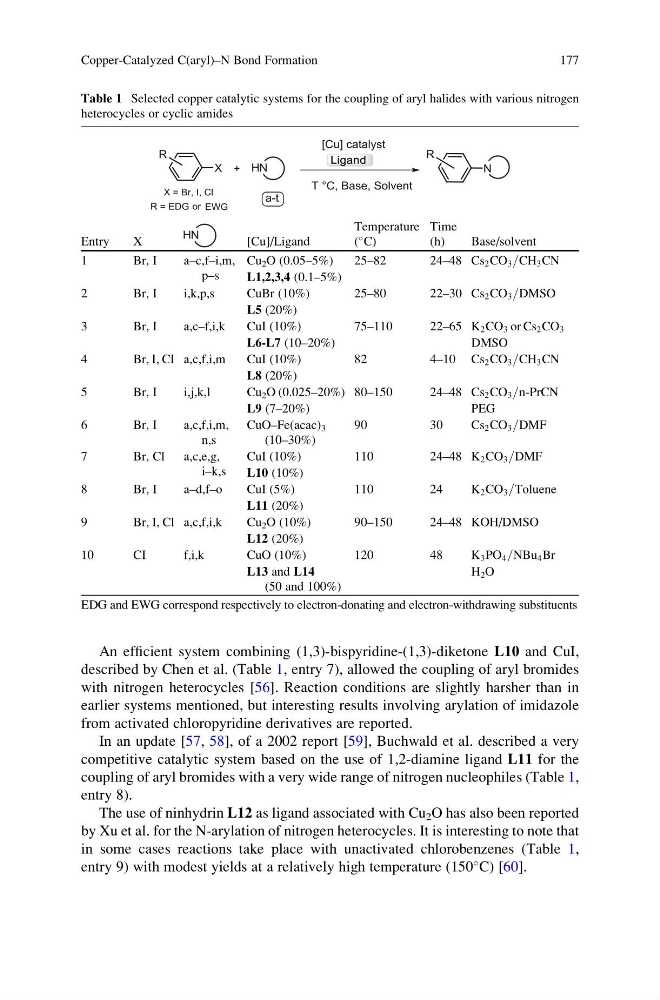
An efficient system combining (1,3)-bispyridine-(1,3)-diketone L10 and CuI,
described by Chen et al. (Table 1, entry 7), allowed the coupling of aryl bromides
with nitrogen heterocycles [56]. Reaction conditions are slightly harsher than in
earlier systems mentioned, but interesting results involving arylation of imidazole
from activated chloropyridine derivatives are reported.
In an update [57, 58], of a 2002 report [59], Buchwald et al. described a very
competitive catalytic system based on the use of 1,2-diamine ligand L11 for the
coupling of aryl bromides with a very wide range of nitrogen nucleophiles (Table 1,
entry 8).
The use of ninhydrin L12 as ligand associated with Cu 2 O has also been reported
by Xu et al. for the N-arylation of nitrogen heterocycles. It is interesting to note that
in some cases reactions take place with unactivated chlorobenzenes (Table 1,
entry 9) with modest yields at a relatively high temperature (150
C) [60].
Table 1 Selected copper catalytic systems for the coupling of aryl halides with various nitrogen
heterocycles or cyclic amides
Entry
X
[Cu]/Ligand
Temperature
(
C)
Time
(h)
Base/solvent
1
Br, I
a–c,f–i,m,
p–s
Cu 2 O (0.05–5%)
25–82
24–48 Cs 2 CO 3 =CH 3 CN
L1,2,3,4 (0.1–5%)
2
Br, I
i,k,p,s
CuBr (10%)
25–80
22–30 Cs 2 CO 3 =DMSO
L5 (20%)
3
Br, I
a,c–f,i,k
CuI (10%)
75–110
22–65 K 2 CO 3 or Cs 2 CO 3
L6-L7 (10–20%)
DMSO
4
Br, I, CI a,c,f,i,m
CuI (10%)
82
4–10 Cs 2 CO 3 =CH 3 CN
L8 (20%)
5
Br, I
i,j,k,l
Cu 2 O (0.025–20%) 80–150
24–48 Cs 2 CO 3 =n-PrCN
L9 (7–20%)
PEG
6
Br, I
a,c,f,i,m,
n,s
CuO–Fe(acac) 3
(10–30%)
90
30
Cs 2 CO 3 =DMF
7
Br, Cl a,c,e,g,
i–k,s
CuI (10%)
110
24–48 K 2 CO 3 =DMF
L10 (10%)
8
Br, I
a–d,f–o
CuI (5%)
110
24
K 2 CO 3 =Toluene
L11 (20%)
9
Br, I, Cl a,c,f,i,k
Cu 2 O (10%)
90–150
24–48 KOH/DMSO
L12 (20%)
10
CI
f,i,k
CuO (10%)
120
48
K 3 PO 4 =NBu 4 Br
L13 and L14
(50 and 100%)
H 2 O
EDG and EWG correspond respectively to electron-donating and electron-withdrawing substituents
Copper-Catalyzed C(aryl)–N Bond Formation
177
described by Chen et al. (Table 1, entry 7), allowed the coupling of aryl bromides
with nitrogen heterocycles [56]. Reaction conditions are slightly harsher than in
earlier systems mentioned, but interesting results involving arylation of imidazole
from activated chloropyridine derivatives are reported.
In an update [57, 58], of a 2002 report [59], Buchwald et al. described a very
competitive catalytic system based on the use of 1,2-diamine ligand L11 for the
coupling of aryl bromides with a very wide range of nitrogen nucleophiles (Table 1,
entry 8).
The use of ninhydrin L12 as ligand associated with Cu 2 O has also been reported
by Xu et al. for the N-arylation of nitrogen heterocycles. It is interesting to note that
in some cases reactions take place with unactivated chlorobenzenes (Table 1,
entry 9) with modest yields at a relatively high temperature (150
C) [60].
Table 1 Selected copper catalytic systems for the coupling of aryl halides with various nitrogen
heterocycles or cyclic amides
Entry
X
[Cu]/Ligand
Temperature
(
C)
Time
(h)
Base/solvent
1
Br, I
a–c,f–i,m,
p–s
Cu 2 O (0.05–5%)
25–82
24–48 Cs 2 CO 3 =CH 3 CN
L1,2,3,4 (0.1–5%)
2
Br, I
i,k,p,s
CuBr (10%)
25–80
22–30 Cs 2 CO 3 =DMSO
L5 (20%)
3
Br, I
a,c–f,i,k
CuI (10%)
75–110
22–65 K 2 CO 3 or Cs 2 CO 3
L6-L7 (10–20%)
DMSO
4
Br, I, CI a,c,f,i,m
CuI (10%)
82
4–10 Cs 2 CO 3 =CH 3 CN
L8 (20%)
5
Br, I
i,j,k,l
Cu 2 O (0.025–20%) 80–150
24–48 Cs 2 CO 3 =n-PrCN
L9 (7–20%)
PEG
6
Br, I
a,c,f,i,m,
n,s
CuO–Fe(acac) 3
(10–30%)
90
30
Cs 2 CO 3 =DMF
7
Br, Cl a,c,e,g,
i–k,s
CuI (10%)
110
24–48 K 2 CO 3 =DMF
L10 (10%)
8
Br, I
a–d,f–o
CuI (5%)
110
24
K 2 CO 3 =Toluene
L11 (20%)
9
Br, I, Cl a,c,f,i,k
Cu 2 O (10%)
90–150
24–48 KOH/DMSO
L12 (20%)
10
CI
f,i,k
CuO (10%)
120
48
K 3 PO 4 =NBu 4 Br
L13 and L14
(50 and 100%)
H 2 O
EDG and EWG correspond respectively to electron-donating and electron-withdrawing substituents
Copper-Catalyzed C(aryl)–N Bond Formation
177