

Starting, for example, from pyrazole and aryl bromides, it takes less than four
hours. The use of this ligand made it possible to follow the reaction by
31 P NMR
spectroscopy and thus to propose a mechanism for the Ullmann reaction [49, 50].
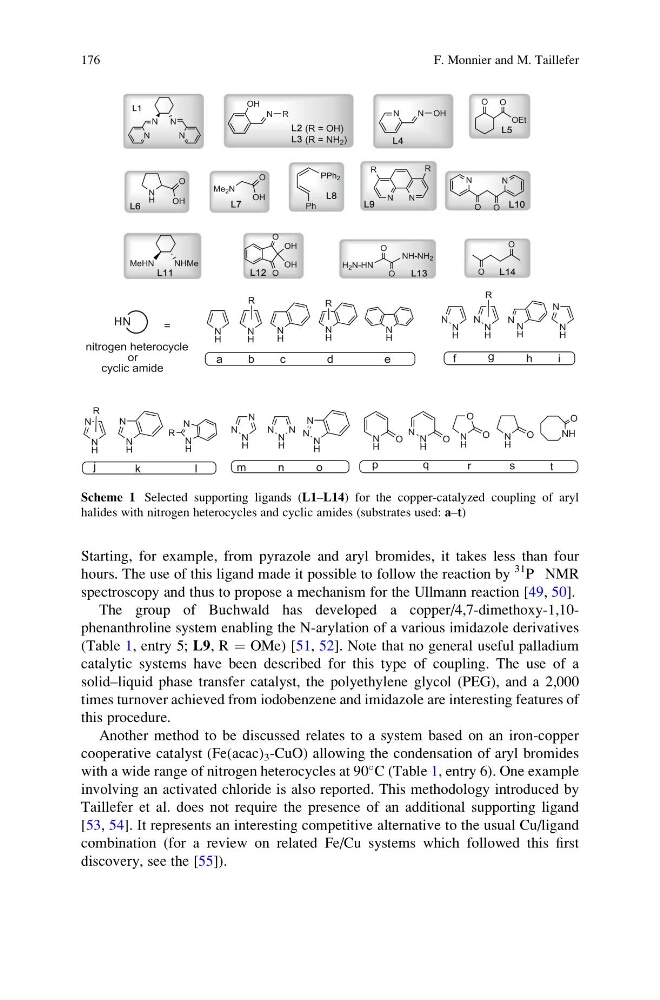
The group of Buchwald has developed a copper/4,7-dimethoxy-1,10phenanthroline system enabling the N-arylation of a various imidazole derivatives
(Table 1, entry 5; L9, R ¼ OMe) [51, 52]. Note that no general useful palladium
catalytic systems have been described for this type of coupling. The use of a
solid–liquid phase transfer catalyst, the polyethylene glycol (PEG), and a 2,000
times turnover achieved from iodobenzene and imidazole are interesting features of
this procedure.
Another method to be discussed relates to a system based on an iron-copper
cooperative catalyst (Fe(acac) 3 -CuO) allowing the condensation of aryl bromides
with a wide range of nitrogen heterocycles at 90
C (Table 1, entry 6). One example
involving an activated chloride is also reported. This methodology introduced by
Taillefer et al. does not require the presence of an additional supporting ligand
[53, 54]. It represents an interesting competitive alternative to the usual Cu/ligand
combination (for a review on related Fe/Cu systems which followed this first
discovery, see the [55]).
Scheme 1 Selected supporting ligands (L1–L14) for the copper-catalyzed coupling of aryl
halides with nitrogen heterocycles and cyclic amides (substrates used: a–t)
176
F. Monnier and M. Taillefer
hours. The use of this ligand made it possible to follow the reaction by
31 P NMR
spectroscopy and thus to propose a mechanism for the Ullmann reaction [49, 50].
The group of Buchwald has developed a copper/4,7-dimethoxy-1,10phenanthroline system enabling the N-arylation of a various imidazole derivatives
(Table 1, entry 5; L9, R ¼ OMe) [51, 52]. Note that no general useful palladium
catalytic systems have been described for this type of coupling. The use of a
solid–liquid phase transfer catalyst, the polyethylene glycol (PEG), and a 2,000
times turnover achieved from iodobenzene and imidazole are interesting features of
this procedure.
Another method to be discussed relates to a system based on an iron-copper
cooperative catalyst (Fe(acac) 3 -CuO) allowing the condensation of aryl bromides
with a wide range of nitrogen heterocycles at 90
C (Table 1, entry 6). One example
involving an activated chloride is also reported. This methodology introduced by
Taillefer et al. does not require the presence of an additional supporting ligand
[53, 54]. It represents an interesting competitive alternative to the usual Cu/ligand
combination (for a review on related Fe/Cu systems which followed this first
discovery, see the [55]).
Scheme 1 Selected supporting ligands (L1–L14) for the copper-catalyzed coupling of aryl
halides with nitrogen heterocycles and cyclic amides (substrates used: a–t)
176
F. Monnier and M. Taillefer