

The last example reports the CuO-catalyzed N-arylation of nitrogen heterocycles
(and also anilines and ammonia) in water. The procedure, reported by Wan et al., is
quite complex. It indeed requires the presence of a very large excess of the
nucleophiles, a phase transfer agent (NBu 4 Br) and two ligands L13 (50%) and
L14 (100%). It however represents one of the rare examples of copper-catalyzed
coupling applied to nonactivated aryl chlorides [61].
Some years ago, Bolm et al. highlighted the fact that a sub-Mol% loading in
copper salt (between 0.05 and 0.001 mol%) was able to successfully promote at
135
C the coupling of the phenyl iodide with the pyrazole and the azaindole in the
presence of a large excess of DMEDA ligand (N,N
0 -dimethylenediamine, L26)
[62–65]. The procedure was also applied to other types of nucleophiles such as
the phenol, the S-methyl-S-phenylsulfoximine, and the phenyl acetylene. Note that
the use of a low amount of copper for the C–N coupling was reported [15], using the
4,7-dimethoxy-1,10-phenanthroline ligand L9 (R ¼ Me) [51, 52] or polydentate
ligands of Schiff base and oxime type (L1–L4) [41–43] (the latter were also
efficient with low amount of copper for the C–O coupling [15]).
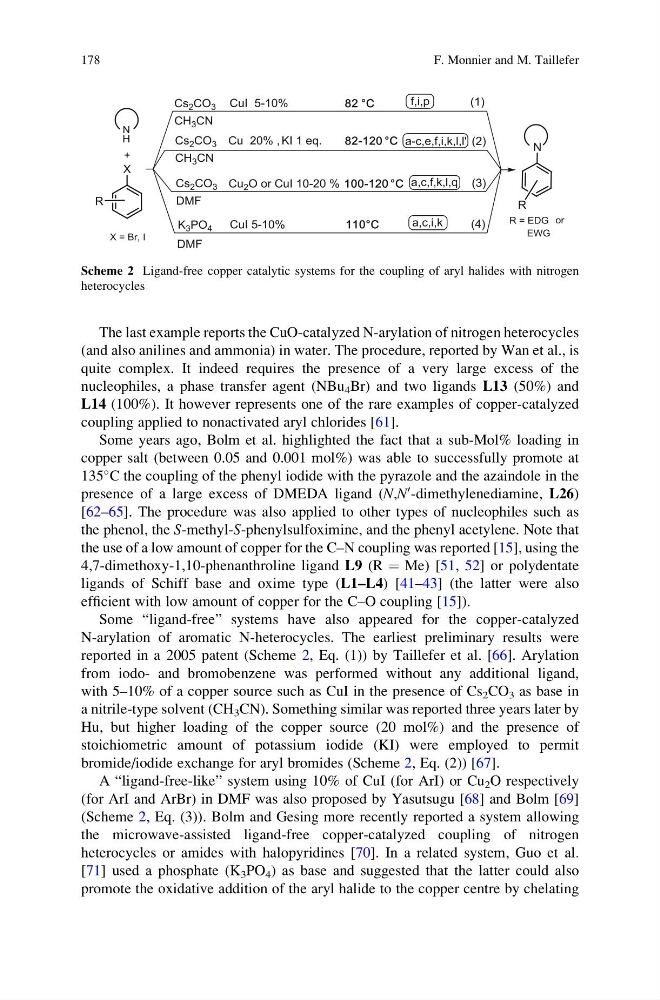
Some “ligand-free” systems have also appeared for the copper-catalyzed
N-arylation of aromatic N-heterocycles. The earliest preliminary results were
reported in a 2005 patent (Scheme 2, Eq. (1)) by Taillefer et al. [66]. Arylation
from iodo- and bromobenzene was performed without any additional ligand,
with 5–10% of a copper source such as CuI in the presence of Cs 2 CO 3 as base in
a nitrile-type solvent (CH 3 CN). Something similar was reported three years later by
Hu, but higher loading of the copper source (20 mol%) and the presence of
stoichiometric amount of potassium iodide (KI) were employed to permit
bromide/iodide exchange for aryl bromides (Scheme 2, Eq. (2)) [67].
A “ligand-free-like” system using 10% of CuI (for ArI) or Cu 2 O respectively
(for ArI and ArBr) in DMF was also proposed by Yasutsugu [68] and Bolm [69]
(Scheme 2, Eq. (3)). Bolm and Gesing more recently reported a system allowing
the microwave-assisted ligand-free copper-catalyzed coupling of nitrogen
heterocycles or amides with halopyridines [70]. In a related system, Guo et al.
[71] used a phosphate (K 3 PO 4 ) as base and suggested that the latter could also
promote the oxidative addition of the aryl halide to the copper centre by chelating
Scheme 2 Ligand-free copper catalytic systems for the coupling of aryl halides with nitrogen
heterocycles
178
F. Monnier and M. Taillefer
(and also anilines and ammonia) in water. The procedure, reported by Wan et al., is
quite complex. It indeed requires the presence of a very large excess of the
nucleophiles, a phase transfer agent (NBu 4 Br) and two ligands L13 (50%) and
L14 (100%). It however represents one of the rare examples of copper-catalyzed
coupling applied to nonactivated aryl chlorides [61].
Some years ago, Bolm et al. highlighted the fact that a sub-Mol% loading in
copper salt (between 0.05 and 0.001 mol%) was able to successfully promote at
135
C the coupling of the phenyl iodide with the pyrazole and the azaindole in the
presence of a large excess of DMEDA ligand (N,N
0 -dimethylenediamine, L26)
[62–65]. The procedure was also applied to other types of nucleophiles such as
the phenol, the S-methyl-S-phenylsulfoximine, and the phenyl acetylene. Note that
the use of a low amount of copper for the C–N coupling was reported [15], using the
4,7-dimethoxy-1,10-phenanthroline ligand L9 (R ¼ Me) [51, 52] or polydentate
ligands of Schiff base and oxime type (L1–L4) [41–43] (the latter were also
efficient with low amount of copper for the C–O coupling [15]).
Some “ligand-free” systems have also appeared for the copper-catalyzed
N-arylation of aromatic N-heterocycles. The earliest preliminary results were
reported in a 2005 patent (Scheme 2, Eq. (1)) by Taillefer et al. [66]. Arylation
from iodo- and bromobenzene was performed without any additional ligand,
with 5–10% of a copper source such as CuI in the presence of Cs 2 CO 3 as base in
a nitrile-type solvent (CH 3 CN). Something similar was reported three years later by
Hu, but higher loading of the copper source (20 mol%) and the presence of
stoichiometric amount of potassium iodide (KI) were employed to permit
bromide/iodide exchange for aryl bromides (Scheme 2, Eq. (2)) [67].
A “ligand-free-like” system using 10% of CuI (for ArI) or Cu 2 O respectively
(for ArI and ArBr) in DMF was also proposed by Yasutsugu [68] and Bolm [69]
(Scheme 2, Eq. (3)). Bolm and Gesing more recently reported a system allowing
the microwave-assisted ligand-free copper-catalyzed coupling of nitrogen
heterocycles or amides with halopyridines [70]. In a related system, Guo et al.
[71] used a phosphate (K 3 PO 4 ) as base and suggested that the latter could also
promote the oxidative addition of the aryl halide to the copper centre by chelating
Scheme 2 Ligand-free copper catalytic systems for the coupling of aryl halides with nitrogen
heterocycles
178
F. Monnier and M. Taillefer