

triethylamine and pyridine provided good yield. However, we continued the
reactions in triethylamine instead of pyridine because of toxicity reasons.
The reaction temperature plays an important role, the reaction at room temperature afforded 80% of the coupled product after 18 h (87%, 24 h), while the duration
of the reaction is drastically decreased to 2.5 h under reflux conditions to provide
quantitative yields (Table 34, entry 1). After optimizing the reaction conditions,
different arylboronic acids were coupled with imidazole using CELL-Cu(0) catalyst, triethylamine as base and methanol as solvent under refluxing conditions, and
the results are summarized in Table 34. Various structurally and electronically
diverse arylboronic acids gave the corresponding N-arylated products in high
yields. However, methyl-, acetyl-, and methoxy-substituted boronic acids required
longer reaction times (Table 34, entries 5, 6 and 8) compared to chloro-, fluoro-, and
trifluoromethyl-substituted boronic acids (Table 34, entries 2, 3 and 4). o- and psubstituted arylboronic acids were equally effective for the coupling with
imidazoles (Table 34, entries 7 and 8).
Later we reported [84] the N-arylation of imidazoles, imides, amines, amides,
and sulfonamides with arylboronic acids using a recyclable Cu(OAc) 2 ·H 2 O/[bmim]
[BF 4 ] system in the absence of a base or additive to afford the corresponding
N-arylated products in good to excellent yields.
Similarly, the cross-coupling reaction between imidazole and phenylboronic
acid was performed with different ILs, and the results are grouped in Fig. 4.
Among the ILs tested, hydrophilic [bmim][BF 4 ] was found to be superior (95%
yield) than that of hydrophobic [bmim][PF 6 ] (80% yield), whereas the crosscoupling reaction was not successful in other molten salts such as n-tetrabutylammonium bromide (n-Bu 4 Br) and 1-n-butyl-3-methylimidazolium bromide,
[bmim][Br], under similar reactions conditions. These results clearly indicate that
both the cation and anion play a significant role in this cross-coupling reactions.
Under optimized reaction conditions, a wide range of structurally diverse
arylboronic acids were coupled with imidazole (Table 35, entries 1–7) using
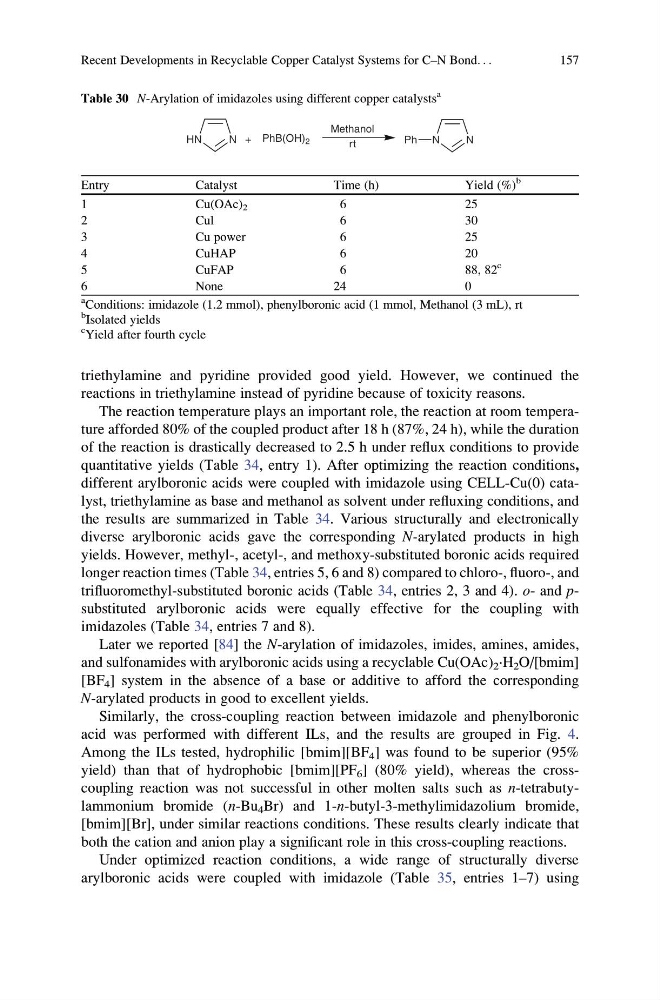
Table 30 N-Arylation of imidazoles using different copper catalysts
a
HN
N
PhB(OH) 2
N
N
Ph
+
Methanol
rt
Entry
Catalyst
Time (h)
Yield (%)
b
1
Cu(OAc) 2
6
2 5
2
Cul
6
30
3
Cu power
6
25
4
CuHAP
6
20
5
CuFAP
6
88, 82
c
6
None
24
0
a
Conditions: imidazole (1.2 mmol), phenylboronic acid (1 mmol, Methanol (3 mL), rt
b
Isolated yields
c
Yield after fourth cycle
Recent Developments in Recyclable Copper Catalyst Systems for C–N Bond. . .
157
reactions in triethylamine instead of pyridine because of toxicity reasons.
The reaction temperature plays an important role, the reaction at room temperature afforded 80% of the coupled product after 18 h (87%, 24 h), while the duration
of the reaction is drastically decreased to 2.5 h under reflux conditions to provide
quantitative yields (Table 34, entry 1). After optimizing the reaction conditions,
different arylboronic acids were coupled with imidazole using CELL-Cu(0) catalyst, triethylamine as base and methanol as solvent under refluxing conditions, and
the results are summarized in Table 34. Various structurally and electronically
diverse arylboronic acids gave the corresponding N-arylated products in high
yields. However, methyl-, acetyl-, and methoxy-substituted boronic acids required
longer reaction times (Table 34, entries 5, 6 and 8) compared to chloro-, fluoro-, and
trifluoromethyl-substituted boronic acids (Table 34, entries 2, 3 and 4). o- and psubstituted arylboronic acids were equally effective for the coupling with
imidazoles (Table 34, entries 7 and 8).
Later we reported [84] the N-arylation of imidazoles, imides, amines, amides,
and sulfonamides with arylboronic acids using a recyclable Cu(OAc) 2 ·H 2 O/[bmim]
[BF 4 ] system in the absence of a base or additive to afford the corresponding
N-arylated products in good to excellent yields.
Similarly, the cross-coupling reaction between imidazole and phenylboronic
acid was performed with different ILs, and the results are grouped in Fig. 4.
Among the ILs tested, hydrophilic [bmim][BF 4 ] was found to be superior (95%
yield) than that of hydrophobic [bmim][PF 6 ] (80% yield), whereas the crosscoupling reaction was not successful in other molten salts such as n-tetrabutylammonium bromide (n-Bu 4 Br) and 1-n-butyl-3-methylimidazolium bromide,
[bmim][Br], under similar reactions conditions. These results clearly indicate that
both the cation and anion play a significant role in this cross-coupling reactions.
Under optimized reaction conditions, a wide range of structurally diverse
arylboronic acids were coupled with imidazole (Table 35, entries 1–7) using
Table 30 N-Arylation of imidazoles using different copper catalysts
a
HN
N
PhB(OH) 2
N
N
Ph
+
Methanol
rt
Entry
Catalyst
Time (h)
Yield (%)
b
1
Cu(OAc) 2
6
2 5
2
Cul
6
30
3
Cu power
6
25
4
CuHAP
6
20
5
CuFAP
6
88, 82
c
6
None
24
0
a
Conditions: imidazole (1.2 mmol), phenylboronic acid (1 mmol, Methanol (3 mL), rt
b
Isolated yields
c
Yield after fourth cycle
Recent Developments in Recyclable Copper Catalyst Systems for C–N Bond. . .
157