

Cu(OAc) 2 ÁH 2 O/[bmim][BF 4 ] system to produce the corresponding substituted Naryl imidazoles in good to excellent yields. Finally, upon completion of the
reaction, the ionic liquid phase containing [bmim][BF 4 ] and catalyst was almost
quantitatively recovered by simple extraction of the product with Et 2 O. The
recovered ionic liquid phase containing the catalyst was reused for several cycles
with consistent activity (Table 35, entry 1).
In an endeavor to expand the scope of the above methodology, the catalytic
system was applied to imides, amines, amides, and sulfonamides. A series of
substituted arylboronic acids were coupled with phthalimide (Table 36, entries
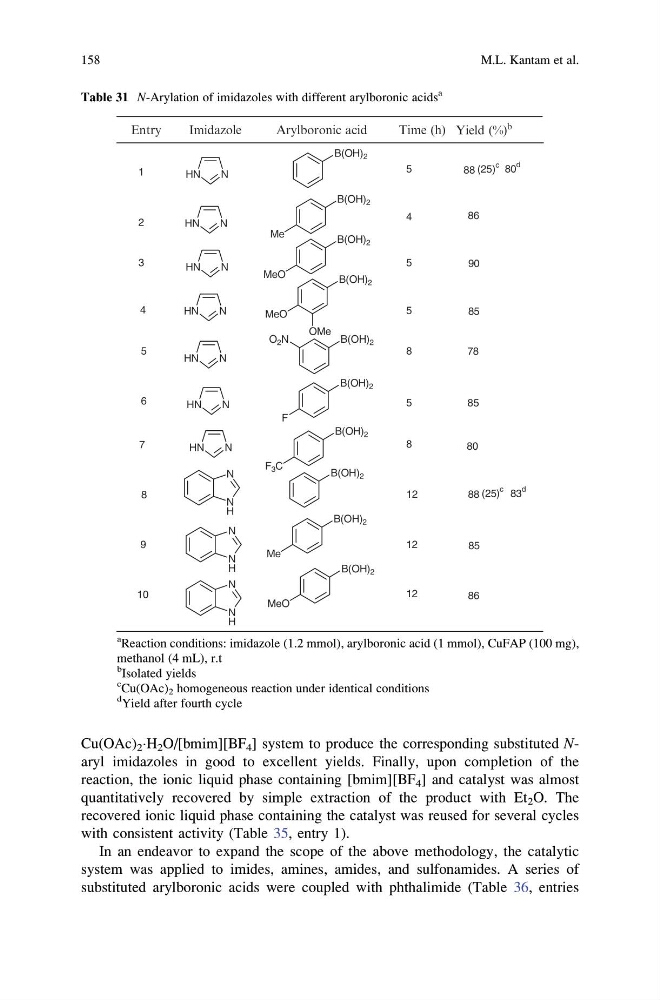
Table 31 N-Arylation of imidazoles with different arylboronic acids
a
HN
N
HN
N
HN
N
HN
N
B(OH) 2
B(OH) 2
MeO
B(OH) 2
Me
B(OH) 2
O 2 N
HN
N
HN
N
HN
N
B(OH) 2
MeO
OMe
B(OH) 2
F
B(OH) 2
F 3 C
B(OH) 2
B(OH) 2
MeO
B(OH) 2
Me
N
H
N
N
H
N
N
H
N
Entry
Imidazole
Arylboronic acid
Time (h)
1
2
3
4
5
4
5
8
88
86
90
78
5
6
7
5
85
5
85
(25)
c 80
d
8
80
8
9
10
12
12
88
85
86
(25)
c 83
d
12
Yield (%)
b
a
Reaction conditions: imidazole (1.2 mmol), arylboronic acid (1 mmol), CuFAP (100 mg),
methanol (4 mL), r.t
b
Isolated yields
c
Cu(OAc) 2 homogeneous reaction under identical conditions
d
Yield after fourth cycle
158
M.L. Kantam et al.
reaction, the ionic liquid phase containing [bmim][BF 4 ] and catalyst was almost
quantitatively recovered by simple extraction of the product with Et 2 O. The
recovered ionic liquid phase containing the catalyst was reused for several cycles
with consistent activity (Table 35, entry 1).
In an endeavor to expand the scope of the above methodology, the catalytic
system was applied to imides, amines, amides, and sulfonamides. A series of
substituted arylboronic acids were coupled with phthalimide (Table 36, entries
Table 31 N-Arylation of imidazoles with different arylboronic acids
a
HN
N
HN
N
HN
N
HN
N
B(OH) 2
B(OH) 2
MeO
B(OH) 2
Me
B(OH) 2
O 2 N
HN
N
HN
N
HN
N
B(OH) 2
MeO
OMe
B(OH) 2
F
B(OH) 2
F 3 C
B(OH) 2
B(OH) 2
MeO
B(OH) 2
Me
N
H
N
N
H
N
N
H
N
Entry
Imidazole
Arylboronic acid
Time (h)
1
2
3
4
5
4
5
8
88
86
90
78
5
6
7
5
85
5
85
(25)
c 80
d
8
80
8
9
10
12
12
88
85
86
(25)
c 83
d
12
Yield (%)
b
a
Reaction conditions: imidazole (1.2 mmol), arylboronic acid (1 mmol), CuFAP (100 mg),
methanol (4 mL), r.t
b
Isolated yields
c
Cu(OAc) 2 homogeneous reaction under identical conditions
d
Yield after fourth cycle
158
M.L. Kantam et al.