

reaction was continued with the filtrate for 10 h. Almost no change in the conversion of iodobenzene was observed. These studies and the non-activity of Cu(OAc) 2
in N-arylation of imidazole clearly prove that the reaction occurred heterogeneously. Lipshutz et al. [56] also reported that significant amount of supported
metal can be dissolved during the reaction and would redeposit quickly on the solid
during the filtration as a result of unavoidable minor temperature differences during
the filtration. It also may be assumed in this case that during filtration, the solid
matrix (silica) traps the copper species leached from the catalyst during the
reaction.
15 Bio-degradable Cellulose-Supported Copper(0) Catalyst
Cellulose is a natural biopolymer, which is biodegradable, environmentally safe,
widely abundant, inexpensive, and easy to handle [57]. Cellulose and its derivatives
are widely used in chemical and bio-chemical applications and also as supports for
the synthesis of organic molecules [58]. Interestingly, the cellulose fibers also act as
a nanoreactor for the stabilization of metal nanoparticles [59]. However, its use as a
support for catalytic applications is not well explored. Recently, Choplin and
coworkers reported cellulose as the support for water soluble Pd(OAc) 2 /5 TPPTS
system in the Trost–Tsuji allylic alkylation reaction [60]. To corroborate the above
concept in the cross coupling of aryl halides and boronic acids, we reported
N-arylation of imidazoles with aryl halides using a cellulose-supported Cu(0)
catalyst (CELL-Cu(0) [61] . The prepared catalyst was well characterized using
various instrumental techniques. For example, the X-ray diffraction pattern of
CELL-Cu(0) catalyst clearly indicates the presence of Cu (111) and Cu (200)
phases which are attributed to Cu(0) [46]. Further, the high resolution XPS narrow
scan spectrum of the fresh CELL-Cu(0) catalyst shows a Cu 2p3/2 peak at
932.72 ev, which is attributed to Cu (0) [22].
The scope of the cellulose-supported copper catalyst has been examined in
the case of aryl halides, and the results are summarized in Table 23. A very good
yield (89%) was observed for the reaction of imidazole with 4-iodoanisole
60
65
70
75
80
85
90
95
100
0
1
2
3
4
5
6
Yield (%)
Number of cycles
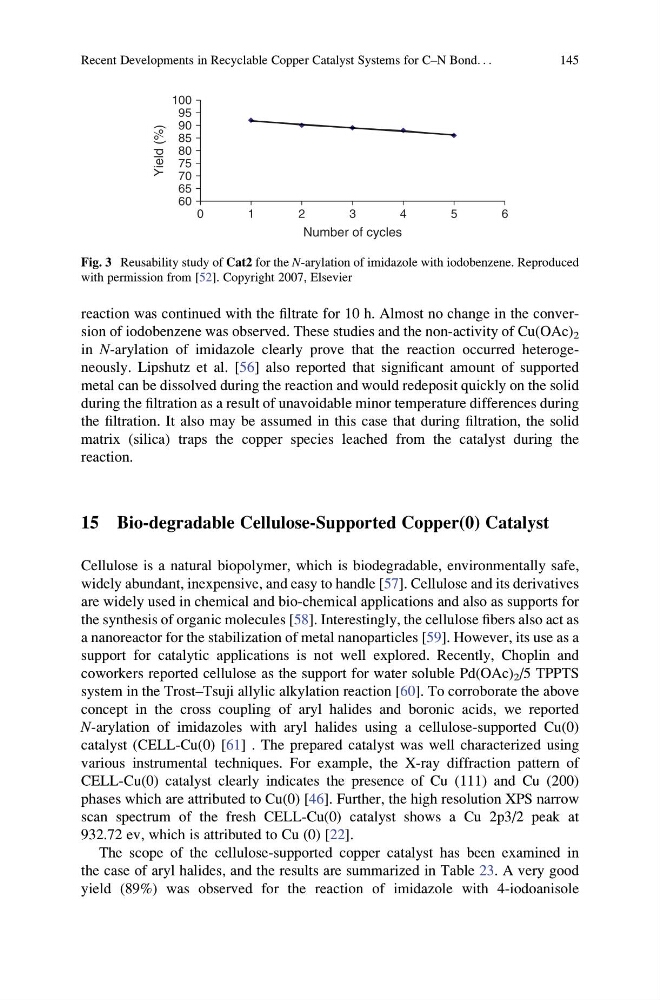
Fig. 3 Reusability study of Cat2 for the N-arylation of imidazole with iodobenzene. Reproduced
with permission from [52]. Copyright 2007, Elsevier
Recent Developments in Recyclable Copper Catalyst Systems for C–N Bond. . .
145
in N-arylation of imidazole clearly prove that the reaction occurred heterogeneously. Lipshutz et al. [56] also reported that significant amount of supported
metal can be dissolved during the reaction and would redeposit quickly on the solid
during the filtration as a result of unavoidable minor temperature differences during
the filtration. It also may be assumed in this case that during filtration, the solid
matrix (silica) traps the copper species leached from the catalyst during the
reaction.
15 Bio-degradable Cellulose-Supported Copper(0) Catalyst
Cellulose is a natural biopolymer, which is biodegradable, environmentally safe,
widely abundant, inexpensive, and easy to handle [57]. Cellulose and its derivatives
are widely used in chemical and bio-chemical applications and also as supports for
the synthesis of organic molecules [58]. Interestingly, the cellulose fibers also act as
a nanoreactor for the stabilization of metal nanoparticles [59]. However, its use as a
support for catalytic applications is not well explored. Recently, Choplin and
coworkers reported cellulose as the support for water soluble Pd(OAc) 2 /5 TPPTS
system in the Trost–Tsuji allylic alkylation reaction [60]. To corroborate the above
concept in the cross coupling of aryl halides and boronic acids, we reported
N-arylation of imidazoles with aryl halides using a cellulose-supported Cu(0)
catalyst (CELL-Cu(0) [61] . The prepared catalyst was well characterized using
various instrumental techniques. For example, the X-ray diffraction pattern of
CELL-Cu(0) catalyst clearly indicates the presence of Cu (111) and Cu (200)
phases which are attributed to Cu(0) [46]. Further, the high resolution XPS narrow
scan spectrum of the fresh CELL-Cu(0) catalyst shows a Cu 2p3/2 peak at
932.72 ev, which is attributed to Cu (0) [22].
The scope of the cellulose-supported copper catalyst has been examined in
the case of aryl halides, and the results are summarized in Table 23. A very good
yield (89%) was observed for the reaction of imidazole with 4-iodoanisole
60
65
70
75
80
85
90
95
100
0
1
2
3
4
5
6
Yield (%)
Number of cycles
Fig. 3 Reusability study of Cat2 for the N-arylation of imidazole with iodobenzene. Reproduced
with permission from [52]. Copyright 2007, Elsevier
Recent Developments in Recyclable Copper Catalyst Systems for C–N Bond. . .
145