

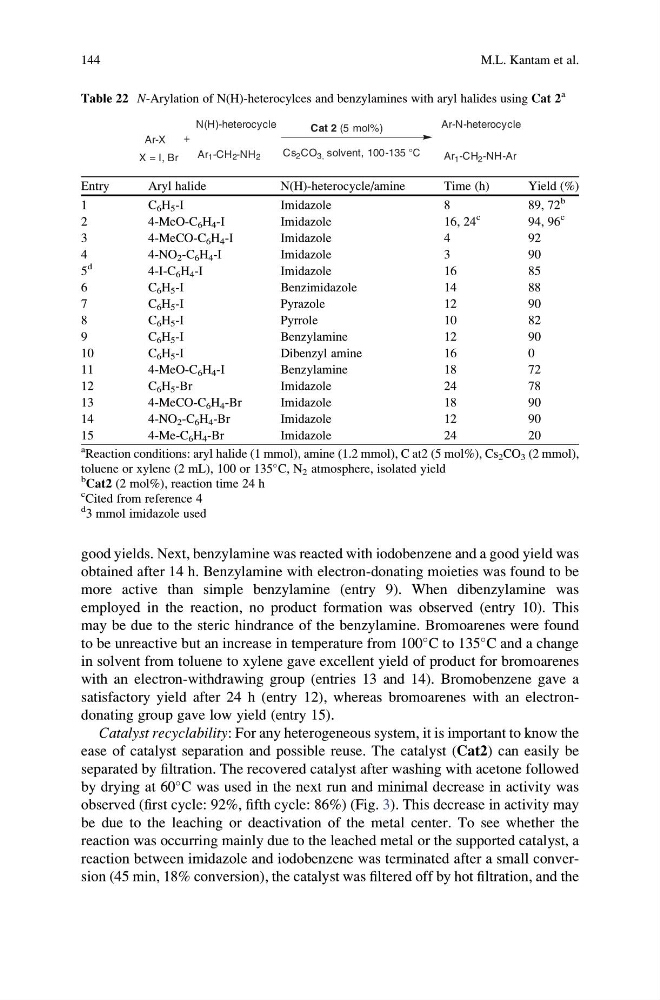
good yields. Next, benzylamine was reacted with iodobenzene and a good yield was
obtained after 14 h. Benzylamine with electron-donating moieties was found to be
more active than simple benzylamine (entry 9). When dibenzylamine was
employed in the reaction, no product formation was observed (entry 10). This
may be due to the steric hindrance of the benzylamine. Bromoarenes were found
to be unreactive but an increase in temperature from 100
C to 135
C and a change
in solvent from toluene to xylene gave excellent yield of product for bromoarenes
with an electron-withdrawing group (entries 13 and 14). Bromobenzene gave a
satisfactory yield after 24 h (entry 12), whereas bromoarenes with an electrondonating group gave low yield (entry 15).
Catalyst recyclability: For any heterogeneous system, it is important to know the
ease of catalyst separation and possible reuse. The catalyst (Cat2) can easily be
separated by filtration. The recovered catalyst after washing with acetone followed
by drying at 60
C was used in the next run and minimal decrease in activity was
observed (first cycle: 92%, fifth cycle: 86%) (Fig. 3). This decrease in activity may
be due to the leaching or deactivation of the metal center. To see whether the
reaction was occurring mainly due to the leached metal or the supported catalyst, a
reaction between imidazole and iodobenzene was terminated after a small conversion (45 min, 18% conversion), the catalyst was filtered off by hot filtration, and the
Table 22 N-Arylation of N(H)-heterocylces and benzylamines with aryl halides using Cat 2
a
Ar-X
N(H)-heterocycle
+
Ar-N-heterocycle
Ar 1 -CH 2 -NH 2
Cs 2 CO 3, solvent, 100-135 °C
Cat 2 (5 mol%)
Ar 1 -CH 2 -NH-Ar
X = I, Br
Entry
Aryl halide
N(H)-heterocycle/amine
Time (h)
Yield (%)
1
C 6 H 5 -I
Imidazole
8
89, 72
b
2
4-MeO-C 6 H 4 -I
Imidazole
16, 24
c
94, 96
c
3
4-MeCO-C 6 H 4 -I
Imidazole
4
92
4
4-NO 2 -C 6 H 4 -I
Imidazole
3
90
5
d
4-I-C 6 H 4 -I
Imidazole
16
85
6
C 6 H 5 -I
Benzimidazole
14
88
7
C 6 H 5 -I
Pyrazole
12
90
8
C 6 H 5 -I
Pyrrole
10
82
9
C 6 H 5 -I
Benzylamine
12
90
10
C 6 H 5 -I
Dibenzyl amine
16
0
11
4-MeO-C 6 H 4 -I
Benzylamine
18
72
12
C 6 H 5 -Br
Imidazole
24
78
13
4-MeCO-C 6 H 4 -Br
Imidazole
18
90
14
4-NO 2 -C 6 H 4 -Br
Imidazole
12
90
15
4-Me-C 6 H 4 -Br
Imidazole
24
20
a
Reaction conditions: aryl halide (1 mmol), amine (1.2 mmol), C at2 (5 mol%), Cs 2 CO 3 (2 mmol),
toluene or xylene (2 mL), 100 or 135
C, N 2 atmosphere, isolated yield
b
Cat2 (2 mol%), reaction time 24 h
c
Cited from reference 4
d
3 mmol imidazole used
144
M.L. Kantam et al.
obtained after 14 h. Benzylamine with electron-donating moieties was found to be
more active than simple benzylamine (entry 9). When dibenzylamine was
employed in the reaction, no product formation was observed (entry 10). This
may be due to the steric hindrance of the benzylamine. Bromoarenes were found
to be unreactive but an increase in temperature from 100
C to 135
C and a change
in solvent from toluene to xylene gave excellent yield of product for bromoarenes
with an electron-withdrawing group (entries 13 and 14). Bromobenzene gave a
satisfactory yield after 24 h (entry 12), whereas bromoarenes with an electrondonating group gave low yield (entry 15).
Catalyst recyclability: For any heterogeneous system, it is important to know the
ease of catalyst separation and possible reuse. The catalyst (Cat2) can easily be
separated by filtration. The recovered catalyst after washing with acetone followed
by drying at 60
C was used in the next run and minimal decrease in activity was
observed (first cycle: 92%, fifth cycle: 86%) (Fig. 3). This decrease in activity may
be due to the leaching or deactivation of the metal center. To see whether the
reaction was occurring mainly due to the leached metal or the supported catalyst, a
reaction between imidazole and iodobenzene was terminated after a small conversion (45 min, 18% conversion), the catalyst was filtered off by hot filtration, and the
Table 22 N-Arylation of N(H)-heterocylces and benzylamines with aryl halides using Cat 2
a
Ar-X
N(H)-heterocycle
+
Ar-N-heterocycle
Ar 1 -CH 2 -NH 2
Cs 2 CO 3, solvent, 100-135 °C
Cat 2 (5 mol%)
Ar 1 -CH 2 -NH-Ar
X = I, Br
Entry
Aryl halide
N(H)-heterocycle/amine
Time (h)
Yield (%)
1
C 6 H 5 -I
Imidazole
8
89, 72
b
2
4-MeO-C 6 H 4 -I
Imidazole
16, 24
c
94, 96
c
3
4-MeCO-C 6 H 4 -I
Imidazole
4
92
4
4-NO 2 -C 6 H 4 -I
Imidazole
3
90
5
d
4-I-C 6 H 4 -I
Imidazole
16
85
6
C 6 H 5 -I
Benzimidazole
14
88
7
C 6 H 5 -I
Pyrazole
12
90
8
C 6 H 5 -I
Pyrrole
10
82
9
C 6 H 5 -I
Benzylamine
12
90
10
C 6 H 5 -I
Dibenzyl amine
16
0
11
4-MeO-C 6 H 4 -I
Benzylamine
18
72
12
C 6 H 5 -Br
Imidazole
24
78
13
4-MeCO-C 6 H 4 -Br
Imidazole
18
90
14
4-NO 2 -C 6 H 4 -Br
Imidazole
12
90
15
4-Me-C 6 H 4 -Br
Imidazole
24
20
a
Reaction conditions: aryl halide (1 mmol), amine (1.2 mmol), C at2 (5 mol%), Cs 2 CO 3 (2 mmol),
toluene or xylene (2 mL), 100 or 135
C, N 2 atmosphere, isolated yield
b
Cat2 (2 mol%), reaction time 24 h
c
Cited from reference 4
d
3 mmol imidazole used
144
M.L. Kantam et al.