

9 CuI Nanoparticles
In 2009, Sreedhar et al. reported [25] the use of CuI nanoparticles for the coupling
of aryl bromides and chlorides with various azoles in the absence of both ligands
and strong bases in DMF solvent. Specifically, this method uses inexpensive aryl
chlorides [26].
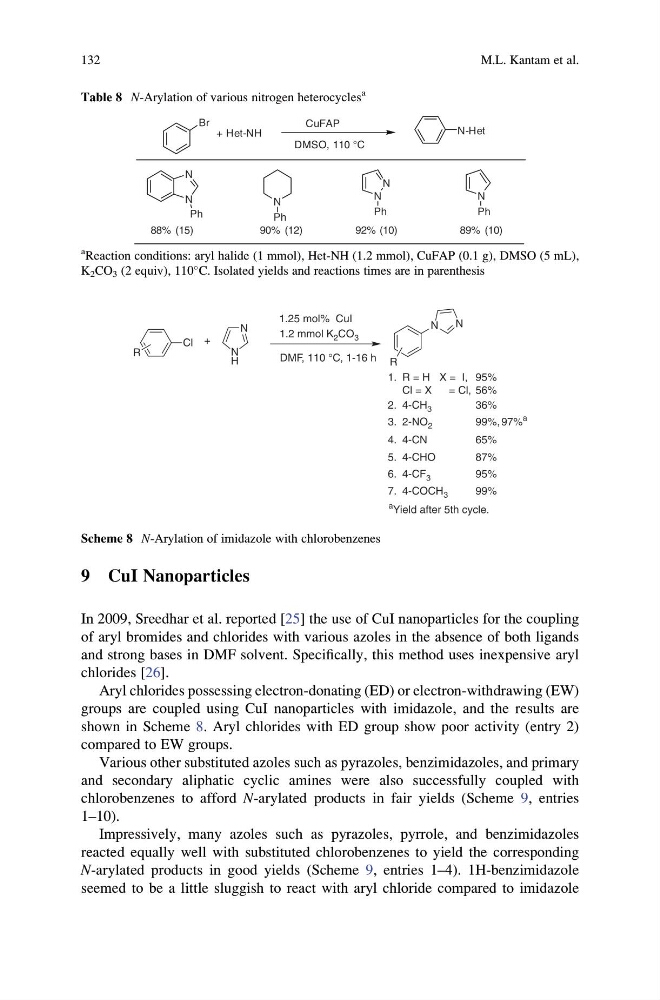
Aryl chlorides possessing electron-donating (ED) or electron-withdrawing (EW)
groups are coupled using CuI nanoparticles with imidazole, and the results are
shown in Scheme 8. Aryl chlorides with ED group show poor activity (entry 2)
compared to EW groups.
Various other substituted azoles such as pyrazoles, benzimidazoles, and primary
and secondary aliphatic cyclic amines were also successfully coupled with
chlorobenzenes to afford N-arylated products in fair yields (Scheme 9, entries
1–10).
Impressively, many azoles such as pyrazoles, pyrrole, and benzimidazoles
reacted equally well with substituted chlorobenzenes to yield the corresponding
N-arylated products in good yields (Scheme 9, entries 1–4). 1H-benzimidazole
seemed to be a little sluggish to react with aryl chloride compared to imidazole
Table 8 N-Arylation of various nitrogen heterocycles
a
Br
DMSO, 110 °C
+
N-Het
Het-NH
N
N
N
N
N
N
CuFAP
88% (15)
90% (12)
92% (10)
89% (10)
Ph
Ph
Ph
Ph
a
Reaction conditions: aryl halide (1 mmol), Het-NH (1.2 mmol), CuFAP (0.1 g), DMSO (5 mL),
K 2 CO 3 (2 equiv), 110
C. Isolated yields and reactions times are in parenthesis
1.25 mol% CuI
+
1.
2.
X = I, 95%
= Cl, 56%
3.
4.
5.
6.
DMF, 110 °C, 1-16 h
N
R
36%
99%, 97%
a
65%
87%
99%
95%
7.
R = H
Cl
4-CH 3
2-NO 2
4-CN
4-CHO
4-CF 3
4-COCH 3
Cl = X
1.2 mmol K 2 CO 3
N
N
H
N
R
a Yield after 5th cycle.
Scheme 8 N-Arylation of imidazole with chlorobenzenes
132
M.L. Kantam et al.
In 2009, Sreedhar et al. reported [25] the use of CuI nanoparticles for the coupling
of aryl bromides and chlorides with various azoles in the absence of both ligands
and strong bases in DMF solvent. Specifically, this method uses inexpensive aryl
chlorides [26].
Aryl chlorides possessing electron-donating (ED) or electron-withdrawing (EW)
groups are coupled using CuI nanoparticles with imidazole, and the results are
shown in Scheme 8. Aryl chlorides with ED group show poor activity (entry 2)
compared to EW groups.
Various other substituted azoles such as pyrazoles, benzimidazoles, and primary
and secondary aliphatic cyclic amines were also successfully coupled with
chlorobenzenes to afford N-arylated products in fair yields (Scheme 9, entries
1–10).
Impressively, many azoles such as pyrazoles, pyrrole, and benzimidazoles
reacted equally well with substituted chlorobenzenes to yield the corresponding
N-arylated products in good yields (Scheme 9, entries 1–4). 1H-benzimidazole
seemed to be a little sluggish to react with aryl chloride compared to imidazole
Table 8 N-Arylation of various nitrogen heterocycles
a
Br
DMSO, 110 °C
+
N-Het
Het-NH
N
N
N
N
N
N
CuFAP
88% (15)
90% (12)
92% (10)
89% (10)
Ph
Ph
Ph
Ph
a
Reaction conditions: aryl halide (1 mmol), Het-NH (1.2 mmol), CuFAP (0.1 g), DMSO (5 mL),
K 2 CO 3 (2 equiv), 110
C. Isolated yields and reactions times are in parenthesis
1.25 mol% CuI
+
1.
2.
X = I, 95%
= Cl, 56%
3.
4.
5.
6.
DMF, 110 °C, 1-16 h
N
R
36%
99%, 97%
a
65%
87%
99%
95%
7.
R = H
Cl
4-CH 3
2-NO 2
4-CN
4-CHO
4-CF 3
4-COCH 3
Cl = X
1.2 mmol K 2 CO 3
N
N
H
N
R
a Yield after 5th cycle.
Scheme 8 N-Arylation of imidazole with chlorobenzenes
132
M.L. Kantam et al.