

5 CuI/L-Proline/[Bmim]BF 4 Ionic Liquids with Vinyl Halides
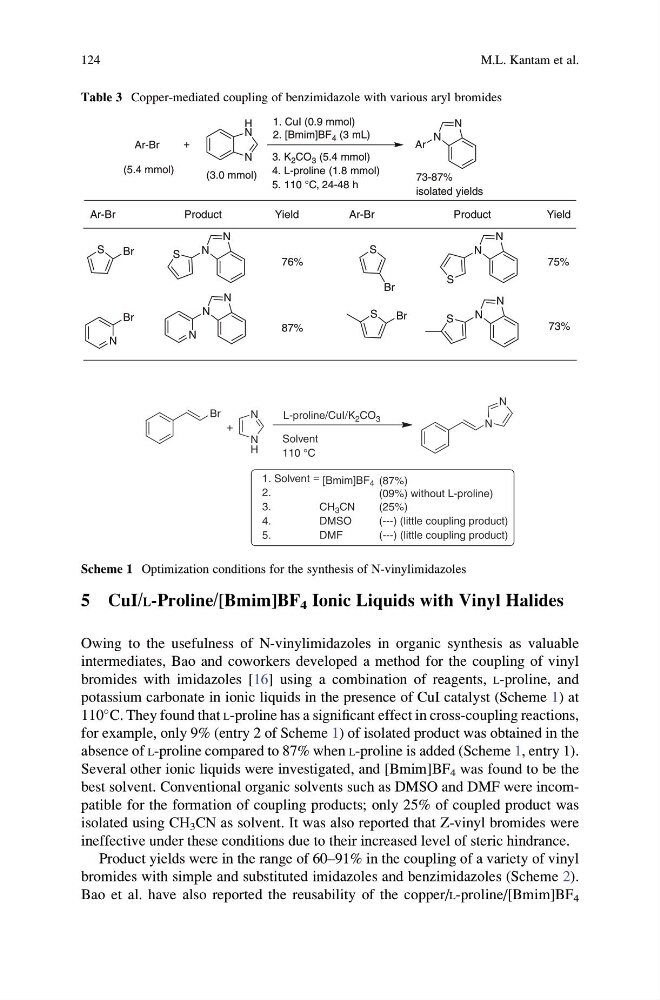
Owing to the usefulness of N-vinylimidazoles in organic synthesis as valuable
intermediates, Bao and coworkers developed a method for the coupling of vinyl
bromides with imidazoles [16] using a combination of reagents, L-proline, and
potassium carbonate in ionic liquids in the presence of CuI catalyst (Scheme 1) at
110
C. They found that L-proline has a significant effect in cross-coupling reactions,
for example, only 9% (entry 2 of Scheme 1) of isolated product was obtained in the
absence of L-proline compared to 87% when L-proline is added (Scheme 1, entry 1).
Several other ionic liquids were investigated, and [Bmim]BF 4 was found to be the
best solvent. Conventional organic solvents such as DMSO and DMF were incompatible for the formation of coupling products; only 25% of coupled product was
isolated using CH 3 CN as solvent. It was also reported that Z-vinyl bromides were
ineffective under these conditions due to their increased level of steric hindrance.
Product yields were in the range of 60–91% in the coupling of a variety of vinyl
bromides with simple and substituted imidazoles and benzimidazoles (Scheme 2).
Bao et al. have also reported the reusability of the copper/L-proline/[Bmim]BF 4
Table 3 Copper-mediated coupling of benzimidazole with various aryl bromides
1. CuI (0.9 mmol)
2. [Bmim]BF 4 (3 mL)
3. K 2 CO 3 (5.4 mmol)
4. L-proline (1.8 mmol)
5. 110 °C, 24-48 h
+
Product
Product
Yield
76%
Ar-Br
Ar-Br
Ar-Br
Yield
S
Br
87%
Br
N
N
H
N
N
N
Ar
N
N
S
N
N
N
75%
S
N
N
Br
S
73%
S
Br
N
N
S
(5.4 mmol)
(3.0 mmol)
73-87%
isolated yields
Br
N
H
N
N
L-proline/CuI/K 2 CO 3
Solvent
110 °C
1. Solvent = [Bmim]BF 4 (87%)
2.
(09%) without L-proline)
3.
CH 3 CN
(25%)
4.
DMSO
(---) (little coupling product)
5.
DMF
(---) (little coupling product)
+
N
Scheme 1 Optimization conditions for the synthesis of N-vinylimidazoles
124
M.L. Kantam et al.
Owing to the usefulness of N-vinylimidazoles in organic synthesis as valuable
intermediates, Bao and coworkers developed a method for the coupling of vinyl
bromides with imidazoles [16] using a combination of reagents, L-proline, and
potassium carbonate in ionic liquids in the presence of CuI catalyst (Scheme 1) at
110
C. They found that L-proline has a significant effect in cross-coupling reactions,
for example, only 9% (entry 2 of Scheme 1) of isolated product was obtained in the
absence of L-proline compared to 87% when L-proline is added (Scheme 1, entry 1).
Several other ionic liquids were investigated, and [Bmim]BF 4 was found to be the
best solvent. Conventional organic solvents such as DMSO and DMF were incompatible for the formation of coupling products; only 25% of coupled product was
isolated using CH 3 CN as solvent. It was also reported that Z-vinyl bromides were
ineffective under these conditions due to their increased level of steric hindrance.
Product yields were in the range of 60–91% in the coupling of a variety of vinyl
bromides with simple and substituted imidazoles and benzimidazoles (Scheme 2).
Bao et al. have also reported the reusability of the copper/L-proline/[Bmim]BF 4
Table 3 Copper-mediated coupling of benzimidazole with various aryl bromides
1. CuI (0.9 mmol)
2. [Bmim]BF 4 (3 mL)
3. K 2 CO 3 (5.4 mmol)
4. L-proline (1.8 mmol)
5. 110 °C, 24-48 h
+
Product
Product
Yield
76%
Ar-Br
Ar-Br
Ar-Br
Yield
S
Br
87%
Br
N
N
H
N
N
N
Ar
N
N
S
N
N
N
75%
S
N
N
Br
S
73%
S
Br
N
N
S
(5.4 mmol)
(3.0 mmol)
73-87%
isolated yields
Br
N
H
N
N
L-proline/CuI/K 2 CO 3
Solvent
110 °C
1. Solvent = [Bmim]BF 4 (87%)
2.
(09%) without L-proline)
3.
CH 3 CN
(25%)
4.
DMSO
(---) (little coupling product)
5.
DMF
(---) (little coupling product)
+
N
Scheme 1 Optimization conditions for the synthesis of N-vinylimidazoles
124
M.L. Kantam et al.