

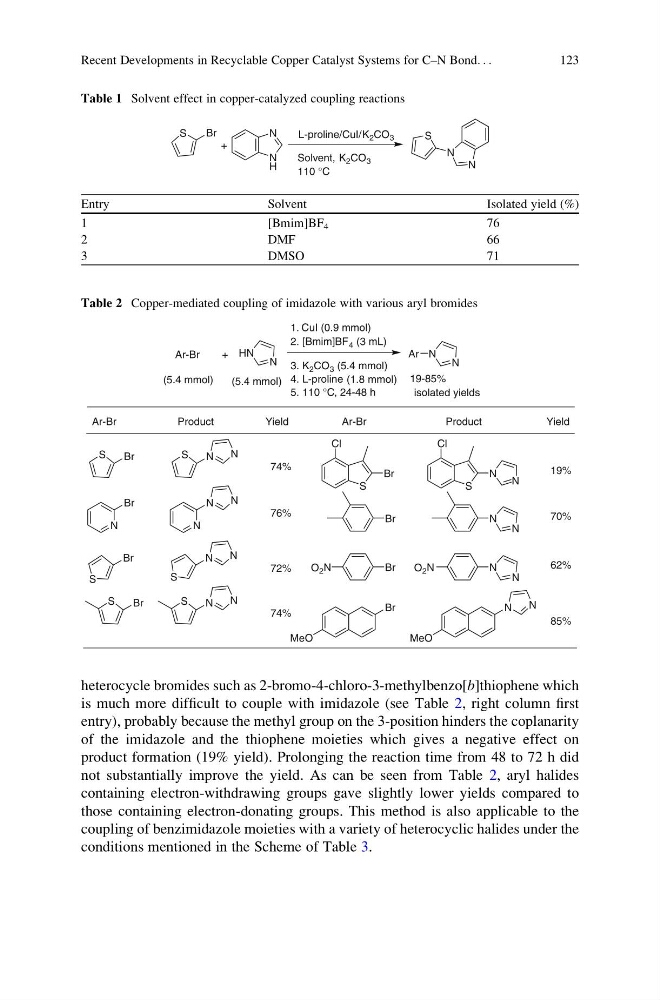
heterocycle bromides such as 2-bromo-4-chloro-3-methylbenzo[b]thiophene which
is much more difficult to couple with imidazole (see Table 2, right column first
entry), probably because the methyl group on the 3-position hinders the coplanarity
of the imidazole and the thiophene moieties which gives a negative effect on
product formation (19% yield). Prolonging the reaction time from 48 to 72 h did
not substantially improve the yield. As can be seen from Table 2, aryl halides
containing electron-withdrawing groups gave slightly lower yields compared to
those containing electron-donating groups. This method is also applicable to the
coupling of benzimidazole moieties with a variety of heterocyclic halides under the
conditions mentioned in the Scheme of Table 3.
Table 2 Copper-mediated coupling of imidazole with various aryl bromides
1. CuI (0.9 mmol)
2. [Bmim]BF 4 (3 mL)
3. K 2 CO 3 (5.4 mmol)
4. L-proline (1.8 mmol)
5. 110 °C, 24-48 h
+
Product
Product
Yield
74%
N
HN
Ar-Br
N
N
Ar
Ar-Br
Ar-Br
Yield
S
Br
S
N
N
76%
Br
N
N
N
N
72%
S
Br
N
N
S
74%
S
Br
S
N
N
19%
S
Br
Cl
S
Cl
70%
Br
N
N
62%
Br
O 2 N
N
O 2 N
N
MeO
Br
MeO
N
N
85%
(5.4 mmol)
(5.4 mmol)
19-85%
isolated yields
N N
Table 1 Solvent effect in copper-catalyzed coupling reactions
Br
N
H
N
L-proline/CuI/K 2 CO 3
Solvent, K 2 CO 3
110 °C
+
S
N
N
S
Entry
Solvent
Isolated yield (%)
1
[Bmim]BF 4
76
2
DMF
66
3
DMSO
71
Recent Developments in Recyclable Copper Catalyst Systems for C–N Bond. . .
123
is much more difficult to couple with imidazole (see Table 2, right column first
entry), probably because the methyl group on the 3-position hinders the coplanarity
of the imidazole and the thiophene moieties which gives a negative effect on
product formation (19% yield). Prolonging the reaction time from 48 to 72 h did
not substantially improve the yield. As can be seen from Table 2, aryl halides
containing electron-withdrawing groups gave slightly lower yields compared to
those containing electron-donating groups. This method is also applicable to the
coupling of benzimidazole moieties with a variety of heterocyclic halides under the
conditions mentioned in the Scheme of Table 3.
Table 2 Copper-mediated coupling of imidazole with various aryl bromides
1. CuI (0.9 mmol)
2. [Bmim]BF 4 (3 mL)
3. K 2 CO 3 (5.4 mmol)
4. L-proline (1.8 mmol)
5. 110 °C, 24-48 h
+
Product
Product
Yield
74%
N
HN
Ar-Br
N
N
Ar
Ar-Br
Ar-Br
Yield
S
Br
S
N
N
76%
Br
N
N
N
N
72%
S
Br
N
N
S
74%
S
Br
S
N
N
19%
S
Br
Cl
S
Cl
70%
Br
N
N
62%
Br
O 2 N
N
O 2 N
N
MeO
Br
MeO
N
N
85%
(5.4 mmol)
(5.4 mmol)
19-85%
isolated yields
N N
Table 1 Solvent effect in copper-catalyzed coupling reactions
Br
N
H
N
L-proline/CuI/K 2 CO 3
Solvent, K 2 CO 3
110 °C
+
S
N
N
S
Entry
Solvent
Isolated yield (%)
1
[Bmim]BF 4
76
2
DMF
66
3
DMSO
71
Recent Developments in Recyclable Copper Catalyst Systems for C–N Bond. . .
123