

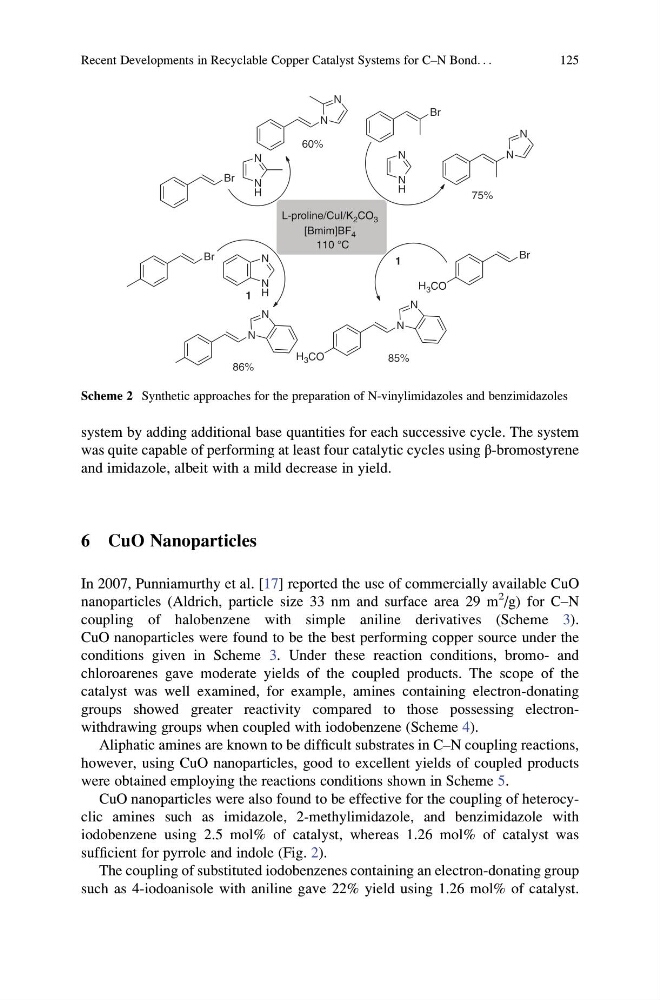
system by adding additional base quantities for each successive cycle. The system
was quite capable of performing at least four catalytic cycles using β-bromostyrene
and imidazole, albeit with a mild decrease in yield.
6 CuO Nanoparticles
In 2007, Punniamurthy et al. [17] reported the use of commercially available CuO
nanoparticles (Aldrich, particle size 33 nm and surface area 29 m
2 /g) for C–N
coupling of halobenzene with simple aniline derivatives (Scheme 3).
CuO nanoparticles were found to be the best performing copper source under the
conditions given in Scheme 3. Under these reaction conditions, bromo- and
chloroarenes gave moderate yields of the coupled products. The scope of the
catalyst was well examined, for example, amines containing electron-donating
groups showed greater reactivity compared to those possessing electronwithdrawing groups when coupled with iodobenzene (Scheme 4).
Aliphatic amines are known to be difficult substrates in C–N coupling reactions,
however, using CuO nanoparticles, good to excellent yields of coupled products
were obtained employing the reactions conditions shown in Scheme 5.
CuO nanoparticles were also found to be effective for the coupling of heterocyclic amines such as imidazole, 2-methylimidazole, and benzimidazole with
iodobenzene using 2.5 mol% of catalyst, whereas 1.26 mol% of catalyst was
sufficient for pyrrole and indole (Fig. 2).
The coupling of substituted iodobenzenes containing an electron-donating group
such as 4-iodoanisole with aniline gave 22% yield using 1.26 mol% of catalyst.
Br
N
H
N
N
N
75%
Br
N
N
86%
Br
N
H
N
N
N
60%
Br
H 3 CO
N
N
85%
N
H
N
H 3 CO
1
1
L-proline/CuI/K 2 CO 3
[Bmim]BF 4
110 °C
Scheme 2 Synthetic approaches for the preparation of N-vinylimidazoles and benzimidazoles
Recent Developments in Recyclable Copper Catalyst Systems for C–N Bond. . .
125
was quite capable of performing at least four catalytic cycles using β-bromostyrene
and imidazole, albeit with a mild decrease in yield.
6 CuO Nanoparticles
In 2007, Punniamurthy et al. [17] reported the use of commercially available CuO
nanoparticles (Aldrich, particle size 33 nm and surface area 29 m
2 /g) for C–N
coupling of halobenzene with simple aniline derivatives (Scheme 3).
CuO nanoparticles were found to be the best performing copper source under the
conditions given in Scheme 3. Under these reaction conditions, bromo- and
chloroarenes gave moderate yields of the coupled products. The scope of the
catalyst was well examined, for example, amines containing electron-donating
groups showed greater reactivity compared to those possessing electronwithdrawing groups when coupled with iodobenzene (Scheme 4).
Aliphatic amines are known to be difficult substrates in C–N coupling reactions,
however, using CuO nanoparticles, good to excellent yields of coupled products
were obtained employing the reactions conditions shown in Scheme 5.
CuO nanoparticles were also found to be effective for the coupling of heterocyclic amines such as imidazole, 2-methylimidazole, and benzimidazole with
iodobenzene using 2.5 mol% of catalyst, whereas 1.26 mol% of catalyst was
sufficient for pyrrole and indole (Fig. 2).
The coupling of substituted iodobenzenes containing an electron-donating group
such as 4-iodoanisole with aniline gave 22% yield using 1.26 mol% of catalyst.
Br
N
H
N
N
N
75%
Br
N
N
86%
Br
N
H
N
N
N
60%
Br
H 3 CO
N
N
85%
N
H
N
H 3 CO
1
1
L-proline/CuI/K 2 CO 3
[Bmim]BF 4
110 °C
Scheme 2 Synthetic approaches for the preparation of N-vinylimidazoles and benzimidazoles
Recent Developments in Recyclable Copper Catalyst Systems for C–N Bond. . .
125