

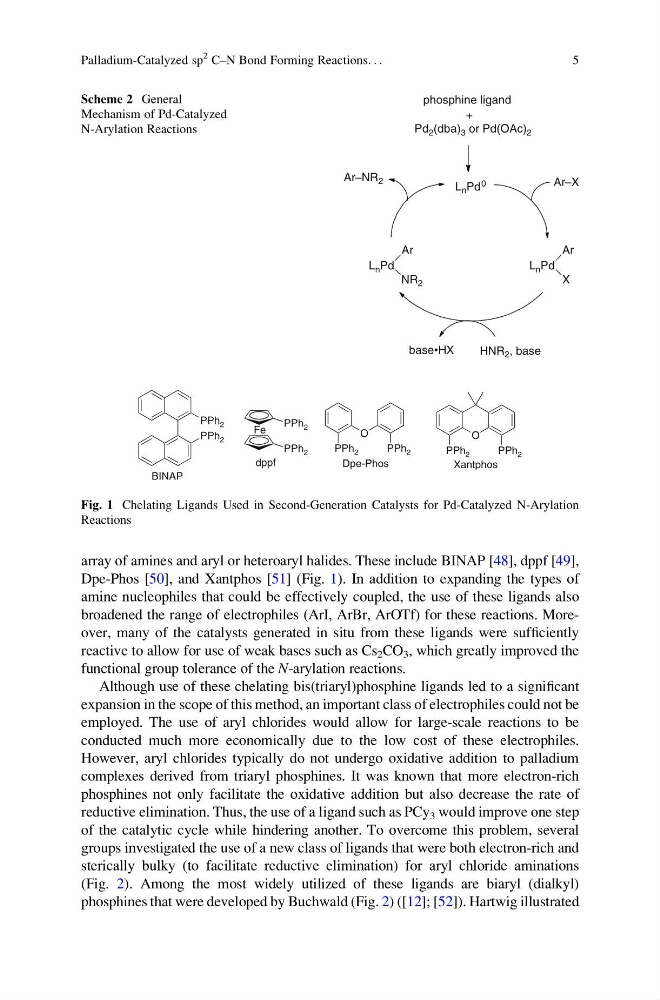
array of amines and aryl or heteroaryl halides. These include BINAP [48], dppf [49],
Dpe-Phos [50], and Xantphos [51] (Fig. 1). In addition to expanding the types of
amine nucleophiles that could be effectively coupled, the use of these ligands also
broadened the range of electrophiles (ArI, ArBr, ArOTf) for these reactions. Moreover, many of the catalysts generated in situ from these ligands were sufficiently
reactive to allow for use of weak bases such as Cs 2 CO 3 , which greatly improved the
functional group tolerance of the N-arylation reactions.
Although use of these chelating bis(triaryl)phosphine ligands led to a significant
expansion in the scope of this method, an important class of electrophiles could not be
employed. The use of aryl chlorides would allow for large-scale reactions to be
conducted much more economically due to the low cost of these electrophiles.
However, aryl chlorides typically do not undergo oxidative addition to palladium
complexes derived from triaryl phosphines. It was known that more electron-rich
phosphines not only facilitate the oxidative addition but also decrease the rate of
reductive elimination. Thus, the use of a ligand such as PCy 3 would improve one step
of the catalytic cycle while hindering another. To overcome this problem, several
groups investigated the use of a new class of ligands that were both electron-rich and
sterically bulky (to facilitate reductive elimination) for aryl chloride aminations
(Fig. 2). Among the most widely utilized of these ligands are biaryl (dialkyl)
phosphines that were developed by Buchwald (Fig. 2) ([12]; [52]). Hartwig illustrated
phosphine ligand
+
Pd 2 (dba) 3 or Pd(OAc) 2
L n Pd 0
L n Pd
Ar
X
L n Pd
Ar
NR 2
HNR 2 , base
base HX
Ar X
Ar NR 2
Scheme 2 General
Mechanism of Pd-Catalyzed
N-Arylation Reactions
PPh 2
PPh 2
BINAP
Fe
PPh 2
PPh 2
dppf
O
PPh 2
PPh 2
Dpe-Phos
O
PPh 2
PPh 2
Xantphos
Fig. 1 Chelating Ligands Used in Second-Generation Catalysts for Pd-Catalyzed N-Arylation
Reactions
Palladium-Catalyzed sp
2 C–N Bond Forming Reactions. . .
5
Dpe-Phos [50], and Xantphos [51] (Fig. 1). In addition to expanding the types of
amine nucleophiles that could be effectively coupled, the use of these ligands also
broadened the range of electrophiles (ArI, ArBr, ArOTf) for these reactions. Moreover, many of the catalysts generated in situ from these ligands were sufficiently
reactive to allow for use of weak bases such as Cs 2 CO 3 , which greatly improved the
functional group tolerance of the N-arylation reactions.
Although use of these chelating bis(triaryl)phosphine ligands led to a significant
expansion in the scope of this method, an important class of electrophiles could not be
employed. The use of aryl chlorides would allow for large-scale reactions to be
conducted much more economically due to the low cost of these electrophiles.
However, aryl chlorides typically do not undergo oxidative addition to palladium
complexes derived from triaryl phosphines. It was known that more electron-rich
phosphines not only facilitate the oxidative addition but also decrease the rate of
reductive elimination. Thus, the use of a ligand such as PCy 3 would improve one step
of the catalytic cycle while hindering another. To overcome this problem, several
groups investigated the use of a new class of ligands that were both electron-rich and
sterically bulky (to facilitate reductive elimination) for aryl chloride aminations
(Fig. 2). Among the most widely utilized of these ligands are biaryl (dialkyl)
phosphines that were developed by Buchwald (Fig. 2) ([12]; [52]). Hartwig illustrated
phosphine ligand
+
Pd 2 (dba) 3 or Pd(OAc) 2
L n Pd 0
L n Pd
Ar
X
L n Pd
Ar
NR 2
HNR 2 , base
base HX
Ar X
Ar NR 2
Scheme 2 General
Mechanism of Pd-Catalyzed
N-Arylation Reactions
PPh 2
PPh 2
BINAP
Fe
PPh 2
PPh 2
dppf
O
PPh 2
PPh 2
Dpe-Phos
O
PPh 2
PPh 2
Xantphos
Fig. 1 Chelating Ligands Used in Second-Generation Catalysts for Pd-Catalyzed N-Arylation
Reactions
Palladium-Catalyzed sp
2 C–N Bond Forming Reactions. . .
5