

mechanism that involved transmetallation of the NMe 2 group followed by C–N bondforming reductive elimination.
Also in the mid-1994, Buchwald and coworkers developed a means to significantly
expand the scope of the Migita reaction through an in situ transamination protocol
that exchanged the dimethylamino group of Bu 3 SnNMe 2 with various amines [29].
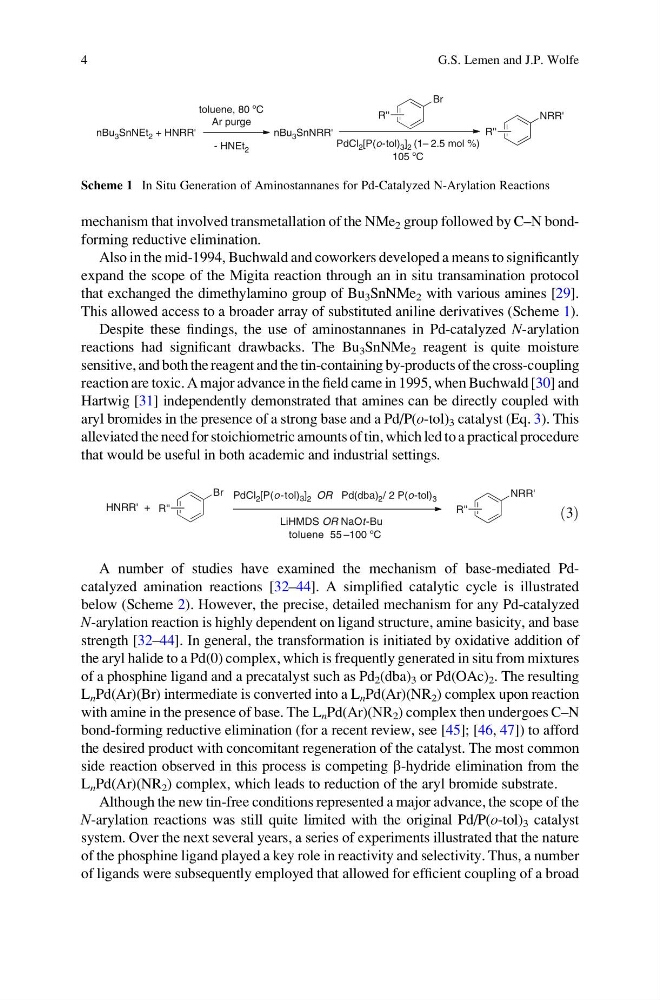
This allowed access to a broader array of substituted aniline derivatives (Scheme 1).
Despite these findings, the use of aminostannanes in Pd-catalyzed N-arylation
reactions had significant drawbacks. The Bu 3 SnNMe 2 reagent is quite moisture
sensitive, and both the reagent and the tin-containing by-products of the cross-coupling
reaction are toxic. A major advance in the field came in 1995, when Buchwald [30] and
Hartwig [31] independently demonstrated that amines can be directly coupled with
aryl bromides in the presence of a strong base and a Pd/P(o-tol) 3 catalyst (Eq. 3). This
alleviated the need for stoichiometric amounts of tin, which led to a practical procedure
that would be useful in both academic and industrial settings.
HNRR' +
Br
R''
PdCl 2 [P(o-tol) 3 ] 2 OR Pd(dba) 2 / 2 P(o-tol) 3
LiHMDS OR NaOt-Bu
toluene 55 100 ºC
NRR'
R''
ð3Þ
A number of studies have examined the mechanism of base-mediated Pdcatalyzed amination reactions [32–44]. A simplified catalytic cycle is illustrated
below (Scheme 2). However, the precise, detailed mechanism for any Pd-catalyzed
N-arylation reaction is highly dependent on ligand structure, amine basicity, and base
strength [32–44]. In general, the transformation is initiated by oxidative addition of
the aryl halide to a Pd(0) complex, which is frequently generated in situ from mixtures
of a phosphine ligand and a precatalyst such as Pd 2 (dba) 3 or Pd(OAc) 2 . The resulting
L n Pd(Ar)(Br) intermediate is converted into a L n Pd(Ar)(NR 2 ) complex upon reaction
with amine in the presence of base. The L n Pd(Ar)(NR 2 ) complex then undergoes C–N
bond-forming reductive elimination (for a recent review, see [45]; [46, 47]) to afford
the desired product with concomitant regeneration of the catalyst. The most common
side reaction observed in this process is competing b-hydride elimination from the
L n Pd(Ar)(NR 2 ) complex, which leads to reduction of the aryl bromide substrate.
Although the new tin-free conditions represented a major advance, the scope of the
N-arylation reactions was still quite limited with the original Pd/P(o-tol) 3 catalyst
system. Over the next several years, a series of experiments illustrated that the nature
of the phosphine ligand played a key role in reactivity and selectivity. Thus, a number
of ligands were subsequently employed that allowed for efficient coupling of a broad
nBu 3 SnNEt 2 + HNRR'
toluene, 80 ºC
Ar purge
- HNEt 2
nBu 3 SnNRR'
Br
R''
PdCl 2 [P(o-tol) 3 ] 2 (1– 2.5 mol %)
105 ºC
NRR'
R''
Scheme 1 In Situ Generation of Aminostannanes for Pd-Catalyzed N-Arylation Reactions
4
G.S. Lemen and J.P. Wolfe
Also in the mid-1994, Buchwald and coworkers developed a means to significantly
expand the scope of the Migita reaction through an in situ transamination protocol
that exchanged the dimethylamino group of Bu 3 SnNMe 2 with various amines [29].
This allowed access to a broader array of substituted aniline derivatives (Scheme 1).
Despite these findings, the use of aminostannanes in Pd-catalyzed N-arylation
reactions had significant drawbacks. The Bu 3 SnNMe 2 reagent is quite moisture
sensitive, and both the reagent and the tin-containing by-products of the cross-coupling
reaction are toxic. A major advance in the field came in 1995, when Buchwald [30] and
Hartwig [31] independently demonstrated that amines can be directly coupled with
aryl bromides in the presence of a strong base and a Pd/P(o-tol) 3 catalyst (Eq. 3). This
alleviated the need for stoichiometric amounts of tin, which led to a practical procedure
that would be useful in both academic and industrial settings.
HNRR' +
Br
R''
PdCl 2 [P(o-tol) 3 ] 2 OR Pd(dba) 2 / 2 P(o-tol) 3
LiHMDS OR NaOt-Bu
toluene 55 100 ºC
NRR'
R''
ð3Þ
A number of studies have examined the mechanism of base-mediated Pdcatalyzed amination reactions [32–44]. A simplified catalytic cycle is illustrated
below (Scheme 2). However, the precise, detailed mechanism for any Pd-catalyzed
N-arylation reaction is highly dependent on ligand structure, amine basicity, and base
strength [32–44]. In general, the transformation is initiated by oxidative addition of
the aryl halide to a Pd(0) complex, which is frequently generated in situ from mixtures
of a phosphine ligand and a precatalyst such as Pd 2 (dba) 3 or Pd(OAc) 2 . The resulting
L n Pd(Ar)(Br) intermediate is converted into a L n Pd(Ar)(NR 2 ) complex upon reaction
with amine in the presence of base. The L n Pd(Ar)(NR 2 ) complex then undergoes C–N
bond-forming reductive elimination (for a recent review, see [45]; [46, 47]) to afford
the desired product with concomitant regeneration of the catalyst. The most common
side reaction observed in this process is competing b-hydride elimination from the
L n Pd(Ar)(NR 2 ) complex, which leads to reduction of the aryl bromide substrate.
Although the new tin-free conditions represented a major advance, the scope of the
N-arylation reactions was still quite limited with the original Pd/P(o-tol) 3 catalyst
system. Over the next several years, a series of experiments illustrated that the nature
of the phosphine ligand played a key role in reactivity and selectivity. Thus, a number
of ligands were subsequently employed that allowed for efficient coupling of a broad
nBu 3 SnNEt 2 + HNRR'
toluene, 80 ºC
Ar purge
- HNEt 2
nBu 3 SnNRR'
Br
R''
PdCl 2 [P(o-tol) 3 ] 2 (1– 2.5 mol %)
105 ºC
NRR'
R''
Scheme 1 In Situ Generation of Aminostannanes for Pd-Catalyzed N-Arylation Reactions
4
G.S. Lemen and J.P. Wolfe