

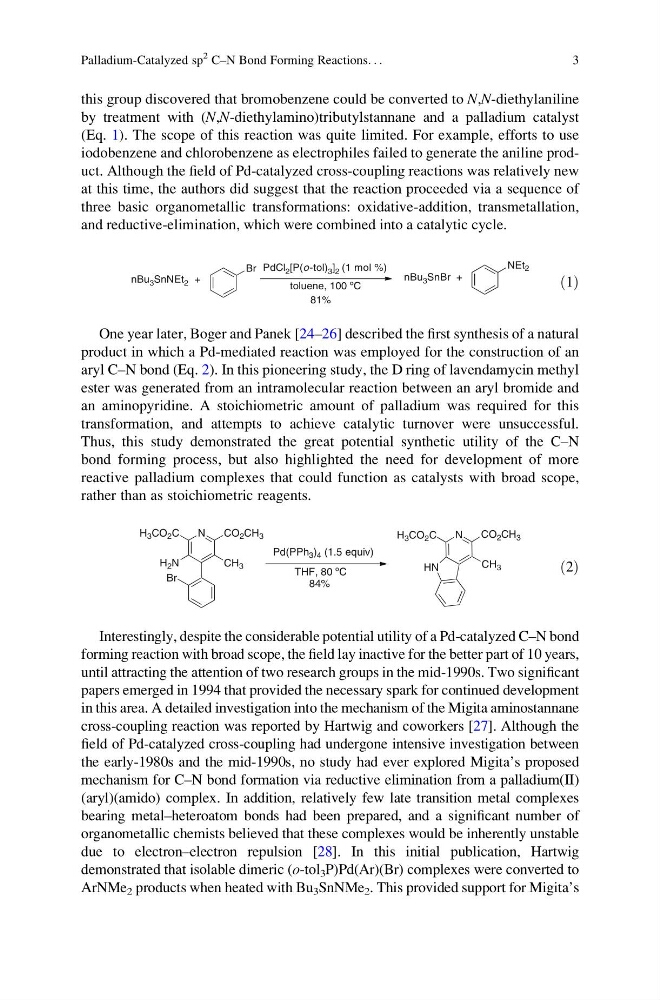
this group discovered that bromobenzene could be converted to N,N-diethylaniline
by treatment with (N,N-diethylamino)tributylstannane and a palladium catalyst
(Eq. 1). The scope of this reaction was quite limited. For example, efforts to use
iodobenzene and chlorobenzene as electrophiles failed to generate the aniline product. Although the field of Pd-catalyzed cross-coupling reactions was relatively new
at this time, the authors did suggest that the reaction proceeded via a sequence of
three basic organometallic transformations: oxidative-addition, transmetallation,
and reductive-elimination, which were combined into a catalytic cycle.
nBu 3 SnNEt 2 +
Br PdCl 2 [P(o-tol) 3 ] 2 (1 mol %)
nBu 3 SnBr +
NEt 2
81%
toluene, 100 ºC
ð1Þ
One year later, Boger and Panek [24–26] described the first synthesis of a natural
product in which a Pd-mediated reaction was employed for the construction of an
aryl C–N bond (Eq. 2). In this pioneering study, the D ring of lavendamycin methyl
ester was generated from an intramolecular reaction between an aryl bromide and
an aminopyridine. A stoichiometric amount of palladium was required for this
transformation, and attempts to achieve catalytic turnover were unsuccessful.
Thus, this study demonstrated the great potential synthetic utility of the C–N
bond forming process, but also highlighted the need for development of more
reactive palladium complexes that could function as catalysts with broad scope,
rather than as stoichiometric reagents.
N
Br
H 2 N
H 3 CO 2 C
CO 2 CH 3
CH 3
Pd(PPh 3 ) 4 (1.5 equiv)
N
H 3 CO 2 C
CO 2 CH 3
CH 3
HN
84%
THF, 80 ºC
ð2Þ
Interestingly, despite the considerable potential utility of a Pd-catalyzed C–N bond
forming reaction with broad scope, the field lay inactive for the better part of 10 years,
until attracting the attention of two research groups in the mid-1990s. Two significant
papers emerged in 1994 that provided the necessary spark for continued development
in this area. A detailed investigation into the mechanism of the Migita aminostannane
cross-coupling reaction was reported by Hartwig and coworkers [27]. Although the
field of Pd-catalyzed cross-coupling had undergone intensive investigation between
the early-1980s and the mid-1990s, no study had ever explored Migita’s proposed
mechanism for C–N bond formation via reductive elimination from a palladium(II)
(aryl)(amido) complex. In addition, relatively few late transition metal complexes
bearing metal–heteroatom bonds had been prepared, and a significant number of
organometallic chemists believed that these complexes would be inherently unstable
due to electron–electron repulsion [28]. In this initial publication, Hartwig
demonstrated that isolable dimeric (o-tol 3 P)Pd(Ar)(Br) complexes were converted to
ArNMe 2 products when heated with Bu 3 SnNMe 2 . This provided support for Migita’s
Palladium-Catalyzed sp
2 C–N Bond Forming Reactions. . .
3
by treatment with (N,N-diethylamino)tributylstannane and a palladium catalyst
(Eq. 1). The scope of this reaction was quite limited. For example, efforts to use
iodobenzene and chlorobenzene as electrophiles failed to generate the aniline product. Although the field of Pd-catalyzed cross-coupling reactions was relatively new
at this time, the authors did suggest that the reaction proceeded via a sequence of
three basic organometallic transformations: oxidative-addition, transmetallation,
and reductive-elimination, which were combined into a catalytic cycle.
nBu 3 SnNEt 2 +
Br PdCl 2 [P(o-tol) 3 ] 2 (1 mol %)
nBu 3 SnBr +
NEt 2
81%
toluene, 100 ºC
ð1Þ
One year later, Boger and Panek [24–26] described the first synthesis of a natural
product in which a Pd-mediated reaction was employed for the construction of an
aryl C–N bond (Eq. 2). In this pioneering study, the D ring of lavendamycin methyl
ester was generated from an intramolecular reaction between an aryl bromide and
an aminopyridine. A stoichiometric amount of palladium was required for this
transformation, and attempts to achieve catalytic turnover were unsuccessful.
Thus, this study demonstrated the great potential synthetic utility of the C–N
bond forming process, but also highlighted the need for development of more
reactive palladium complexes that could function as catalysts with broad scope,
rather than as stoichiometric reagents.
N
Br
H 2 N
H 3 CO 2 C
CO 2 CH 3
CH 3
Pd(PPh 3 ) 4 (1.5 equiv)
N
H 3 CO 2 C
CO 2 CH 3
CH 3
HN
84%
THF, 80 ºC
ð2Þ
Interestingly, despite the considerable potential utility of a Pd-catalyzed C–N bond
forming reaction with broad scope, the field lay inactive for the better part of 10 years,
until attracting the attention of two research groups in the mid-1990s. Two significant
papers emerged in 1994 that provided the necessary spark for continued development
in this area. A detailed investigation into the mechanism of the Migita aminostannane
cross-coupling reaction was reported by Hartwig and coworkers [27]. Although the
field of Pd-catalyzed cross-coupling had undergone intensive investigation between
the early-1980s and the mid-1990s, no study had ever explored Migita’s proposed
mechanism for C–N bond formation via reductive elimination from a palladium(II)
(aryl)(amido) complex. In addition, relatively few late transition metal complexes
bearing metal–heteroatom bonds had been prepared, and a significant number of
organometallic chemists believed that these complexes would be inherently unstable
due to electron–electron repulsion [28]. In this initial publication, Hartwig
demonstrated that isolable dimeric (o-tol 3 P)Pd(Ar)(Br) complexes were converted to
ArNMe 2 products when heated with Bu 3 SnNMe 2 . This provided support for Migita’s
Palladium-Catalyzed sp
2 C–N Bond Forming Reactions. . .
3